

Saturday marks 5 years since Kabul fell.
The mission that began in the airlift is not finished and it has been a rough road for the last year and a half, but this was the best week for Afghan legislation in months. In a single forty-eight hour stretch, the Afghanistan TPS Act picked up a Senate companion, a new bipartisan bill, the ARCH Act, was introduced to make sure the record of our allies’ service can never be erased, and 35 members of Congress sent a letter to Secretaries Rubio, Mullin, and Hegseth about Camp As Sayliyah.
Two bills, both chambers, both parties.
Five years since the fall of Kabul, and AfghanEvac is still showing up for our Afghan allies. We rarely ask for donations but we cannot do it alone. $25 keeps our explainers and pathways tool online, $100 powers Battle Buddies, and $5,000 funds a town hall in a neighborhood somewhere in our country.
ACTION THIS WEEK
Register for the Global Alliance Update on Wednesday, August 12, a state of the movement at 8:00 AM Pacific and 4:00 PM in London. You will hear from leaders from the U.S., U.K, Canada, and more. Then AfghanEvac, in partnership with Local Staff International, will release The Allied Ledger. Sign up at afghanevac.org/global-alliance-update.
Tell your members of Congress to cosponsor the Afghanistan TPS Act. The bill now has a House version, H.R. 9899, and a Senate companion introduced August 6. It takes ninety seconds and routes to your Representative and both Senators at afghanevac.org/tps.
Back the new ARCH Act. The Afghan Ally Records and Credential Heritage Act was introduced in the Senate on August 7. Ask your senators to support it, and organizations can endorse, at afghanevac.org/arch.
Comment on the rule that killed the asylum interview before September 28. It applies retroactively to cases already pending, so if you or someone you love is in the affirmative asylum backlog, this is your case. File at afghanevac.org/asylum-interview-action.
Read and share The Unfinished Mission. Our five-year accounting of the Special Immigrant Visa program is at reports.afghanevac.org/unfinished-mission. Post it and tag your members of Congress.
FIVE YEARS ON, THE FIRST GOOD WEEK IN MONTHS
Five years is long enough to learn the difference between motion and progress. This week was progress. The task now is to keep it moving as far down the field before the anniversary coverage fades and the offices go quiet again.
Five years after the fall of Kabul, the honest measure of the mission is not a speech. It is a count. We laid the whole record out this week in a new report, The Unfinished Mission, the first full accounting of seventeen years of the Special Immigrant Visa program, and it broke through to national television with a segment on CNN’s The Lead with Jake Tapper.
And then Congress moved. On August 6, the Afghanistan TPS Act gained a Senate companion, so protection from deportation can now advance on both sides of the Capitol at once. On August 7, a bipartisan quartet of senators, Mike Rounds, Amy Klobuchar, Chris Coons, and Thom Tillis, introduced the ARCH Act, the Afghan Ally Records and Credential Heritage Act, to make sure the government preserves the proof of who these allies are and what they did. Two Republicans and two Democrats on each bill. Members do not put their names on Afghan legislation during a recess by accident. They do it because they have decided it is worth the cost.
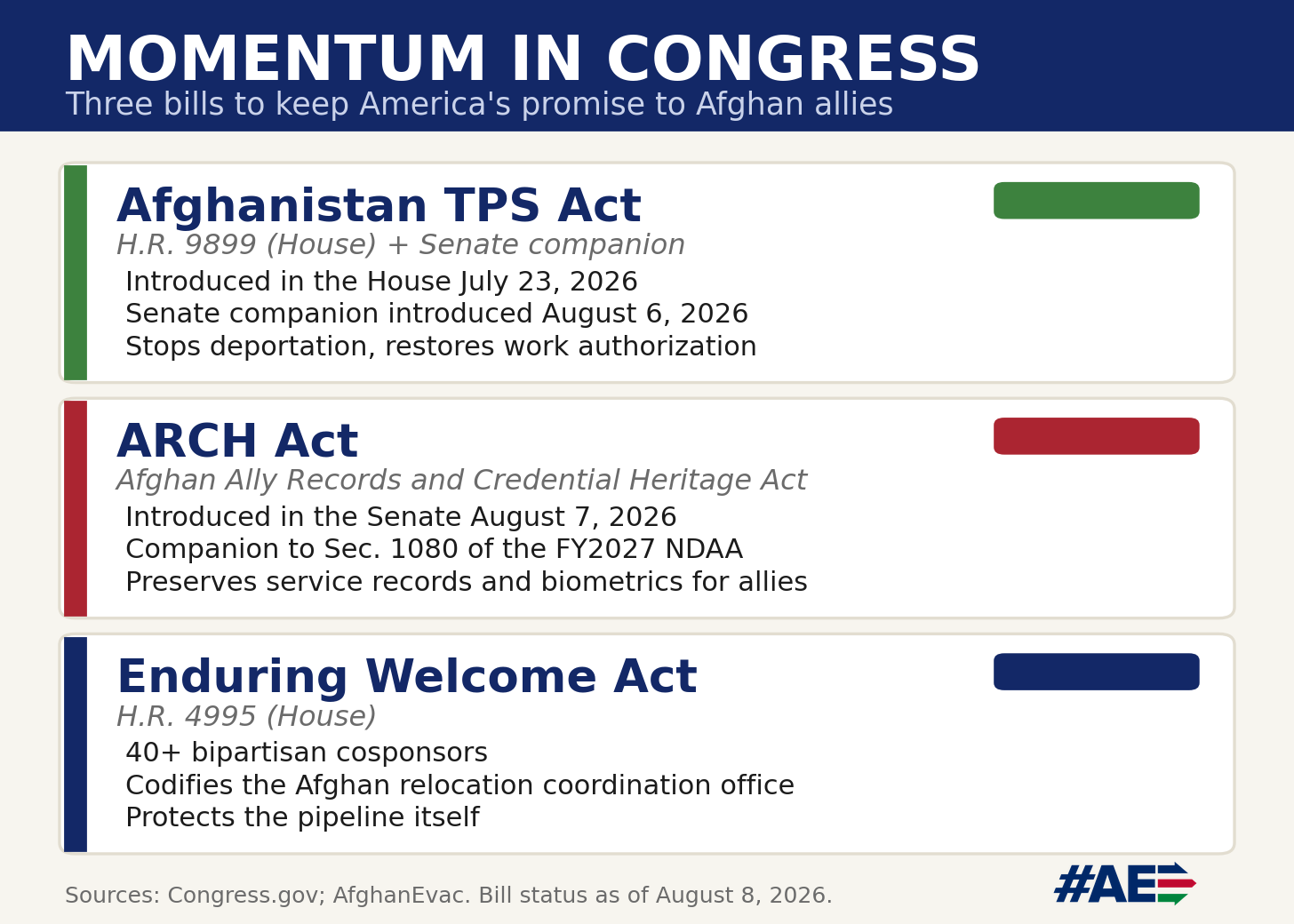
We are clear-eyed about what these bills are and are not. Neither bill puts people on a plane tomorrow, and we will not pretend otherwise. What they do is build the legal architecture that outlasts any single administration, protection from removal for those already here, and a permanent, verifiable record of service for those still in danger. That architecture is how a promise stops lurching from crisis to crisis and becomes law. AfghanEvac endorses both, and our ask this week is simple. Turn support into cosponsors, because the cosponsor list is the one thing that forces a hearing.
SETTING THE RECORD STRAIGHT AS THE RUMORS SPREAD
SIV issuances have not resumed. All visa interviews, for every type of case, are still being denied. The travel ban that bars Afghan entry is still in force. No bill has passed, no program has restarted in the background, and nothing has quietly reopened.
So where is the confusion coming from? One court ruling, misread. On July 30, a federal court ordered the State Department to process I-730 following-to-join cases for the family members of people already granted asylum in the United States, because the travel ban never applied to those cases in the first place. The ruling is real, and it is welcome, but it is narrow. It moved a single category, the relatives of approved asylees, and it moved nothing else. Somewhere between the courthouse and the group chat, “a court ordered State to issue travel documents in a handful of asylum cases” became “visas are being issued again.” They are not.
We are seeing a flood of bad information as a result, across social media, in WhatsApp groups, and on Facebook, some of it honest confusion and some of it outright scams. If you see a post claiming the doors have reopened, or anyone asking for money to move your case, stop and verify before you act.
Here is what is actually true, and one practical step for families with an appointment in Islamabad.
The one narrow exception, I-730 reunification for people already granted asylum
If you have been granted asylum in the United States, the travel ban never applied to your following-to-join family members, because the proclamation exempts asylees in its own text. A federal court in the Eastern District of Virginia confirmed this on July 30 and ordered the State Department to process travel documents for approved family members it had wrongly held up.
This ruling is narrow. It reaches only the I-730 relatives of people with approved asylum. It does not reopen SIV, refugee, or parole travel, and it does not lift the travel ban for anyone else. If this is your situation, talk to a trusted immigration attorney before you act.
We STILL recommend postponing or rescheduling visa interviews.
Trying to reschedule an immigrant visa appointment in Islamabad
Send to islamabadivinquiry@state.gov
Subject line, replacing only the name with the applicant’s name: IV005 - APPOINTMENT RESCHEDULING - YOUR FULL NAME
In the body, include:
Your full name
Your case number (it may begin with ISL, KBL, or similar)
A valid email address and phone number
A short description of your situation, question, or inquiry
Why it matters Hope is not a plan, and a scammer’s promise is not a policy change. Right now the fastest way to protect a family is accurate information, the real status of the ban, the single narrow exception that exists, and the exact steps that actually reach a person.
WHAT THE ARCH ACT ACTUALLY DOES
The ARCH Act answers a quiet emergency. As the pipeline stalls and records scatter, an ally’s single most valuable asset, the documented proof that they served alongside American forces, can disappear. The Afghan Ally Records and Credential Heritage Act directs the Department of Defense to verify and preserve the service records and biometric data of at-risk Afghan allies within 180 days, and to stand up a secure online portal so that an individual, a designee, or a representative can apply from anywhere, including inside Afghanistan, to have that service documented and protected.
It is written for the people the Taliban hunts first. Afghan special operations forces, pilots, intelligence officers, judges, prosecutors, and defense officials who served at least a year between December 22, 2001, and September 1, 2021. The bill was introduced August 7 by Senators Rounds, Klobuchar, Coons, and Tillis, and it stands as a companion to Section 1080 of the FY2027 National Defense Authorization Act, which gives it two paths forward, on its own or inside the must-pass defense bill.
Why it matters A revoked approval or a lost file can turn a decorated ally into a stranger the system does not recognize. Preserving the record is not a clerical nicety. It is the difference between a case that can be reopened and a person the United States can pretend it never knew.
THE TPS ACT NOW MOVES ON BOTH SIDES OF THE CAPITOL
The Afghanistan TPS Act designates Afghanistan for Temporary Protected Status through July 1, 2029, which for the length of the designation means an Afghan national already here cannot be deported to Afghanistan and can apply to work legally. The House bill, H.R. 9899, was introduced July 23 by Reps. Jason Crow, Don Bacon, Sam Liccardo, and Maria Elvira Salazar. On August 6 it gained a Senate companion, and that matters, because a bill moving in one chamber is a request while a bill moving in both is a plan.
The path from here is a cosponsorship fight, and it is the cheapest, most effective thing any reader can do. Members count the messages from home. A constituent asking their own representative and senators to sign on is what turns a bipartisan introduction into a bill leadership cannot ignore.
BREAKING: Rep. Joe Wilson (R-SC), one of President Trump’s closest allies in Congress, is standing strong with us on this bill. He committed to me personally this weekend that he will cosponsor and has long stood with our allies.
Why it matters TPS is the emergency brake. It does not grant a green card or replace the SIV these families earned, but it stops a deportation while the larger promise is kept, and for an ally living one policy reversal away from removal, that floor is the ground to stand on.
CONGRESS PRESSES STATE ON CAMP AS SAYLIYAH
Thirty-five members of Congress, led by Rep. Scott Peters and Sen. Richard Blumenthal, told Secretaries Rubio, Mullin, and Hegseth this week to stop stalling on the roughly 1,100 vetted allies stranded at Camp As Sayliyah before it closes September 30. Restart processing, brief Congress, and move no one without their consent.
This letter was signed by Democrats. The one before it, from Jason Crow and Don Bacon, was bipartisan. Both are right, because keeping this promise has never belonged to one party, and every form of oversight and engagement counts. The administration ignored the June 24 briefing that earlier letter demanded. It should not ignore this one. Keep the letters coming.
Why it matters Oversight is how a closing date becomes a plan instead of an abandonment. We want the momentum to keep moving, from both sides of the aisle.
THE GLOBAL ALLIANCE UPDATE: A STATE OF THE MOVEMENT
This Tuesday, August 12, at 8:00 AM Pacific and 4:00 PM in London, we host the Global Alliance Update, and this one is a state of the mission. It is free and virtual, and it brings the fight into one room across two continents.
The speakers are Ambassador Tim Davis (U.S.), MP Johnny Mercer(U.K), EUROMIL President Emmanuel Jacob, Major General (Retired) Denis Thompson (Canada), and HIAS CEO Dr. Beth Oppenheim. Dr. Sara De Jonge and Jon Feltham from Local Staff International will join me to lead the briefing.
We use the hour to take stock and to build. We unveil The Allied Ledger, our accounting of how allied nations have supported their wartime partners and where the gaps remain, alongside new Guidelines for the Rights and Protection of Local Staff, developed with Local Staff International to set a standard for protecting mission partners in the conflicts still to come. This is the recognition that the United States is not the only government that made promises, and not the only one being measured against them.
IN PLEASANTON, THE COMMUNITY SHOWED UP
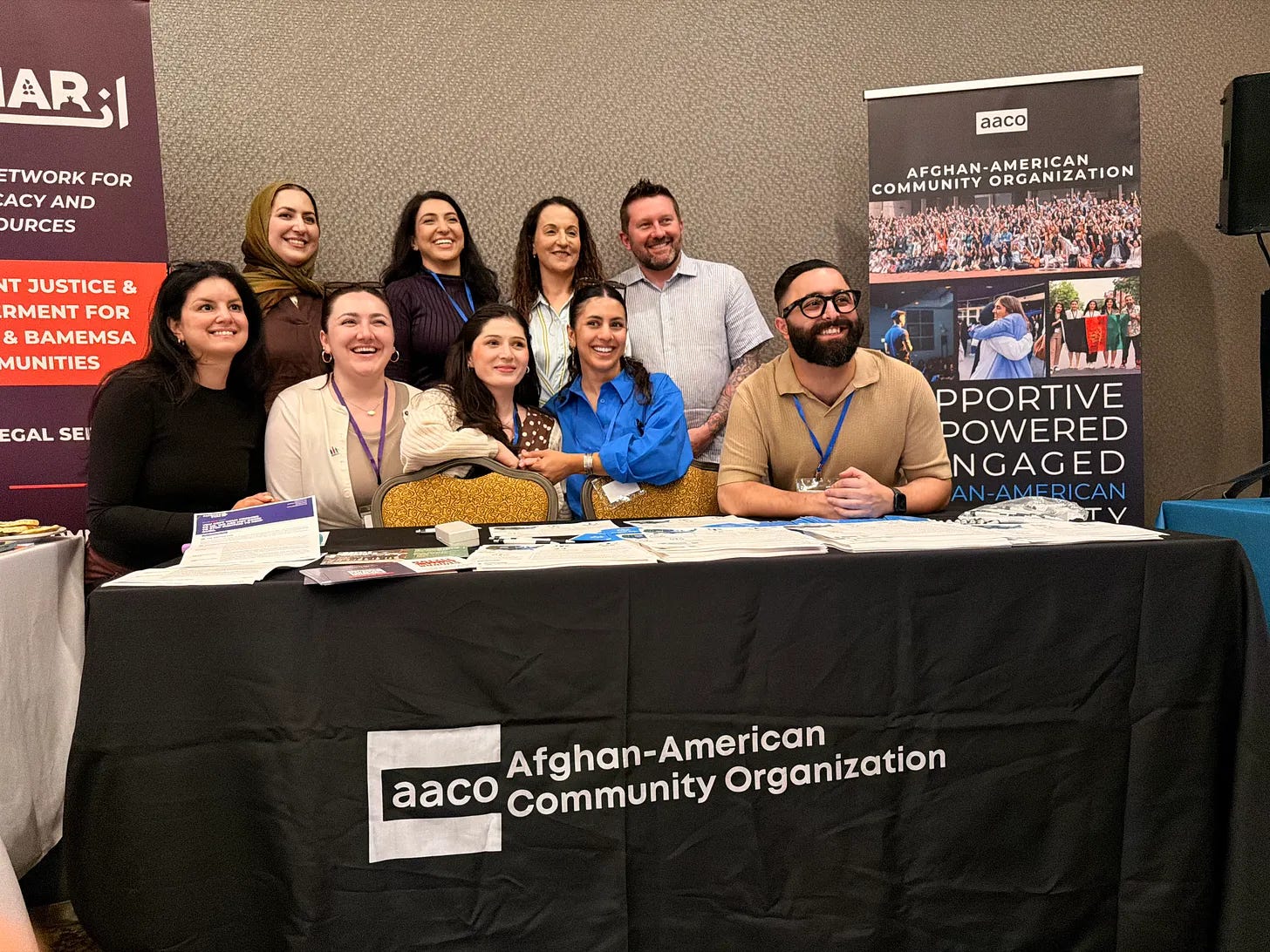
We attended a legal clinic and town hall in Pleasanton, hosted by the Afghan-American Community Organization and CAIR-California. Immigration attorney and AACO board member Spojmie Nasiri and I ran the town hall together, taking questions from families who drove in for straight answers. The clinic did the practical work this moment demands, screenings and know-your-rights guidance delivered in Pashto, Dari, and English by people who do this every day. A huge thanks to AACO and CAIR-California, who keep showing up for this community and made the day happen.
INTERNATIONAL: THE RETURNS HAVE NOT STOPPED
While Congress debated protection, the machinery of forced return kept grinding across the region. Pakistan’s deportation drive continues, with thousands of Afghans pushed back across the border on some single days this year, families among them, under a repatriation plan that has swept up people with valid documents alongside the undocumented. The United Nations has again urged Islamabad to halt the forced returns, and warned that Afghans sent back face a growing risk of trafficking as the crises inside the country deepen.
Why it matters Every week the pipeline stays frozen, the decision is made somewhere else, at a border crossing or on a deportation charter, by governments that will not wait for Washington to finish deciding.
IN THE NEWS
The Unfinished Mission on CNN, The Lead with Jake Tapper -- CNN
Report: Hundreds of thousands of Afghans shut out of US resettlement -- KPBS
The Unfinished Mission on KPBS -- KPBS
We’re purposefully breaking promise to Afghans -- Charleston Gazette-Mail
Who Really Abandoned Afghanistan? -- J.D. Marks
Shawn VanDiver and Beth Bailey on Five Years of Advocacy, The Afghanistan Project Podcast Ep. 150 -- The Afghanistan Project
Uncertain Future for Afghan Refugees; Qatar Camp to Close -- TOLOnews
State Department ordered to process travel documents for families of Afghan refugees in lawsuit -- Stars and Stripes
Five years is not an anniversary. It is an indictment, and it is a choice about what the sixth year looks like.
Last week, a bipartisan group of Senators decided the sixth year should include a record that cannot be erased and a protection that cannot be revoked on a whim, and members of Congress put their names to a demand that the people at Camp As Sayliyah not be abandoned.
That is not the finish line. It is the first stretch of open road we have seen in a long time, and open road is only worth anything if we drive it.
So cosponsor the bills, register for Tuesday, make some noise. The allies America vetted are still here, still waiting, and still organizing. So are we.
Hello Mr. Shawn,
Thank you for your weekly reports and for your tireless efforts to remove the obstacles facing our Afghan allies, especially SIV applicants. Your efforts, along with those of other legal and human rights organizations, are truly encouraging and give us hope.
I wish you and your respected family good health, happiness, and continued success.