

Last week, we shared some of the emails we received in response to letters we had sent. Some were three lines. Some were whole lives. Almost none of them asked us for anything.
So we are staying there this week.
August is hard from start to finish. And for those who do the work, this coming Wednesday is a hard date to sit with.
There is real news this morning, including a federal court ruling that far too many people are misreading. We are going to explain it.
Two urgent things. Then Wednesday. Then the people.
BEFORE ANYTHING ELSE, TWO THINGS HAPPENING RIGHT NOW
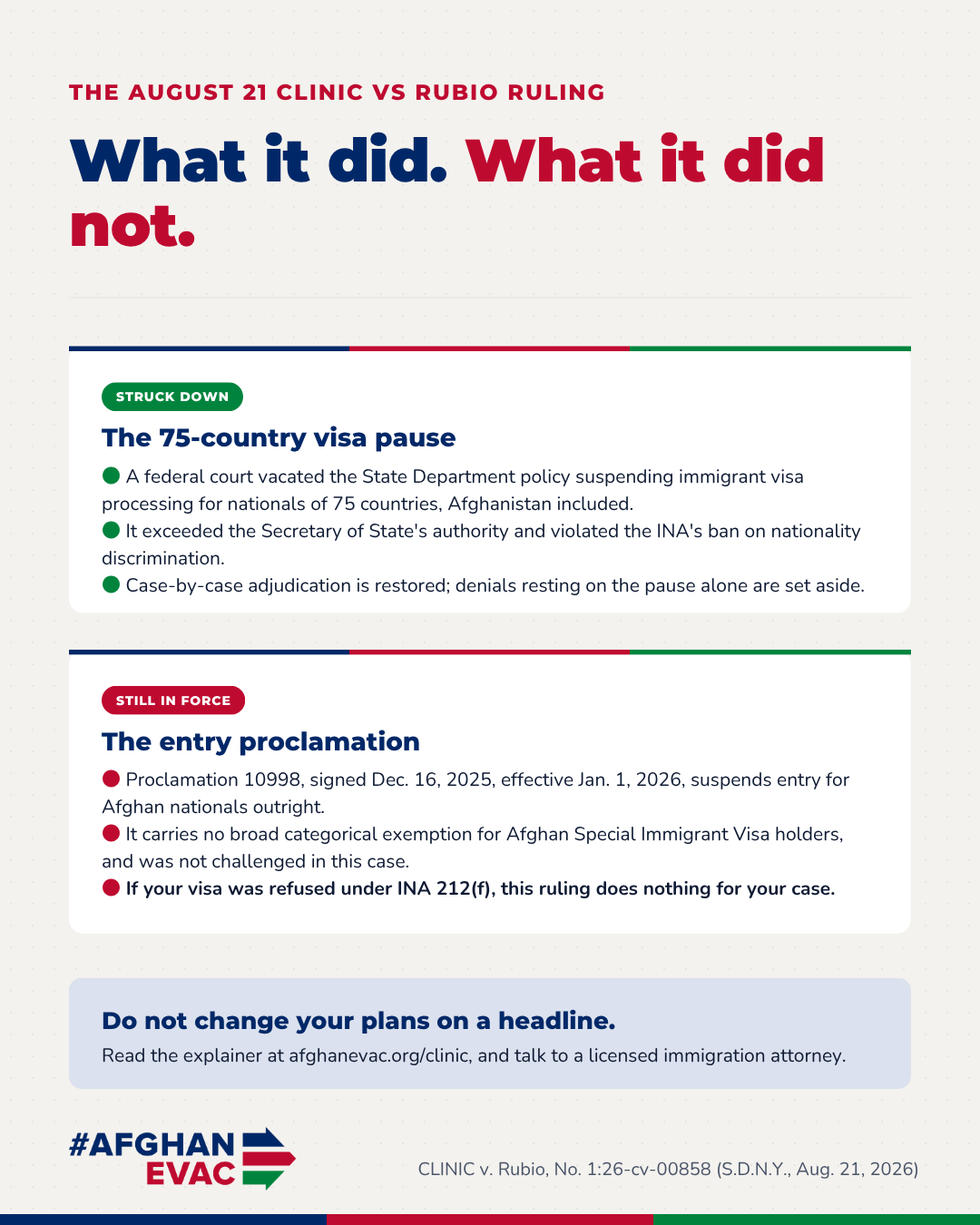
One. A federal judge struck down the visa ban on Friday, and it does not open the door. On August 21, Judge Jeannette A. Vargas of the Southern District of New York vacated the State Department policy that suspended immigrant visa processing for nationals of 75 countries, including Afghanistan.
That is a real win. We will take it.
It is not the win we need, and it does not reopen the door.
A separate order, the entry proclamation signed on December 16, 2025, still bars Afghans from entering the United States. That proclamation was not before the court. If your visa was refused under section 212(f), the authority behind the entry ban, Friday’s ruling does not fix your case.
Please do not book travel, quit a job, or give up a lease on the strength of a headline. Read afghanevac.org/clinic, watch the explainer video on our Facebook page, and talk to a licensed immigration attorney about your specific case.
Two. If you are in the United States of America and got a letter withdrawing your Chief of Mission approval, you have 120 days to respond, and you should not answer it alone. Afghan allies who came to the United States on Special Immigrant Visas and now hold green cards are receiving emails from the National Visa Center withdrawing the Chief of Mission approval that made their visas possible.
This is not routine paperwork.
It can lead to a Notice of Intent to Revoke and, from there, removal proceedings. The clock begins on the date of the email.
Include a copy of your green card or other proof that you are in the United States, because without it we cannot move your case forward. A member of our staff will help route you to a lawyer.
Many lawyers are working on cases just like yours. It may take some time to match an attorney with your case, and we cannot guarantee availability. We are here as a resource to do the best we can with the resources available, with partners we can stand behind and alongside to help where they can.
This is what is happening now, but it isn’t everything. Keep reading.
WEDNESDAY
Wednesday, August 26, 2026, marks five years to the day since the attack at Abbey Gate on August 26, 2021.
Say their names.
Staff Sgt. Darin Taylor Hoover. Sgt. Johanny Rosario Pichardo. Sgt. Nicole Gee. Cpl. Hunter Lopez. Cpl. Daegan William-Tyeler Page. Cpl. Humberto Sanchez. Lance Cpl. David Lee Espinoza. Lance Cpl. Jared Schmitz. Lance Cpl. Rylee McCollum. Lance Cpl. Dylan R. Merola. Lance Cpl. Kareem Nikoui. Hospitalman Maxton Soviak. Staff Sgt. Ryan Knauss.
Eleven Marines. One sailor. One soldier.
Most of them were barely into their twenties. They stood in a crowd, in the heat, pulling strangers through a gate, and they did not stop.
At least 170 Afghans died in that same crowd. Mothers holding paperwork. Fathers who had gotten their families that far and no farther. Children.
Their names are not read aloud at ceremonies in this country. They should be. We remember them in the same breath.
Abbey Gate is not the entire story.
More than 2,400 American service members died in Afghanistan across twenty years, alongside troops from dozens of allied nations and tens of thousands of Afghan soldiers, police officers, and civilians who fought and fell on our side of that war.
Interpreters walked point. Drivers took the road first. Entire families were lost.
Here is what that sacrifice bought.
Thousands of Americans came home because Afghans stood between them and the people trying to kill them. Thousands of Afghans are alive in our communities because Americans held a gate and would not move.
That exchange is the moral foundation of this work.
America made a promise. It was not aspirational. It was a debt.
To the Gold Star families, five years into carrying this publicly, on a schedule you did not choose, in front of people who were not there: We see you.
To the Afghans who were in that crowd and survived: We see you, too.
There is a memorial card at the bottom of this post for anyone who wants something to share on Wednesday.
THE PEOPLE WHO SHOWED UP THIS WEEK
While all of that was happening, ordinary people kept getting in cars and going to appointments with strangers. Battle Buddies continued its record of no detentions for Afghan allies, with accompaniments across the country.
In Texas, an Afghan family who recently lost their father had a biometrics appointment at U.S. Citizenship and Immigration Services. They were met there by their Battle Buddy, Steve, a Navy veteran who served in Afghanistan as part of a military training team in Kabul. Six kids in that family. Steve came with snacks. He stayed with them the whole way through.
My kid is about the same age as their oldest daughter, and I was able to connect with her and the younger kids about their common experiences.
In the DC area, Monica and Leisel sat in on the asylum hearing of an Afghan ally who had served in the Afghan National Police, who carries wounds from a Taliban attack, and who has built a good life here since. Their presence was a message to him, and it was also a message to the immigration judge. He was granted asylum. Monica’s note afterward was six words longer than it needed to be, in the best way, calling him “a wonderful addition to United States and [I’m] so thankful for the great outcome.”
On Tuesday we go to Philadelphia to stand with someone who served in the Afghan National Mine Removal Group (NMRG), his military’s premier unit for route clearance, mine reduction, and counter-IED work, and he was in firefights alongside American forces. He and his family got onto one of the flights out of Kabul airport five years ago almost to the day. His two youngest were born here. Wednesday’s anniversary and his green card interview are separated by about eighteen hours.
And then there was a Battle Buddy in Eugene. She read a story in the Eugene Weekly this week about an Afghan family who had rebuilt their business in Oregon, and she did not forward it to anyone or post about it. She found the woman in the story, reached out to contribute to her circle of Afghan women in need, and asked whether the family needed a hand with anything. Her email to us ended with one line.
I’m proud to be a Battle Buddy!
That is the whole model. Somebody reads something, and instead of feeling bad about it, they go find the person and ask what they need. If you want to be that person, the training is about forty minutes.
THE VOICES OF OUR ALLIES
Last week we said we would start sharing the letters that fill our inbox every week, always without names or anything that could identify anyone. Here is this week’s, and there is a pattern in it.
They organized.
Starting last Sunday and continuing all week, Afghan Priority 1 and Priority 2 families stranded in Pakistan wrote to us collectively. Dozens of letters, many of them word for word identical, sent separately by people who coordinated across cities and camps so that the same request would land the same way. Years of waiting. Cases that stopped moving. Expired visas, expired documents, children who cannot go to school, and a deportation regime that has forced more than 213,000 Afghans back across that border since April 2025. They are not asking for sympathy. They are asking to be put in front of Congress in one voice rather than ten thousand separate emails.
We do not want our voices to stop at an office desk.
And they’re asking for us to meet with President Trump. We will ask for the meeting but we don’t have high hopes he will take us up on it.
An Afghan Special Immigrant Visa applicant in Peshawar, four years into waiting for an interview that has never been scheduled, wrote to ask a question we cannot answer.
I am requesting an update regarding my interview scheduling.
A young Afghan woman still inside the country wrote about fearing for her safety, about trying to keep studying under a government that has closed the doors to her, and about wanting a future she can use to help other people. She had clearly read everything we have published about how narrow the pathways are right now. She wrote this anyway.
I am not asking for preferential treatment; I am simply trying to understand whether there is any safe and realistic pathway available to me.
Read that line twice. Then consider that the honest answer, this week, in the fifth year, is almost none. That is not a natural condition. It is the result of decisions, made by people with names, and it can be reversed by those same people.
We are not going to dress any of this up.
WHERE THINGS STAND
The visa ruling, in full. CLINIC v. Rubio, No. 1:26-cv-00858 (S.D.N.Y.), decided August 21. Judge Vargas found the 75-country suspension exceeded the Secretary of State’s authority and violated the Immigration and Nationality Act’s ban on nationality discrimination in issuing immigrant visas. “In many ways, this is not a challenging case,” she wrote. Case-by-case adjudication is restored and denials resting on the pause alone are set aside. The entry proclamation is untouched, carries no broad categorical exemption for Afghan Special Immigrant Visa holders, and is the wall that actually keeps our allies out. We expect an appeal and a stay request. There are three ways the proclamation ends. Congress legislates around it, a court finds it unlawful, or the President rescinds it with a signature this afternoon at no cost to anyone. Our breakdown is at afghanevac.org/clinic.
We are about to enter the last month before Camp As Sayliyah’s publicly stated closure date. What happens after September 30, no one has said. More than a thousand Afghans are still there, overwhelmingly women and children, roughly 150 of them the immediate family of American service members and veterans, with hundreds more military family members caught elsewhere in the same freeze. As of this week nobody inside has been told what happens on October 1. Army Times and Military Times ran it Thursday. On August 7, thirty-five members of Congress led by Rep. Scott Peters and Sen. Richard Blumenthal wrote to Secretaries Rubio, Mullin, and Hegseth demanding these vetted allies be processed first. Read the letter. Their interviews are done. Their Chief of Mission approvals are in hand. What is missing is a decision.
A lawsuit over the rule that takes away the asylum interview. On Wednesday, August 19, the National Immigrant Justice Center, the Center for Gender and Refugee Studies, and Human Rights First sued in federal court in Washington over a USCIS interim final rule that took effect July 28. The rule lets asylum officers refer cases straight to immigration court without ever conducting an affirmative asylum interview, deciding on the written application alone. By the government’s own estimate, up to 31 percent of the 1.4 million pending affirmative asylum cases could be affected. The case is Immigration Equality v. Mullin, brought on behalf of Immigration Equality, Oasis Legal Services, HIAS, and the Florence Immigrant and Refugee Rights Project. Read the plaintiffs’ statement. Afghans with pending affirmative asylum claims are squarely inside this. The interview is where a person gets to explain, in their own words and to a human being, why they cannot go home. Taking it away turns a protection process into a paperwork screen.
The August 18 press conference made news. With Rep. Don Bacon, Sharif Aly of the International Refugee Assistance Project, Laila Ayub of Project ANAR, Danilo Zak of Church World Service, and Sean Jamshidi, a medically retired Marine gunnery sergeant whose brother is inside that camp. Bacon, a retired Air Force brigadier general, put it plainly. “Most Americans want a decent, I would call it a Christian policy here, and that’s not what we’re getting.” He and Rep. Julie Johnson signaled a discharge petition on the Afghanistan Temporary Protected Status Act is coming soon. It takes 218 signatures and it is the only tool that works when leadership will not schedule a bill.
We went to the Truman Project to explain how Enduring Welcome was built and how it was taken apart. Jessica Bradley Rushing, former #AfghanEvac Chief of Staff, who ran communications and engagement at the State Department’s Coordinator for Afghan Relocation Efforts before joining us, moderated a discussion with two members of our Executive Advisory Council, Chris Purdy, Founder and CEO of The Chamberlain Network, and Camille Mackler, former Executive Director of Immigrant ARC and me. It was not a debate about whether the promise was made. Thank you to the Truman Project for having us come talk about what we have lived through. We hope we honored the spirit of everyone who built that program and everyone still waiting on it. We want to do more of these, so if your organization is hosting something, send it our way.
Three quiet changes that can cost someone their case. As of August 13, the Board of Immigration Appeals held that leaving the country on advance parole can trigger the three- and ten-year unlawful presence bars, which it generally did not before. That is a court decision, not an agency memo, which makes it harder to undo. As of August 21, USCIS made it substantially harder to reschedule an affirmative asylum interview or biometrics appointment, stopped issuing the Failure to Appear warning notice, and will now consider terminating a parolee’s status over a missed appointment, with evidence due fourteen calendar days ahead. And on September 18 the new public charge rule takes effect for green card applications, including benefits you applied for and never received. It does not apply to refugees and asylees adjusting status. Church World Service and USAHello track all of it in their weekly State of Play, translated into nine languages including Dari.
Five years on, the UN says Afghan women have been erased from public life. UN Women’s assessment is that the exclusion of women and girls from education, work, movement, and public space has been normalized rather than contested, while funding for women-serving programs collapses. Every month the pipeline stays frozen is another month an Afghan woman with a pending case cannot work, cannot study, and cannot leave.
A case at the Supreme Court worth watching. The Court has asked for a response in the petition brought by the Afghan couple challenging the Virginia adoption order that placed their orphaned relative with another family, on Fourteenth Amendment due process grounds. A request for a response is not a grant of review, but it means somebody is reading. Counsel put the response deadline at September 16. The precedent reaches well past one family.
ACTION THIS WEEK
Read and share the ruling explainer at afghanevac.org/clinic. The most useful thing you can do this week is stop a family from making an irreversible decision on a misread headline.
Ask your representative and both senators to cosponsor the Afghanistan Temporary Protected Status Act, H.R. 9899 and S. 5308, at afghanevac.org/tps. If they are already on, ask them to sign the discharge petition when it drops.
Come to the Afghan Community Town Hall in Lowell, Massachusetts, on August 30 at 11:00 a.m. Sign up today at afghanevac.org/bos-town-hall.
Mark Wednesday. Post a name, or all thirteen, or the Afghans who died in that crowd. The card at the bottom of this post is yours to use.
Get ready for September. The FY27 presidential determination on refugee admissions lands next month and Camp As Sayliyah closes September 30. Both need volume on short notice.
Donate at afghanevac.org/donate. Battle Buddies runs on it. So do the explainers that keep families from making bad decisions in weeks like this one.
IN THE NEWS
Stories from the past week.
The visa ruling
Federal judge strikes down Trump visa ban targeting 75 countries -- NPR
Federal judge blocks Trump administration’s visa pauses for 75 countries -- The Hill
Federal judge vacates Trump policy that suspended processing of immigration visas from 75 countries -- PBS NewsHour
Trump administration’s 75-country visa ban was illegal, judge rules -- KPBS
US judge strikes down Trump visa suspension for 75 countries, including Afghanistan -- Khaama Press
US judge strikes down Trump visa suspension for 75 countries, including Afghanistan -- Ariana News
Asylum and due process
Immigrant rights groups sue to protect due process for asylum seekers -- National Immigrant Justice Center
Lawsuit challenges new rule that could send more asylum seekers straight to immigration court -- KJZZ
Camp As Sayliyah
Afghans building lives here
The Afghan refugee who wants to go to space -- The World from PRX
A business in Kabul, a business in Eugene -- Eugene Weekly
From the five-year mark, still worth putting in front of people
The Ongoing Betrayal of Our Afghan Allies -- The New Republic
Five years after Taliban takeover, Afghan women ‘erased from public life’ -- UN News
Five years after the Taliban takeover: the normalization of the exclusion of women and girls in Afghanistan -- UN Women
From shelter to repatriation: Pakistan’s policy shift toward Afghan refugees -- The Friday Times
Our reports
The Allied Ledger -- #AfghanEvac and Local Staff International
The Unfinished Mission -- #AfghanEvac
One more week of this. August 26 is Wednesday and August 30 is the last flight out, and then it is September and the calendar lets go of us for another year. If you need to sit this week out, sit it out. Free legal help, pathway information, safety guidance, and mental health and crisis support are all at afghanevac.org/resources, for you whether you are in Kabul, Doha, Islamabad, or down the street from us in San Diego.
But if you have anything left, spend it the way Steve and Monica and Leisel and one Battle Buddy in Eugene spent theirs this week, which is on one person, in one room, on one ordinary Tuesday. Five years ago thirteen Americans held a gate open at the cost of their lives so that people they had never met could get through it. Nobody is asking that of you. We are asking for a phone call, a hearing, a car ride, and a name said out loud on Wednesday.
That is how a promise gets kept. Not all at once, and not by the government that made it, but by us, one at a time, until they are all home.