

Two things happened to Afghan families this week that will matter for years, and neither one happened on the House floor.
The first happened in the Federal Register, on a Tuesday, in a rule that became effective the moment it was published. USCIS can now send certain affirmative asylum applicants directly to immigration court based on the paper file alone. No interview first. No notice, no comment, and no chance to object before implementation. And it reaches cases that are already pending.
The second happened in a Virginia courtroom, on a Thursday and it’s HUGE. A federal judge set aside the policy that has been using the travel ban to keep approved family members of Afghan asylees out of the country. Not a waiver for the seven people who sued. The policy itself. It should mean a lot of families finally get to come.
Elsewhere, a secretive removal court created in 1996 held its first hearing, Britain admitted it endangered 18,500 of its own allies and found nobody to blame, and we received hundreds of letters from Afghans awaiting processing around the world.
ACTION THIS WEEK
Comment on the Employment Authorization Document rule before Tuesday. This is the last real chance. Comments close August 4, Docket USCIS-2026-0067. More than 3,100 comments are already in.
Comment on the rule that just abolished the guarantee of an affirmative asylum interview. The interim final rule took effect July 28 and comments close September 28.
Ask your House member to cosponsor the Afghanistan TPS Act, H.R. 9899. Two members joined on July 30, and there are now six cosponsors from three parties. Over 650 letters from 48 states plus DC have gone to Congress. Two have not sent a single letter: Montana and North Dakota. Send yours in ninety seconds.
Register for the Global Alliance Update on August 12. We release The Allied Ledger and new Guidelines for the Rights and Protection of Local Staff with Local Staff International.
TWO WINS IN COURT
On July 30, Judge Anthony Trenga of the Eastern District of Virginia ruled that the administration cannot use the travel ban to block family members of people already granted asylum here. The proclamations exempt asylees by their own text, the court found, and the State Department’s contrary policy was unlawful and must be set aside.
The government has fifteen days to issue travel documents to five approved family members and must reconsider two more applications without applying the ban. The plaintiffs are seven Afghan allies granted asylum in the United States. The International Refugee Assistance Project litigated it.
The same day, a Ninth Circuit panel ruled 2 to 1 that the administration cannot deny bond hearings to immigrants arrested inside the United States, rejecting an attempt to extend mandatory detention far beyond border arrests. At least four other circuits have now rejected that policy. Two have gone the other way, and the administration has already asked the Supreme Court to take it up.
Why it matters Family reunification for Afghan asylees was quietly strangled by a policy nobody voted on, and a court just undid it. Wins like this hold only if the government complies and only if they survive appeal, so watch the fifteen-day deadline as closely as you watched the ruling.
USCIS ENDED THE GUARANTEED AFFIRMATIVE ASYLUM INTERVIEW
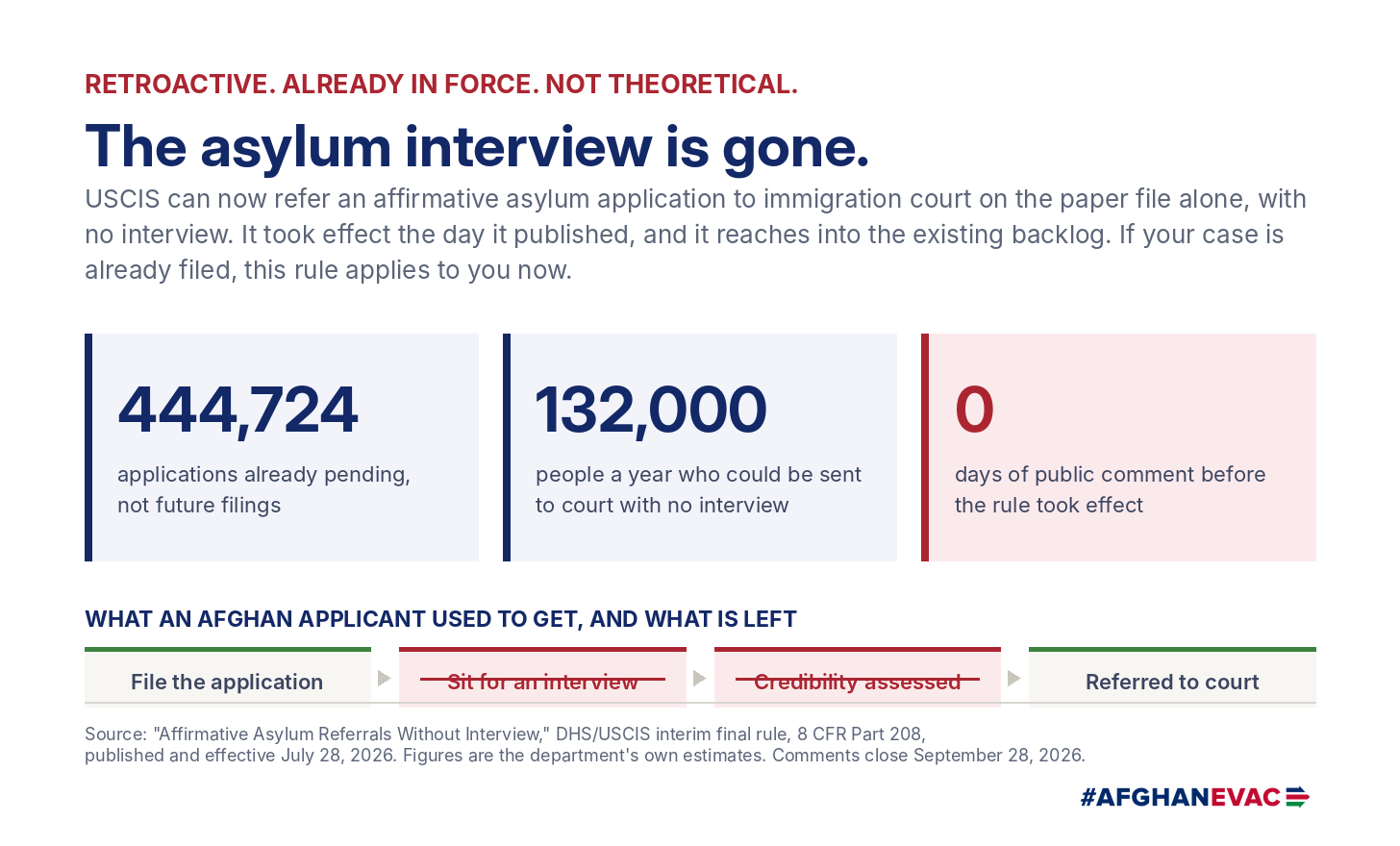
On July 28, the Department of Homeland Security published an interim final rule and made it effective the same day. It lets U.S. Citizenship and Immigration Services send an affirmative asylum application to immigration court on the paper file alone. No interview. The rule strips the language indicating applicants have a right to one, drops the requirement that a referral letter assess credibility, and lets an officer deny a discretionary claim without ever determining whether the person is a refugee.
This is retroactive, and that is the part to understand. It is not a rule for people who file from here on. It reaches into the backlog, applying to 444,724 applications already pending, every one filed by someone who was told an interview was coming. For Afghan families who were brought here by the U.S. government but don’t yet have durable status, it is close to a blanket, because parole delays this government created pushed most Afghan affirmative filers past the one-year mark, which is exactly the category the rule targets. If your case is in that queue, this is not a debate about future policy. It already applies to you.
Think about who is in that queue. Allies whose Chief of Mission approval was revoked have been filing affirmatively on the advice of counsel, because it was the door still open. Their strongest evidence is not a document. It is the account they give out loud, to a person, under questioning. That is what an asylum interview is for. Removing it does not streamline these cases. It removes the only place where the facts of them can surface.
The rule can still be changed. An interim final rule can be amended, withdrawn, or vacated, and the record built between now and September 28 is what a court reads when someone challenges it, so file a comment and do not let the timing convince you it is pointless.
We have the explainer ready to go and a simple ask for every attorney reading this. If you have an Afghan client with a pending affirmative case, check the file this week. Do not assume an interview is coming.
Why it matters An asylum claim is won or lost on testimony. Take away the chance to testify and you have not made a process faster; you have decided the outcome and skipped the part where anyone listens. For an Afghan ally whose Chief of Mission approval was already pulled, that is the difference between a defense and a deportation.
THE TPS ACT GREW WHILE CONGRESS WAS OUT OF TOWN
The Afghanistan TPS Act of 2026, H.R. 9899, picked up two more cosponsors on July 30, Reps. Kevin Kiley of California and Lateefah Simon of California. That brings the bill to six cosponsors from three parties, alongside sponsor Rep. Jason Crow and original cosponsors Sam Liccardo, Maria Elvira Salazar, Don Bacon, and Bill Keating.
The endorsement list grew faster than the cosponsor list. More than forty organizations have signed on since the bill dropped, watch our social media for the thank you posts.
Members added their names during a recess, which tells you these were not floor-vote decisions made under pressure. They were choices. Our own count puts constituent letters past 650 in less than a week, but two states are still at zero. If you live in Montana or North Dakota, you can personally help us ensure lawmakers have heard from Americans in all 50 states and DC that they want our allies protected.
Why it matters A bill that grows during recess has real support underneath it. Every cosponsor makes it harder for congressional leadership to ignore.
EXPECT AN EXTENSION AT CAS, NOT A DECISION
I spent the end of last week in Doha, meeting with people who work on this every day. I am not going to characterize those conversations. What I will tell you is what I came home believing.
Camp As Sayliyah is on the books to close September 30, and that date is soft. The International Organization for Migration’s contract at the site now runs through the end of the year, and the State Department has not worked out what it intends to do with the exactly 1,039 people still there. An extension is what happens when nobody makes a decision, and I would expect one.
The path forward is not complicated and it has not changed. Bring the people who have not been denied to the United States. They were vetted, they were approved, and the only thing between them and a flight is a signature nobody wants to put on paper. For the smaller number who have been denied, find them a safe place to go, deliberately and with their consent, rather than scrambling when a deadline arrives. That is the entire plan. It does not require new law, a new appropriation, or a new agreement with anyone. It requires the State Department to choose.
Why it matters Every extension buys time that nobody is spending. The families at Camp As Sayliyah are not waiting on a process, they are waiting on a decision, and the longer it goes unmade the more it starts to look like the decision itself.
A DORMANT DEPORTATION COURT IS NOW RUNNING
A removal court created in 1996, but never used, has held its first hearing. We are watching not only because of the respondent, but because a proceeding built to use classified evidence could eventually be pointed at people whose files are thick with wartime intelligence reporting.
That is our community.
On July 30, the Alien Terrorist Removal Court heard the case of Nazira Haji Zada, a 47-year-old Afghan lawful permanent resident in Fort Worth, Texas. The Justice Department accuses her of supporting her family’s Election Day shooting plot. Her son and son-in-law have already pleaded guilty.
We are not defending her and we take no position on her guilt. The allegations are grave, and if the government can prove them it should.
Our concern is the machinery. This court can rely on classified evidence a respondent cannot fully review and uses a lower burden of proof than a criminal trial. Yet the underlying plot was prosecuted in public, and the guilty pleas are on a public docket. Choosing the secretive forum when the open one worked raises questions about why this court is attractive and who might be next.
Afghan allies carry files filled with intelligence fragments, informant reporting, and unverified derogatory information collected in a combat zone. We already see Chief of Mission approvals revoked without an explanation or a record to contest. A removal process designed to use secret evidence fits that population uncomfortably well.
We are flagging it now, before it happens, rather than writing about it afterward.
Why it matters A court unused for thirty years is now active. Exceptional government powers rarely remain confined to the first case used to justify them.
THE LETTERS
Three groups of Afghans wrote to us this week and did not coordinate with one another. SIV applicants in Pakistan, Tajikistan, and Afghanistan, who organized their own advocacy and gathered videos, photographs, and signatures. P-1, P-2, and refugee families in Pakistan, asking for an attorney who can look at cases frozen for years. And families refused under Section 212(f), turned away by a proclamation rather than anything in their file. They described the same life. Documents expiring, children out of school, rent unpaid, police at the door despite a pending case. One put it plainly: “We are not asking for special treatment. We are simply asking for protection, dignity, and the opportunity for our pending cases to be processed in a timely manner.”
One letter said they have written for nearly a year without hearing SIV cases raised in our meetings or public remarks, and we would rather give a straight answer than an easy one. We raise these cases every week, in congressional meetings, filings, reports, and the pathways tool we built for this purpose. What we do not do is name every population in every post, because a post that lists everyone says nothing to anyone.
These policies are almost never written for one population. Section 212(f) does not distinguish between an interpreter with an approved visa and a P-2 applicant awaiting a referral, and the travel ban does not check which program you are in. That is why we attack the proclamation, the rule, and the funding decision rather than arguing category by category. When the thing itself falls, it falls for all of you at once. Send your materials, we will use them, and on a week when your program name does not appear, do not read that as absence.
Why it matters The paperwork sorts you into programs. The policy does not. One proclamation reaches an interpreter in Herat, a journalist in Islamabad, and a family already approved, in the same afternoon. That is why we fight the policy and not the category.
THE AGENCY MAKING “WELLNESS” CALLS IS SHARING INFORMATION WITH ICE
On July 28, Reuters reported that the Office of Refugee Resettlement has passed more than 460,000 leads to immigration enforcement since January 2025, contributing to thousands of arrests of children and the sponsors who took them in. Hold that next to what we flagged two weeks ago. The same office is placing what it calls wellbeing calls to roughly 800 Afghan arrivals, asking about identity, household composition, and immigration status, with answers that are not anonymous and may be kept for fifteen years.
Our guidance has not changed, and this week it hardened. You are not required to answer. Not where you live, not your status, not anything about your family or your case. Declining does not affect your benefits. If you have a case pending, talk to a trusted immigration attorney or your resettlement agency before you say a word.
Why it matters A government agency created to help vulnerable immigrants has also been supplying information to immigration enforcement. That is the context for every call an Afghan family receives, and why “just a wellness check” is not a safe assumption.
BRITAIN NAMES ITS FAILURE
On July 30, the House of Commons Defence Committee released “Shifting heaven and earth? The Afghan data breach and resettlement schemes,” its report on the Ministry of Defence breach that compromised more than 18,500 applications and put far more people than that in danger, including families. The committee called it a foreseeable systemic failure, found it was buried under secrecy for far too long, and noted that no individual appears to have been held personally accountable.
Why it matters Every allied government watching this outcome learns the same lesson, that the cost of failing Afghan allies is a report. Accountability that arrives without consequence teaches the next ministry exactly how little is at stake.
INTERNATIONAL: WHAT THE UN COUNTED IN THREE MONTHS
On July 28, the United Nations Assistance Mission in Afghanistan published its quarterly human rights update for April through June, with two annexes. In three months, the Taliban’s vice ministry arbitrarily arrested 389 people. Authorities carried out 137 judicial corporal punishments including public floggings. They arbitrarily arrested 29 former members of the Afghan National Defence and Security Forces, and they killed eight. In the same quarter, 120,000 men sat university entrance exams and not one woman or girl did.
The first annex is about one city’s dress code. In Herat, between June 6 and 8, inspectors arrested at least 30 women and girls for not wearing chadors and sent them to the provincial prison. When residents of the Jibreil area, a Shi’a Hazara neighborhood, protested peacefully on June 9, plainclothes security forces beat them, shot at them, killed a boy, and arrested at least 17. In the days after, intelligence officials stopped people at random to search their phones for protest footage, and women stopped going outside.
The second annex counts cross-border civilian casualties, 399 in the quarter, 57 killed and 342 injured, among them 112 children. UNAMA attributes all of them to Pakistani security forces. The worst came on June 28 in Paktya, where an airstrike collapsed a three-storey house and the local mosque called on neighbors to help dig out the survivors. Twenty minutes later, Pakistani forces struck the same house again. Twenty-two killed, at least 185 injured, most of them by the second strike. Separately, on July 28 Germany put 31 Afghan men on a deportation charter to Kabul. One had no criminal record at all.
Why it matters Eight former Afghan security force members killed in ninety days is the answer to anyone who claims returns to Afghanistan are safe. That is the country the United States is sending people back toward, and the one families in Qatar are waiting not to be sent to.
DOMESTIC DETENTIONS RAMPING UP
ICE has recently increased detentions at domestic U.S. airports. Arrests have occurred at departure gates and arrivals, reportedly using passenger information shared through government travel systems.
People without secure immigration status may face detention even on domestic flights. Having a pending application or valid work permit does not necessarily prevent an arrest. Those potentially at heightened risk include:
Former TPS holders. Afghanistan’s TPS designation was terminated effective July 14, 2025. Former beneficiaries who do not have another lawful status may be exposed to enforcement.
People with pending applications. Filing for asylum, an SIV, adjustment of status, or another form of protection does not necessarily provide lawful status or prevent ICE from making an arrest while the application remains pending.
People whose visas or authorized periods of stay have expired. A pending immigration application or valid employment authorization document does not, by itself, guarantee protection from detention.
People with prior arrests or criminal records. Criminal convictions, pending charges, and, in some circumstances, prior arrests may increase scrutiny or create additional immigration consequences. Lawful permanent residents can also face detention depending on the nature of their records and travel history.
The legal risks vary significantly by person. Citizenship, lawful permanent residence, parole, a pending application, and employment authorization are not interchangeable, and none of this guidance should substitute for advice about an individual case.
Why it matters The categories of people being detained at airports appear to have widened significantly. Based on the current pattern, we recommend that Afghans without U.S. citizenship or secure lawful status consult a qualified immigration attorney before flying. Lawful permanent residents with any arrest, charge, or conviction should also seek individualized legal advice before traveling.
Consult an immigration lawyer for specific advice for your case, and make a safety plan in the event of any detention.
SOMETHING WORTH KNOWING
The federal contract funding legal representation for unaccompanied immigrant children expired on July 31, stripping counsel from more than 25,000 children. Immigration arrests hit 1,474 a day through July 11, the fastest pace of this administration.
And the Dorcas fight comes to a head this week. Plaintiffs’ response to the government’s emergency motion to stay is due today (August 3) in the First Circuit, and the government’s opening merits brief is due August 11. Until that stay motion is decided, U.S. Citizenship and Immigration Services must keep adjudicating Afghan cases. The court could rule any day, so watch this one.
IN THE NEWS
Stories from the past week.
The Alien Terrorist Removal Court
Secretive terrorist removal court set for first hearing in Afghan woman’s case -- CNN
Alien Terrorist Removal Court holds its first-ever hearing after 30 years -- NPR
Afghan woman plans to fight DOJ efforts to deport her over allegation she is an ‘alien terrorist’ -- CBS News
Administration to use secretive deportation court for the first time -- UPI
Justice Department files first case in U.S. Alien Terrorist Removal Court -- U.S. Department of Justice
The asylum rule and the courts
Affirmative Asylum Referrals Without Interview -- Federal Register
New rule could speed deportation of asylum seekers -- The Hill
Federal Judge Rejects Travel Ban Use Against Afghan Asylees’ Families -- Global Refuge
US appeals court rejects Trump expansion of mandatory migrant detention -- Al Jazeera
Enforcement and detention
Thousands of children, sponsors arrested by ICE after tips from US child migrant agency -- Reuters
ICE Arrests Surge at Airports, Opening New Front in Deportation Drive -- The New York Times
More than 25,000 children lose previous legal protections, as federal contract ends -- NPR
ICE working to open four new detention facilities with space for 5,500 detainees -- NBC News
Immigrant detention should not be a death sentence -- The Hill
This Week by the {Immigration} Numbers (July 31, 2026) -- Austin Kocher
Britain’s reckoning
Shifting heaven and earth? The Afghan data breach -- House of Commons Defence Committee
UK lawmakers say Afghan allies were put at risk by secrecy, policy failures -- Amu TV
MoD data breach was a ‘foreseeable’ failure that left Afghans in danger -- Radio NewsHub
Inside Afghanistan and the region
A hijab inspection, a slap, a warning letter: Inside three months of Taliban rule -- UN News
Former Afghan security personnel still face killings and torture, says UN -- Afghanistan International
Over 130 publicly flogged in Afghanistan in three months, U.N. says -- Khaama Press
Months of fighting between Afghanistan and Pakistan have killed nearly 500 Afghan civilians, UN says -- Associated Press
MSF urges Pakistan to halt forced returns of Afghan refugees -- Amu TV
Returning Afghans face growing risk of trafficking as crises deepen -- UN News
Germany deports 31 Afghans to Kabul on direct flight, including one without criminal record -- KabulNow
Germany defends deporting non-criminal to Afghanistan -- The Local
The Afghanistan TPS Act
Crow introduces bill to grant vulnerable Afghans Temporary Protected Status -- Office of Rep. Jason Crow
New bipartisan bill aims to fulfill America’s promise to Afghan allies -- Office of Rep. Sam Liccardo
In two weeks it will be five years since Kabul fell, and the anniversary coverage is already being assigned.
Reporters will ask what changed.
Here is the honest answer: The machinery got quieter. A promise is not broken with a vote anymore, it is broken with a rule that publishes on a Tuesday and is law by lunch, and with a decision nobody in the State Department wants to sign.
Quiet is the point. It is harder to photograph and easier to deny.
So our mission, together, has got to be to make it loud.
File the comment, send the letter, take the leap, and put your name on the record where it can be counted.
Five years in, the allies America vetted are still here, still waiting, and still organizing.
So are we.
Thank you so much
thanks for your hard working