

Last week was a building week. We put a (metaphorical) weapon in the hands of every immigration attorney fighting for an Afghan client, rebuilt our website into a research and resources arsenal, and watched a federal court refuse to let the administration slam the door on Afghan cases a second time.
There was ground-level work too, from a San Diego meeting with a state lawmaker and Hazara community leaders to a legal clinic in Riverside.
Here is what moved, and what this week demands.
Protection Promised is out, the first in our Five Years On series of original reports, and today we pair it with a Practitioner’s Companion built for the courtroom.
A rebuilt website and a new set of tools put the full record, the pathways, and the litigation in one place.
The Dorcas win held, and a judge told the government it must keep processing Afghan cases.
On the ground in San Diego with Assemblymember Chris Ward and Hazara leaders, and in Riverside alongside immigration attorney Spojmie Nasiri.
Not only building but recognizing the moment. ICE officers killed two men in a week during traffic stops, and after a brief pause, the President ordered the traffic stops to continue.
Start with the ways you can take action, then read on.
ACTION THIS WEEK
Read and share Protection Promised, and get the Companion to counsel. Send Protection Promised and its new Practitioner’s Companion to any attorney with an Afghan client, and point them to The Ledger, V-PRIC, and the litigation tracker.
Comment on the proposed EAD rule, and add your organization’s name. We have launched a new effort with a sign-on and a ready-to-file draft organizational comment. Organizations can sign on today! The comment deadline is August 4.
Register for the AfghanEvac Tools Demonstration. Join us Tuesday, July 21 at 10 a.m. Pacific for a live walkthrough of the rebuilt website and the new tools, including the Ledger, V-PRIC, the litigation tracker, the Enduring Welcome page, and the Practitioner's Companion. Register today.
Register for the Global Alliance Update. Join the August 12 virtual briefing with Local Staff International, where we will release The Allied Ledger and new Guidelines for the Rights and Protection of Local Staff. Sign up at afghanevac.org/global-alliance-update.
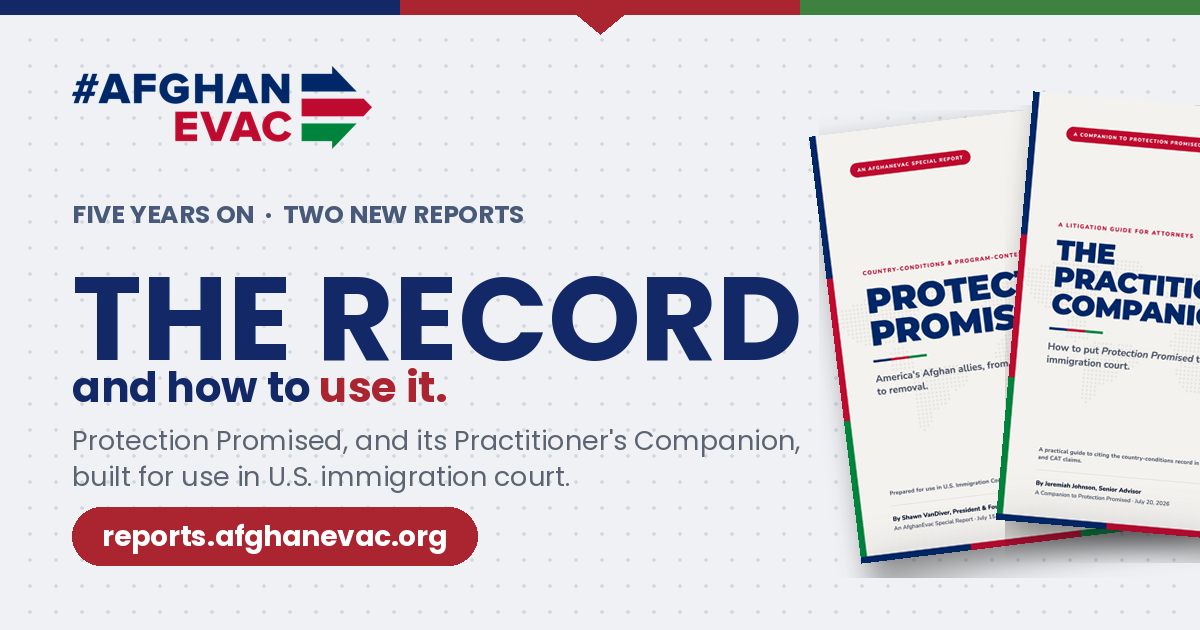
PROTECTION PROMISED: THE RECORD, BUILT FOR THE COURTROOM
For four years, Afghan allies have been fighting a lie, that they were never properly vetted. Last week, we handed every attorney defending them the receipts. On July 15, we launched Protection Promised, the first in our series of original reports marking the fifth anniversary of the fall of Kabul. Subtitled America’s Afghan Allies, from Welcome to Removal, it documents what the United States promised its wartime allies, what it built to keep that promise, and what it has dismantled since January 2025.
This is not a briefing paper. It is a fully sourced evidentiary record, assembled so that counsel and plaintiffs can file it in asylum and immigration proceedings, and in any other litigation where it helps. In one place, it lays out the specific commitments the government made across two administrations, in its own words and documents; how Afghan evacuees and Special Immigrant Visa (SIV) recipients were actually screened and vetted, drawn from the government’s own records rather than the political narrative; and what that record establishes for Afghans defending their status today.
Here is why it matters. When an Afghan father stands in an immigration courtroom in Texas and a judge asks who this man is, the answer should not depend on a headline. It should rest on the government’s own record of the promise it made and the vetting it performed. Protection Promised puts that record in the room.
Today, with this update, we are releasing its companion. The Practitioner’s Companion, subtitled Relief and Legal Standards for Afghan Nationals in U.S. Immigration Court, turns the record into legal argument. Where Protection Promised assembles the evidence, the Companion maps it onto the governing standards for asylum, withholding of removal, and protection under the Convention Against Torture, and walks counsel through the procedural traps that decide real cases, including the one-year asylum filing deadline. It was written by Jeremiah Johnson, an AfghanEvac team member with 23 years of experience as an immigration attorney, including 8 years as an immigration judge and time as an asylum officer with the Department of Homeland Security. Read one for the evidence, and the other for how to use it.
This is the first of several reports coming in the weeks ahead. If you are an attorney, use them. If you know an attorney, send them along. Five years on, the promise is still ours to keep, and now the evidence, along with the roadmap for using it, is in everyone’s hands.
WE REBUILT THE WEBSITE INTO AN ARSENAL
Protection Promised did not arrive alone.
Our website has been completely rebuilt to equip allies and all those who stand with them with the resources, tools, and information they need today, and with a historical record of what got us here, to prepare us for what’s next.
The Ledger is the running record of America’s promise to its Afghan wartime allies, a searchable archive of more than 316 primary-source government documents from the United States and 34 allied nations, plus reports from non-governmental partners, the litigation, and the Afghanistan War Commission record. It is also where the Five Years On special reports live, starting with Protection Promised.
V-PRIC, the Visa Pathways and Relocation Information Center, is a sourced, continuously verified guide to U.S. visa categories and resettlement options across 197 countries, with a Find My Pathway assistant that answers questions in more than 40 languages.
Our new litigation tracker follows the active cases that decide whether the pipeline moves.
Our Enduring Welcome page lays out, in plain terms, where the relocation program stands.
Our updated Resources page pulls the help families, advocates, attorneys, and journalists actually need into one current, navigable hub.
And our refreshed Policy page lays out the full agenda, organized by agency and by bill, from the Enduring Welcome Act to the Afghan Adjustment Act, with section-by-section breakdowns and clear ways to engage.
Why it matters: Advocacy fails when the facts are scattered and the tools are hard to find. A rebuilt, searchable home for the record, the pathways, and the litigation means an attorney, a caseworker, or a stranded family can find what they need in one place, on their own time.
JOIN US TUESDAY FOR A LIVE WALKTHROUGH
On Tuesday, July 21 at 10 a.m. Pacific, we are hosting a live tools demonstration for advocates, attorneys, caseworkers, journalists, and anyone who wants to see how the rebuilt afghanevac.org works in practice. We will walk through the Ledger, V-PRIC, the litigation tracker, the Enduring Welcome page, Protection Promised, and the Practitioner’s Companion. Bring your questions.
THE DORCAS WIN HELD, AND THE COURT TOLD THE GOVERNMENT TO KEEP PROCESSING
On July 15, Chief Judge John McConnell of the U.S. District Court in Rhode Island denied the government’s emergency request to pause USCIS adjudications while its appeal moves forward, keeping in place a ruling won by the team at Democracy Forward. That means U.S. Citizenship and Immigration Services (USCIS) must keep processing applications for Afghans and for nationals of the other countries swept into the travel ban, including pending green card, work permit, citizenship, and asylum cases. Some affected applicants have already started receiving decisions.
This win belongs to Democracy Forward. Congratulations to their litigation team, and our thanks. Their work is the reason USCIS is still deciding these cases today. It does not end the travel ban, it does not restart overseas refugee processing, and the government’s appeal continues. But the administration chose to try to freeze these cases twice, first by policy memo and then by emergency motion, and twice it has been told no. The proposed EAD rule is the next attempt to accomplish by regulation what the courts have blocked by litigation, which is exactly why the comment deadline on August 4 matters.
Why it matters: Every week USCIS keeps adjudicating is a week that Afghan families move closer to stability instead of deeper into limbo. Court orders only help if the government complies, so we will be watching.
THE UN CONDEMNS THE PURGE OF IMMIGRATION JUDGES
On July 16, two United Nations human rights experts, the Special Rapporteurs on the independence of judges and lawyers and on the human rights of migrants, condemned the mass removal of U.S. immigration judges and the politicization of the immigration courts. Since January 2025, at least 135 judges have been terminated, including 113 immigration judges, 13 assistant chief immigration judges, and 9 appellate judges, most without cause or individualized explanation. The data cited by the experts show that the removals were far from random. Of 78 removed judges with available data, 65 had higher-than-average asylum grant rates, and judges with backgrounds in immigrant defense or humanitarian work were removed at disproportionate rates. Only one judge appointed by a Democratic administration remains on the Board of Immigration Appeals.
Read this alongside the mass hearing dockets we have documented, where a single judge is handed 100 or more cases in a single morning, and the design is clear. The administration chose to strip out the judges most likely to grant protection, then flood the ones who remain. “Foreign nationals facing deportation to a threat of torture, persecution, or death must be able to present their case in front of an independent and impartial body,” the experts wrote. That is precisely the body being hollowed out.
Why it matters: Afghan allies defending their status do it in these courtrooms. When the government removes the judges most willing to grant asylum and buries the rest under mass dockets, an Afghan family’s day in court becomes a formality. It is why we brought Jeremiah Johnson, a former immigration judge with 23 years practicing immigration law, onto our team, and why Protection Promised exists, to hand counsel a record that a fair judge can act on.
A SECRET COURT, SWITCHED ON FOR THE FIRST TIME IN THIRTY YEARS
On July 16, the federal government activated the Alien Terrorist Removal Court for the first time in its history. Created in 1996 and never once used, this court is built to deport people on classified evidence, shown to the judge in secret, that the accused never sees and cannot contest. Chief Judge Joan Ericksen issued the first order after a closed hearing. We do not know who the target is, what they are accused of, or what the government claims to hold against them, and under the rules of this court, we may never find out.
Why it matters: This is the machinery of secret deportation, switched on at the very moment the administration is branding vetted Afghan allies as security risks. A person cannot defend himself against evidence he is not allowed to see. For allies already smeared as unvetted, a court that runs on secret evidence is not a hypothetical, it is the next courtroom, and it is one more reason the sourced record we just published matters.
ICE KILLED TWO MEN, THEN THE PRESIDENT ORDERED THE STOPS TO CONTINUE
In the span of a week, ICE officers shot and killed two men during vehicle stops. On July 8 in Houston, officers hunting a different suspect stopped a white van and killed Lorenzo Salgado Araujo, a longtime homebuilder who had lived in the United States for 35 years, had no criminal record, and by his family’s account was close to obtaining legal status. The Department of Homeland Security (DHS) says he tried to ram an officer. His family says he was a construction crew owner who may have feared that men in unmarked cars had come to steal his tools. On July 13 in Biddeford, Maine, officers killed Johan Sebastián Durán Guerrero, who was not the target of their warrant, and left behind a sedan with four bullet holes in the windshield.
For a moment, the administration blinked. Secretary Mullin suspended most ICE vehicle stops nationwide, pending additional training. Then, on July 15, President Trump reversed the pause and ordered the stops to resume. Restraint lasted 24 hours. The DHS Inspector General and the Harris County District Attorney are now investigating the Houston killing.
Why it matters: This is the same enforcement machine that detained Nazeer Paktiawal, an Afghan Special Forces veteran, and left him dead in custody in under 24 hours. It is the reason Battle Buddies exists. When the government kills a man it was not even looking for, then cancels its own safety pause within 24 hours, it is telling every immigrant community, Afghan allies included, that restraint is optional. That is a choice, and it can be unmade.
IN SAN DIEGO WITH ASSEMBLYMEMBER CHRIS WARD AND HAZARA LEADERS
On July 14, we sat down in San Diego with California Assemblymember Chris Ward and leaders of the local Hazara community. The Hazara people have faced targeted persecution in Afghanistan for generations, and that danger did not end when the cameras left Kabul. The families building lives here carry the weight of relatives still hiding, still waiting, still at risk.
The conversation focused on what state and local leaders can do while the federal pathways stay choked: recognizing the specific threats the Hazara community faces, connecting families to resources, and standing with San Diego’s Afghan community as a matter of public record. Assemblymember Ward listened, made some commitments, and we left with a shared understanding of the path ahead. San Diego has long been one of the country’s most important landing places for Afghan allies, and local partnership is how a national promise gets kept on the ground.
IN RIVERSIDE FOR THE AFGHAN COMMUNITY LEGAL AND RESOURCE CLINIC
On Saturday, I spoke at the Afghan Community Legal and Resource Clinic in Riverside, a regional event hosted by the Afghan-American Community Organization and other partners serving Afghan families. I joined immigration attorney Spojmie Nasiri for a conversation about the shifting political and legal landscape, what families are seeing on the ground, and how the community can advocate for itself. The clinic gave families free access to legal consultations, community resources, and support services in one place.
Spojmie and I both emphasized repeatedly how important it is to ensure people have qualified immigration attorneys, not unlicensed or unqualified “immigration specialists.” helping them navigate their cases.
These events are the connective tissue of this work. Policy is decided in Washington, but it is lived in living rooms in Riverside, Roanoke, and Rochester. Showing up, telling the truth about where things stand, and pointing people to real help is how trust gets built and kept.


CAMP AS SAYLIYAH: STILL WAITING, AND NOW ON A CLOCK
Roughly 1,100 Afghans remain stranded at Camp As Sayliyah (CAS) in Qatar, most of them families, many of them already vetted and approved. Members of Congress recently met directly with residents in a virtual town hall and heard about children without schooling, inadequate medical care, and shelters improvised after missile debris fell near the camp during the year’s regional war. The administration has said the camp will shut down on September 30, but there remains no plan for the people stranded there. The danger is not theoretical or confined to the past: residents tell AfghanEvac that missiles are once again flying overhead, and they have shared video with us documenting the renewed attacks from Iran.
Why it matters: These are not strangers at the gate. They are people the United States already cleared, housed on a State Department platform, and promised safety. Approved families should not be living on a countdown clock in a camp the government is trying to close before it has delivered them anywhere safe. A closure without a destination is not a plan, it is an abandonment, and it can still be undone.
PLEASE STOP TRAVELING BACK TO AFGHANISTAN
The pressure to give up and go home is real, and more Afghans are making that choice. We understand the exhaustion behind it. We are asking you, please, not to. Last week, Nangyalai, a former member of the CIA-backed Khost Protection Force, was shot dead by unknown gunmen in Khost, roughly a week after he returned from the United States. He is not the only one. Human rights monitors and Afghan media have documented continuing killings of former Afghan security personnel across multiple provinces, despite the Taliban’s public promise of amnesty.
That promise is a lie, and it is being used against you. The administration points to the Afghans who go back as evidence that the country is safe enough to return people to. It is not. A man who survived the war and reached America was murdered within days of going home. If you can hold on, hold on. Do not let despair, or a false claim of safety, cost you your life.
BATTLE BUDDIES: SHE WALKED IN BESIDE HIM
Katie Estes did not have to think long about answering the call. A former Navy officer, she learned that an Afghan ally reaching the final stretch of his Special Immigrant Visa (SIV) journey needed a Battle Buddy to walk in beside him. He turned out to be a former airman in the Afghan Air Force, and a fellow Delta Air Lines employee in her own area.
Now a systems operations manager at Delta, Katie stood with him through every step of a USCIS appointment that ran the entire morning. “Having her there and walking in with me really boosted my confidence before the appointment,” he said. He saw the symmetry in their paths, both shaped by military service and both now at Delta, and added, “I truly appreciate the time she spent with me, and I want to thank her for her service as well.” Katie, who spent the morning learning his story and the life he has built here, felt the same. “I want to thank him for everything he’s done for both Afghanistan and America,” she said.
Why it matters: This is what the SIV program was built to do, to keep the promise we made and to give our allies room to put down roots. Katie and our ally crossed paths at exactly the right moment, and her presence turned a bureaucratic morning into reassurance. That is the whole idea behind Battle Buddies, and it is why the no-detention record holds wherever our volunteers show up. There are hundreds more stories waiting for someone to step into.
A PERSONAL NOTE
Nine years ago, in March 2017, I wrote that the Special Immigrant Visa program should sit at or near the top of every senator’s and representative’s to-do list, because protecting the people who saved American lives is central to our credibility and our national security. That was nine years ago. Congress still has not gotten it right.
Right now, Congress is failing these Afghans. Not because members do not know the facts, but because keeping this promise has never been treated as urgent enough, by enough of them, often enough. Good people in both parties have stood up, and I am grateful for them. It has not yet been sufficient, and the families at Camp As Sayliyah, the veterans watching their interpreters face deportation, and the allies still in hiding cannot wait for Washington to find its conscience on its own schedule.
So we are not waiting on it. That is why we lead congressional delegations to Camp As Sayliyah, so members see with their own eyes who we left behind. That is why we sit with offices in both chambers and on both sides of the aisle, arming staff with the record, the litigation, and the tools to act. We do not need Congress to agree with us on everything. We need Congress to get this one thing right, and we are going to keep showing up until they do.
IN THE NEWS
Stories from the past week.
The Dorcas ruling
U.S. Judge Strikes Down Four USCIS Policies Delaying Afghan Immigration Cases — Khaama Press
RI federal judge denies Trump’s emergency stay request in asylum application freeze case — Rhode Island Current
The immigration courts
USA: UN experts condemn arbitrary terminations of more than 100 immigration judges — UN Office of the High Commissioner for Human Rights
Justice Department activates untested court for ‘alien terrorist’ deportations — PBS News
The Alien Terrorist Removal Court’s First Case — Just Security
The ICE shootings
ICE shootings in Biddeford, Maine, and Houston spark outcry — CNN
Trump overturns pause of ICE vehicle stops implemented after Maine, Texas shootings — CBS News
Camp As Sayliyah and Qatar
The price of a visa
U.S. Weighs Bond of $100,000 for Some Green-Card Applicants Abroad — The Wall Street Journal
Inside Afghanistan
Former Afghan security force member killed in Khost days after returning from the US — Afghanistan International
The refugee double standard
Inside Trump’s scramble to get White South Africans to the US as refugees — CNN
How Trump’s ‘white preference’ saw 7,727 SA ‘refugees’ enter US while resident immigrants sidelined — Daily Maverick
Nearly five years after Kabul fell, the people who stood with America are still waiting, and last week we chose to arm the fight rather than mourn the anniversary.
A report a lawyer can file.
A toolkit anyone can use.
A court that told the government no.
None of that finishes the mission, but all of it moves it, and every piece of it exists because people refused to accept that the promise was already broken. The promise is not broken. It is unpaid, and a debt can still be paid.
We are building. We are focused. And we are not going anywhere.