

Last week Congress left Washington for August recess, and it left two very different marks on our work.
On the way out the door, a bipartisan group of House members moved to protect Afghans from deportation, while the House Judiciary Committee revived the harshest anti-asylum bill of the last decade.
In between, the pathways tool we built went everywhere, from Navy Times to Air Force Times, and the enforcement machine that has already killed two men in two weeks kept right on running.
Here is what moved, and what this week demands.
ACTION THIS WEEK
Ask your Representative to cosponsor the bipartisan Afghanistan TPS Act. Reps. Crow, Liccardo, Salazar, and Bacon introduced it last week to protect Afghans from deportation through July 1, 2029. Read our full analysis.
Organizations: Comment on the proposed EAD rule, and add your organization’s name. Use the sign-on and the ready-to-file draft comment. The deadline is August 4
Register for the Global Alliance Update. Join the August 12 virtual briefing with Local Staff International, where we release The Allied Ledger and new Guidelines for the Rights and Protection of Local Staff. Sign up today!
Read and share the pathways tool and Protection Promised. Send V-PRIC, Protection Promised, and its Practitioner’s Companion to any Afghan family or any attorney with an Afghan client.
Grab the “Promises Aren’t Temporary” shirt and wear your support. We just launched the Afghanistan TPS Act tee, and wearing it turns quiet support into something members of Congress can see.
A BIPARTISAN BILL TO STOP DEPORTING THE ALLIES WE PROMISED TO PROTECT
This week, Representatives Jason Crow, Sam Liccardo, Maria Elvira Salazar, and Don Bacon introduced the Afghanistan TPS Act of 2026, a bill to designate Afghanistan for Temporary Protected Status from the day it becomes law through July 1, 2029. Two Democrats and two Republicans, one plain idea. Afghans who are already here should not be deported to a country run by the Taliban while their cases work through a system that has been deliberately and systematically slowed. AfghanEvac is proud to support it.
The administration terminated Afghanistan’s prior TPS designation. Congress is now moving to restore that protection by statute and place it beyond the reach of another executive reversal.
Afghan allies risked everything for this country. They deserve to rest easy and pursue the American dream while their immigration paperwork catches up, not live with fear hanging over every doctor’s appointment, every lease signing, and every school drop-off.
TPS is not the whole answer, and it is not a substitute for the visas and the pathways these families earned. It is a floor. It says the United States will not deport the people who stood beside its troops while it decides whether to keep the rest of its promise.
We will be pushing this hard. A bipartisan bill is only as strong as the coalition behind it, so the ask this week is direct. Write your Representative and tell them to cosponsor the Afghanistan TPS Act. More than 200,000 Afghans came through the vetting pipeline on the strength of America’s promise, and tens of thousands of them are living here now under a status this administration is trying to strip. This bill is a chance for Congress to say no. It is a choice, and this time it is the right one.
We also launched the Promises Aren’t Temporary tee. Wear it to a town hall, a district office, or around your community, and turn quiet support into visible advocacy. Every dollar goes back into this fight.
Why it matters: Every Afghan family living under threat of deportation is one policy reversal away from being sent back to the people they fought. TPS would take that weapon off the table for the length of the designation, and a bipartisan bill is the strongest signal yet that keeping this promise is not a partisan act.
WE BUILT A TOOL, AND IT BROKE THROUGH
Last month we launched V-PRIC, the Visa Pathways and Relocation Information Center, a sourced and continuously verified guide to visa categories and resettlement options across 197 countries, with a Find My Pathway assistant that answers questions in more than 40 languages. This week, V-PRIC reached one of the audiences most capable of getting it into the right hands. Army Times, Navy Times, Air Force Times, Marine Corps Times, and Military Times carried the story, along with Ariana News and outlets across the Afghan diaspora.
That reach is operational. Veterans, attorneys, caseworkers, and families cannot use a tool they do not know exists. Every story expands the network connecting an Afghan at risk with credible information about what may still be possible.
Why it matters: Advocacy fails when the people who need help cannot find it. A tool covered from the Army Times to Ariana News is a tool that reaches the veteran, the caseworker, and the family in hiding, which is the entire point of building it.
THE DORCAS FIGHT CONTINUES
The government’s effort to freeze Afghan cases is now in front of the U.S. Court of Appeals for the First Circuit, where its appeal of the Dorcas ruling is moving, docket 26-1703.
A reminder: On July 15, Chief Judge John McConnell denied the government’s emergency request to pause USCIS adjudications while it appeals, so for now U.S. Citizenship and Immigration Services must keep processing green card, work permit, citizenship, and asylum cases for Afghans and for others swept into the travel ban. The credit for that belongs to the litigators at Democracy Forward. The appeal continues, and we are watching the docket.
Last week, they asked the First Circuit for an emergency stay and responses are due August 3rd. We’ll let you know the outcome.
Why it matters: Every application adjudicated is a family moving closer to stability. The appeal continues, but this ruling proves that litigation can keep pathways open while the broader fight proceeds.
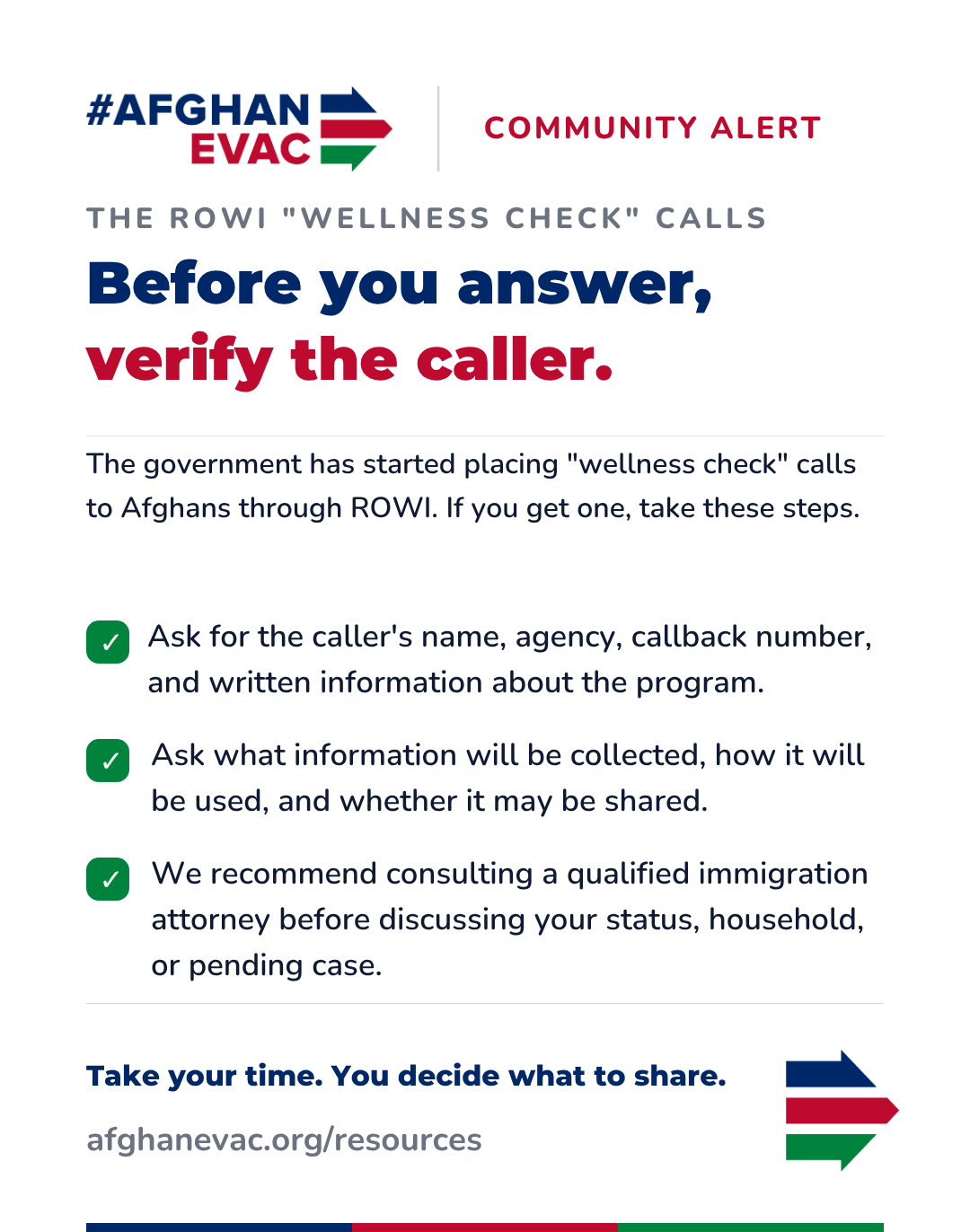
A WARNING FOR FAMILIES: QUESTIONS ABOUT THE ROWI “WELLNESS-CHECK” CALLS
The Office of Refugee Resettlement is conducting outreach through what it calls the Refugee Outreach Wellness Initiative, or ROWI. Reporting indicates that these calls may seek personal information about respondents, their households, immigration status, employment, and other circumstances. We are concerned about that.
The government describes the initiative as an effort to identify needs and connect people with support. Afghan families and advocates have raised legitimate questions about how the information will be stored, used, and shared.
Before providing sensitive information, verify the caller’s identity, ask for written information about the program, and consider speaking with a qualified immigration attorney or accredited representative. Do not rely solely on caller ID, and do not assume that participation is required without first getting clear information.
Why it matters: A call framed as a wellness check is still a request for information, made by a government that has spent this year trying to track, detain, and remove the very people it once promised to protect. Knowing you can decline is protection. Say little, confirm who is calling, and get counsel before you share anything.
ANOTHER WARNING: THE USCIS NOTICES THAT QUIETLY CLOSE AFGHAN ASYLUM CASES
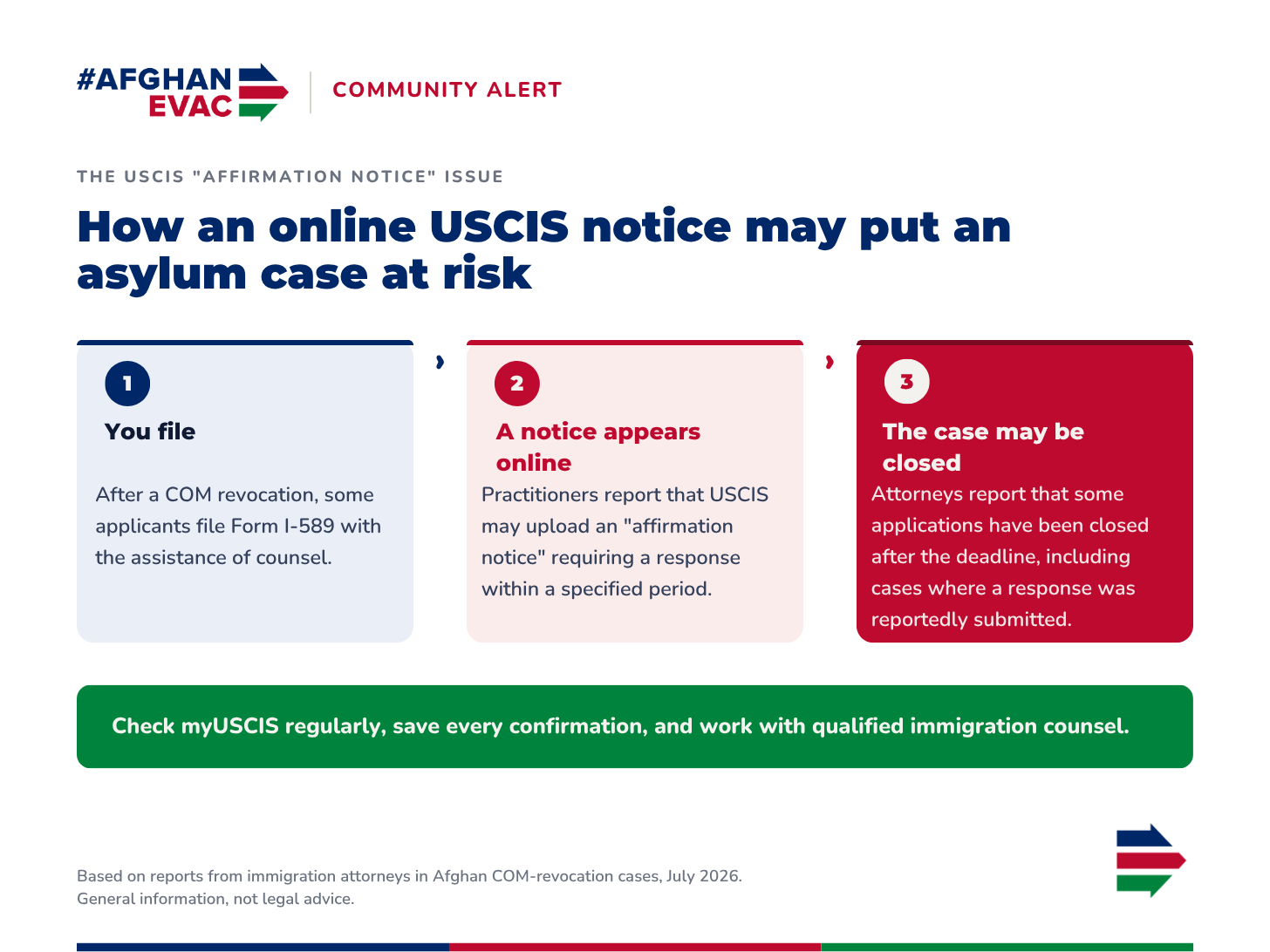
Multiple immigration attorneys have reported a concerning problem affecting some Afghans who filed for asylum after their Chief of Mission approval was revoked.
According to those practitioners, USCIS has uploaded an “affirmation notice” to some applicants’ online accounts requiring a signed response within a specified period. The notice may appear without a prominent alert that action is required. Attorneys have also reported cases being closed after the deadline passed, including some cases in which a response had reportedly been submitted.
AfghanEvac has not confirmed that this reflects a nationwide USCIS policy, but we’ve heard about these from multitple sources and the reports are serious enough to warrant immediate caution.
Check your myUSCIS account regularly, including the documents tab. If you see an affirmation notice, closure notice, or unfamiliar document, contact your immigration attorney immediately. Save copies of every notice, submission, and confirmation.
Why it matters: Missing an online notice may put an asylum application at risk. Do not navigate this process without qualified legal help.
This is general information, not individualized legal advice.
HOUSE JUDICIARY REVIVED THE WORST ANTI-ASYLUM BILL IN A DECADE
On July 21, the House Judiciary Committee marked up and advanced H.R. 9773, the “Permanent Trump Secure Border Act,” a revived version of the old HR2.
The bill would make sweeping changes to asylum screening, detention, humanitarian parole, and procedures involving unaccompanied children. It would raise barriers for many asylum seekers and significantly restrict the government’s ability to establish broad humanitarian parole programs.
Supporters argue that the legislation would deter unlawful migration and prevent abuse of the asylum system. Opponents, including our partners at Church World Service and more than 100 organizations, warn that it would block legitimate protection claims, expand detention, and close emergency pathways for people facing persecution.
For future mission partners, the parole restrictions are especially consequential. Parole is imperfect and temporary, but it remains one of the few emergency tools available when ordinary pathways fail.
Why it matters: This bill has not become law, but it offers a blueprint for dramatically narrowing humanitarian protection across the immigration system.
PAKISTAN’S DEPORTATION MACHINE SPEEDS UP
Pakistan has intensified its deportation drive against Afghans, with more than 4,000 people pushed back across the border in a single day and a new enforcement push underway. Afghans with pending U.S. cases are being swept up alongside the undocumented, and families who fled the Taliban are being returned to it. This is the same pattern we have flagged for months, now running faster.
This is the population caught in the vise. Afghan P-1 and P-2 applicants to the U.S. Refugee Admissions Program, cleared through much of the process and then stranded when the pipeline stopped, are now sending coordinated appeals to AfghanEvac and our partners, pleading for their cases to be restarted before Pakistan deports them. The contrast with our own government matters. Under the last administration, the State Department pressed Islamabad directly to protect pipeline Afghans. This one has been unwilling to engage the same way, even as Pakistan accelerates. Allies caught between a government deporting them and a government that will not issue their visas are running out of ground to stand on.
Why it matters: A stalled American pipeline is not neutral when people are being returned to Taliban control. The United States still has tools it can use, including direct diplomatic engagement with Pakistan, emergency case prioritization, and renewed processing for those already in the pipeline. Delay is a policy choice. So is action.
ON THE HILL
This week, we briefed Democratic and Republican offices in both chambers on the TPS bill, the Pakistan emergency, and the reported USCIS notices affecting Afghan asylum applicants. Those conversations are helping turn community reports into congressional questions, oversight, and legislation.
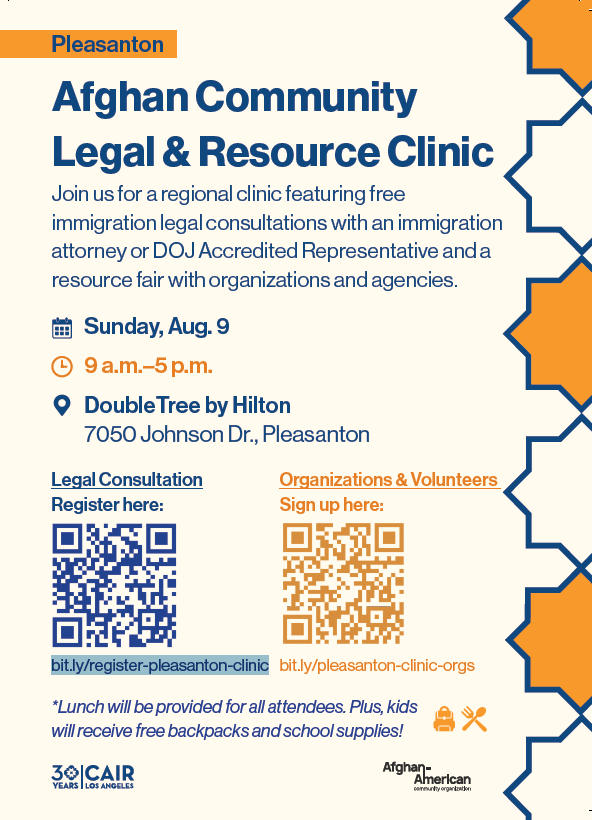
SAVE THE DATE: FREE LEGAL HELP IN THE BAY AREA ON AUGUST 9
On Sunday, August 9, the Bay Area Afghan Legal and Community Resource Clinic runs from 9:00 AM to 5:00 PM at the DoubleTree by Hilton Pleasanton at the Club, 7050 Johnson Drive, Pleasanton.
Hosted by CAIR-LA, the Afghan-American Community Organization, and state, local, and national partners, it offers Afghan families free one-on-one legal consultations with immigration attorneys, in language.
I will be there from 12:00 to 2:00 PM for a town hall on where things stand and what comes next, and to hear directly from the community. If you are in the Bay Area, come by, and tell a family who needs it.
IN THE NEWS
Stories from the past week.
The wellness-check calls
Federal agency seeks to interview Afghan immigrants, alarming refugee groups -- The Washington Post
‘Nefarious’ Trump plan to interview Afghan immigrants sparks deportation fears -- The Independent
U.S. government plan to interview Afghan refugees raises deportation concerns -- Ariana News
The Afghanistan TPS Act
Democrats and Republicans Want To Extend TPS for Afghans -- Newsweek
Bipartisan House effort would let Afghans stay in the U.S. -- WORLD
The pathways tool
New AI tool helps Afghan allies at risk find visa pathways -- Military Times
New AI tool helps Afghan allies at risk find visa pathways -- Navy Times
New AI tool helps Afghan allies at risk find visa pathways -- Air Force Times
New AI tool helps Afghans identify visa pathways -- Ariana News
Congress and the border bill
Markup of H.R. 9773, Permanent Trump Secure Border Act -- House Judiciary Committee
House Republicans move to make Trump’s border policies permanent -- Fox News
The enforcement machine
A Perfect ICE Storm: New Recruits, Less Training, and Deadly Shootings -- The Dispatch
ICE Orders an End to Vehicle Stops After Deadly Shootings by Federal Agents -- The Intercept
Pakistan and the region
Afghans Under Pressure Again In New Pakistani Deportation Drive -- Radio Free Europe/Radio Liberty
Over 4,000 Afghans Return from Pakistan in One Day as Deportations Intensify -- KabulNow
Five years after Kabul fell, the lines of this fight are becoming clearer. On one side of the Capitol, four members of Congress from both parties said plainly that America should not deport the people who stood with us. On the other, a committee advanced legislation that would close critical protection pathways.
That is the struggle in a single week. But the introduction of the Afghanistan TPS Act is proof that pressure works, bipartisan action remains possible, and this promise still has defenders. The promise remains unpaid. We intend to collect.