

Last week was about turning frustration into action.
We launched V-PRIC so families can navigate a system Washington has made harder to understand.
We launched a Work Authorization Explainer so employers stop turning away people already authorized to work.
We continued pushing for answers in Mohammad Nazeer Paktiawal’s death.
And while the Supreme Court reaffirmed birthright citizenship, more than 250,000 Afghan allies remain waiting for America to keep another constitutional promise: keeping its word.
Start with what you can do this week, then read on.
ACTION THIS WEEK
Write your representative about Camp As Sayliyah, now. Roughly 1,100 Afghan allies remain stranded at CAS in Qatar, and Qatar’s relocation deadline is September 2026. Tell your member of Congress that standalone legislation protecting CAS residents and restoring TPS for Afghanistan cannot wait for the NDAA timeline. afghanevac.org/cas-action.
Read and share the Texas Monthly investigation into Nazeer Paktiawal’s death. New reporting on how he died in ICE custody and the questions his family is still waiting to have answered. Read it here.
Press are invited to a briefing Monday where we will break more news about the case.
Share V-PRIC on social media. Our new Visa Pathways and Relocation Information Center offers tailored answers by case type in more than 40 languages, free and with no registration required. Post it and tag @afghanevac. Find it at pathways.afghanevac.org.
If you work at a resettlement agency, in a legal services practice, or at a community organization serving Afghan allies, circulate our Work Authorization Explainer to your employer lists. Too many employers do not know that refugees and people granted asylum are already authorized to work. afghanevac.org/work.
Read my Independence Day letter to the AfghanEvac family. Written for this coalition and our partners on the eve of America’s 250th.
Comment on the EAD rule before August 4. File at afghanevac.org/ead-rule-change.
THE UPDATES
V-PRIC launches, a map for a system built to be a maze
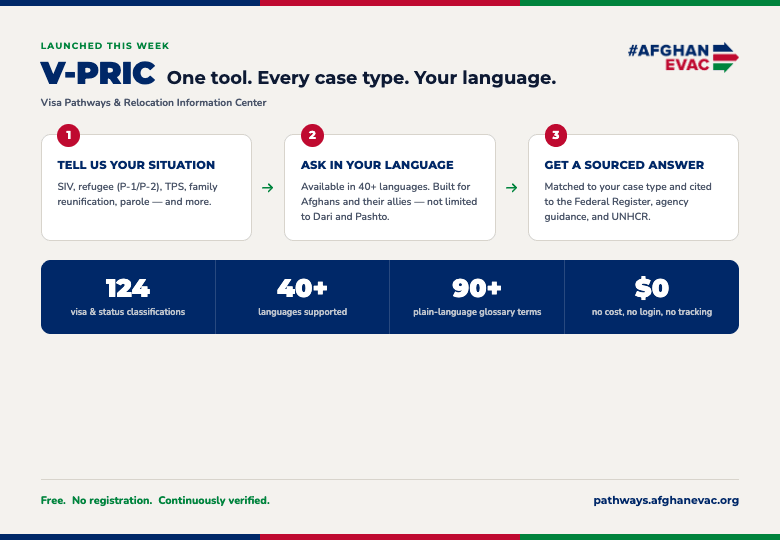
This week AfghanEvac launched V-PRIC, the Visa Pathways and Relocation Information Center, a free, continuously verified map of every U.S. and global pathway still available to Afghans and their allies. It covers 124 U.S. visa and status classifications across 197 countries of resettlement and asylum, with more than 90 plain language glossary terms and 37 official U.S. and court forms, in more than 40 languages. It is live now at pathways.afghanevac.org. Every line is sourced to the Federal Register, published agency guidance, and UNHCR, and verified on a recurring schedule.
It works the way people actually need it to work. Tell it your situation, SIV, refugee, TPS, family reunification, parole, and more. Ask in your language. Get an answer matched to your case type, cited to the source. This was built for Afghans and their allies first, but it is useful to anyone navigating a U.S. or global immigration pathway, because the confusion this year has not stopped at one nationality.
We sent V-PRIC directly to the State Department officials whose decisions helped create the system it documents. SIV processing has stalled. Refugee admissions remain at historic lows. Entire nationalities are barred by travel restrictions. V-PRIC cannot change those policies, but it does make them transparent, documenting every remaining pathway and directing people toward qualified legal assistance instead of misinformation.
If officials are ready to work with us to improve these pathways, our door remains open. Until then, we will continue documenting every policy change, every closure, and every opportunity that still exists.
Why this matters. A government that cannot explain its own rules to the people trying to follow them has stopped administering a system and started running a maze on purpose. We built the map ourselves, and now the confusion is documented, dated, and impossible for State to claim ignorance of.
Employers do not know refugees and asylees can already work, and it is costing our allies jobs
Federal law is clear: refugees and people granted asylum are authorized to work immediately. Yet processing delays and confusion over employment documents have caused too many employers to reject applicants who are legally eligible to work.
This week we launched an explainer along with an open letter to employers explaining exactly what documents satisfy federal employment verification requirements. It is a practical solution to a problem affecting thousands of Afghan families today and we don’t need Washington to act to realize relief.
If you are a resettlement agency employee, work with refugees in your legal services practice, or work at a community organization serving this population, please circulate our explainer to your employer lists.
Why this matters. The federal government created the processing backlog. It did not create the employer confusion, and it certainly is not helping clear it up. That gap is one we can close ourselves, with a letter and a fact sheet, and we are not waiting on anyone’s permission to do it.
The Supreme Court affirmed birthright citizenship, and the timing matters
On June 30, the Supreme Court ruled 6-3 in Trump v. Barbara that children born in the United States are citizens at birth under the Fourteenth Amendment, striking down the administration’s executive order that sought to end birthright citizenship for children of parents unlawfully or temporarily present. Chief Justice Roberts wrote for the majority. Four justices would have gone the other way.
As we said in our statement the day of the ruling, this should not have been a close question. For more than 150 years, the Citizenship Clause has guaranteed birthright citizenship to nearly every child born on American soil. For thousands of Afghan families rebuilding their lives in America, whether their parents are SIV holders or applicants, refugees, asylees, humanitarian parolees, or Temporary Protected Status holders, this ruling means their children born here remain protected by the Constitution regardless of what happens to the parents’ case.
That certainty matters, and so does the warning underneath it. A settled constitutional principle reached the Supreme Court at all, and four justices were prepared to narrow it. As our nation marks 250 years, this decision is a reminder of what those protections make possible, and a reminder that they hold only because people keep defending them.
Why this matters. While this ruling protects children born here, more than 250,000 Afghan allies remain stranded overseas because the legal pathways that would bring them home have been slowed, suspended, or closed. America’s promise to its allies has always been about more than legal status. It is about keeping our word, and our work continues until that word is honored.
A letter to the AfghanEvac family, on the eve of America’s 250th
On July 3, I wrote directly to this coalition, not as a press statement or testimony, but as one member of it to every other. The letter names what has actually happened this year. Enduring Welcome shut down. TPS for Afghans terminated. The CARE office gone. SIV and refugee processing frozen. Roughly 260,000 Afghans stuck in a pipeline our own government stopped moving. It does not soften any of that.
It also names what has not stopped. Over 250 organizations have stood inside this coalition, veterans groups beside resettlement agencies, evangelical churches beside mosques beside synagogues, Afghan Americans beside lifelong Iowans who had never met an Afghan before 2021. The letter closes with a direct word to Afghan allies reading it. They are not a case number and not a backlog. They are the reason this coalition exists. Read the full letter here.
Why this matters. This week’s fights, the tool we built, the letter we sent to employers, the news we are breaking Monday, all of it runs on the same fuel as this coalition. A promise made in wartime does not expire because the news cycle moved on. On the weekend America turns 250, that is the version of this country worth defending, and the one we are asking the rest of it to catch up to.


Texas Monthly investigates the death of Mohammad Nazeer Paktiawal, and Monday we break more
Mohammad Nazeer Paktiawal served alongside U.S. Army Special Forces in Paktika province starting in 2005. He was a father of six in Richardson, Texas. On March 13, ICE agents took him outside his home as he left to drop his children at school. By 9:10 the next morning, he was dead at Parkland Hospital. The Dallas County medical examiner has still not released his complete autopsy, weeks after the office’s own 90-day window expired.
Texas Monthly published a new investigation this week, detailing his case and the questions his family is still waiting to have answered. ICE’s own detainee death report tried to recast him after the fact, citing a SNAP fraud accusation and a theft suspicion from the months before his death. Neither produced a conviction. What the report does not mention is that a Trump administration policy revoked Nazeer’s commercial driver’s license months earlier, taking away the job that supported his six children. His brother, Naseer Paktiawal, is now helping Nazeer’s widow raise all six of those children, in addition to his own. The oldest is 16 and the youngest is still a toddler.
Secretary Mullin told Rep. Julie Johnson at a hearing that DHS would produce a full investigation. It has not. Instead, DHS is trying to thwart the release of Nazeer’s autopsy. Senator Blumenthal, ranking member of the Senate Homeland Security Permanent Subcommittee on Investigations, has said he is prepared to work with Chairman Ron Johnson to subpoena the records if Dallas County and DHS keep sitting on them. Press are invited to a briefing today at 2pm eastern, where we will share new documentation in this case.
Why this matters. A man who survived our war deserved to live. His family deserves the complete autopsy, not a smear campaign built on charges that never held up in court. This is not a partisan question. It is an accountability question, and on Monday we intend to move it forward with facts, not more waiting. It is precisely because of families like this, and stories like Nazeer's, that we can show how individual policies impact individual lives.
195 Afghans signed up for Sacramento, one day before America turned 250
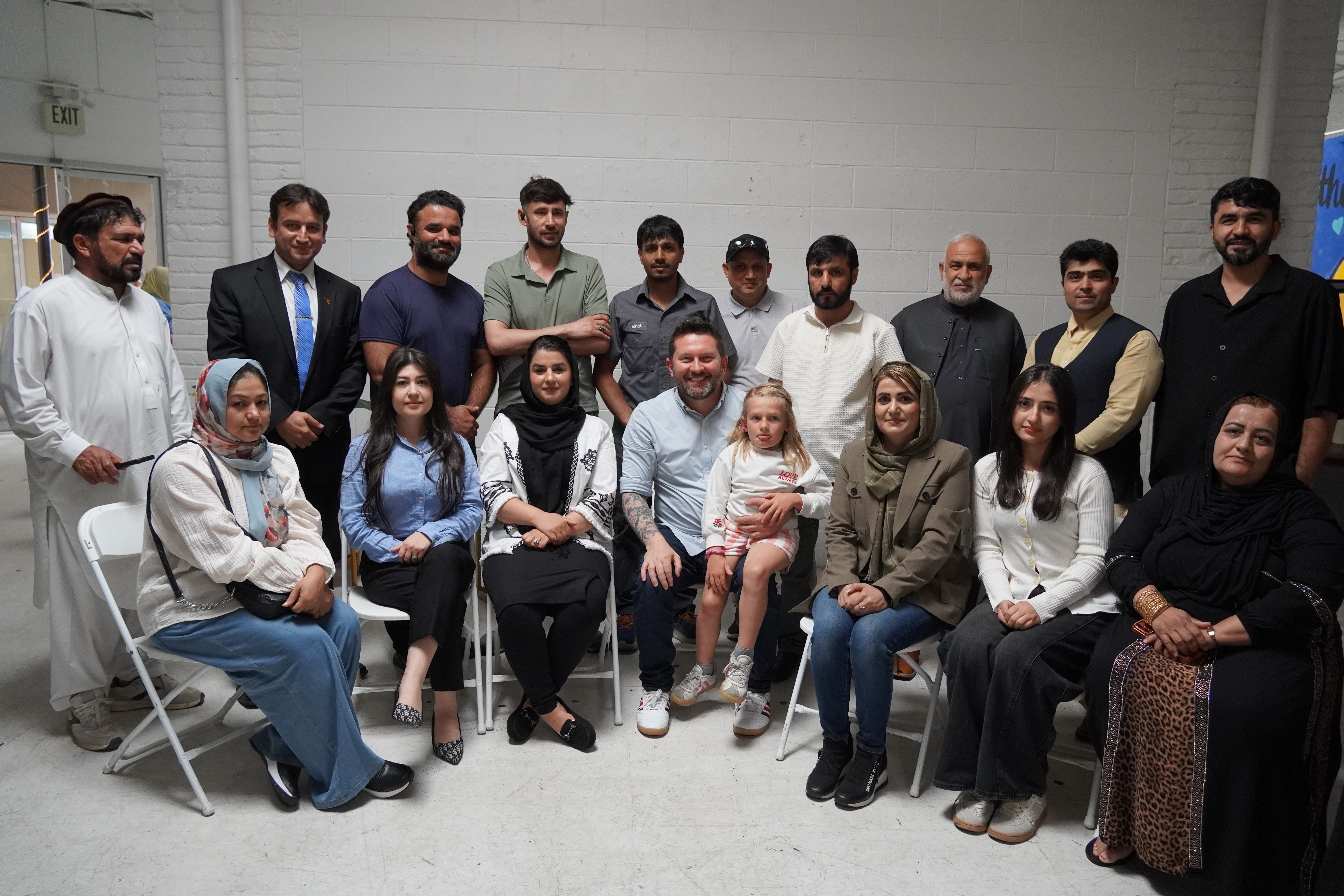
One day before America’s 250th birthday, Afghan families, veterans, attorneys, faith leaders, congressional staff, and community organizations gathered in Sacramento to ask a simple question: what comes next?
More than 195 Sacramento-based Afghans registered, making it one of AfghanEvac’s largest community town halls of the year.
Of the those who signed up, 41 identified as Afghan family members and 37 as Afghan wartime allies or mission partners themselves. People signed up in English, Dari, and Pashto in roughly equal measure.
The questions people brought sorted into a clear set of themes.
The status of pending cases. The largest groups represented were SIV cases, 37 combined between pending and Chief of Mission approved, USRAP P-1/P-2 referrals at 23, and family reunification cases under I-730 or I-130 at 19 combined.
Whether and when USRAP P-1/P-2 processing will resume. Multiple families whose flights were scheduled and then cancelled by the January 2025 executive order are still waiting, in some cases years later, for the program to reopen.
The uncertainty facing people still at Camp As Sayliyah. Several questions came directly from people asking, in their own words, why no one is hearing their voices from Qatar.
Work authorization and EAD renewal delays, the same confusion our new employer letter is meant to resolve.
Whether applying for asylum puts an existing green card or SIV status at risk, and how to protect status while a case is pending.
Family members stuck in Afghanistan or Pakistan, including cases where a scheduled flight was cancelled and the family has waited years since.
What legislative paths remain. Several Afghan community leaders asked directly what reforms AfghanEvac is watching now that the Afghan Adjustment Act has stalled.
None of this happens without the people who worked with us to set this up. Khatima Jafar at NorCal Resist ran point on logistics and security for both sessions. Sweeta Azimi, who works with the California Immigration Project and with AfghanEvac, helped pull the case questions and community outreach together. CAIR brought its network, its trust in the room, and the room itself. Aaron Jones carried the congressional coordination almost single handedly, and we are grateful for it. None of that counts the volunteers who set up chairs, translated, and stayed late.
For everyone who left with a question we could not answer on the spot, we have a two-page explainer available in English, Dari, and Pashto covering exactly what came up most, where every pathway stands today, how to protect against scams, and where to get legal help, a Battle Buddy, or a way to lead in your own community.
Why this matters. This weekend the country marks 250 years. The best version of that story is not a headline. It is 195 Afghan allies and their families who signed up, alongside the veterans, attorneys, congressional staff, and community organizers who stood with them on a Friday afternoon in Sacramento, one day before our country’s birthday, because a promise made in wartime is still a promise. That is the America worth defending, and it is the one we intend to keep building toward, one town hall at a time.
Members are legislating around CAS and the SIV program, and the door for more is still open
Rep. Jason Crow filed Amendment #1144 to the FY2027 NDAA, extending the Afghan SIV program by two years. We are grateful to him for putting this in front of the Armed Services Committee. The House Rules Committee did not select it for a floor vote when it adopted a structured rule for H.R. 8800 on June 30.
On the Senate side, Senator Shaheen’s Section 1088 would bar the Pentagon from using funds authorized by this bill to transfer Camp As Sayliyah residents to Afghanistan or a dangerous third country, and Senator Rounds’s Section 1080 would build a records preservation portal for Afghan allies whose service documentation was lost in the 2021 withdrawal. We are grateful to both senators for putting real legislative language behind this fight, and we want to be straightforward about what each provision does. Section 1088 would not currently protect anyone, because CAS operations are not funded through the DoD stream it restricts, and a congressional notification requirement is not the same as a barrier. Section 1080 remains the strongest Afghan-specific provision in either bill.
The House still has one motion to recommit available before final passage, and the House and Senate will need to reconcile their two different bills in conference regardless. Provisions that exist in only one chamber’s version are not guaranteed to survive that process, but they are not dead either, and conference is where the strongest version of any of these provisions could still end up in the bill that reaches the President’s desk.
Full analysis of what is in each bill is at afghanevac.org/2027-ndaa.
Why this matters. We are grateful to every member of Congress putting real legislative language behind this fight, across committees and across party lines. That work matters, and on its own it is not enough. As of now, Camp As Sayliyah closes in September. The NDAA will not be law until December. A program extension and a funding restriction that does not touch the money keeping CAS running would not close that gap even if both survive conference.
We need bipartisan, standalone legislation that restores TPS for Afghanistan and actually protects the people at CAS, introduced now, not on the NDAA’s timeline.
A national surge in ICE arrests, this time with fewer eyes watching
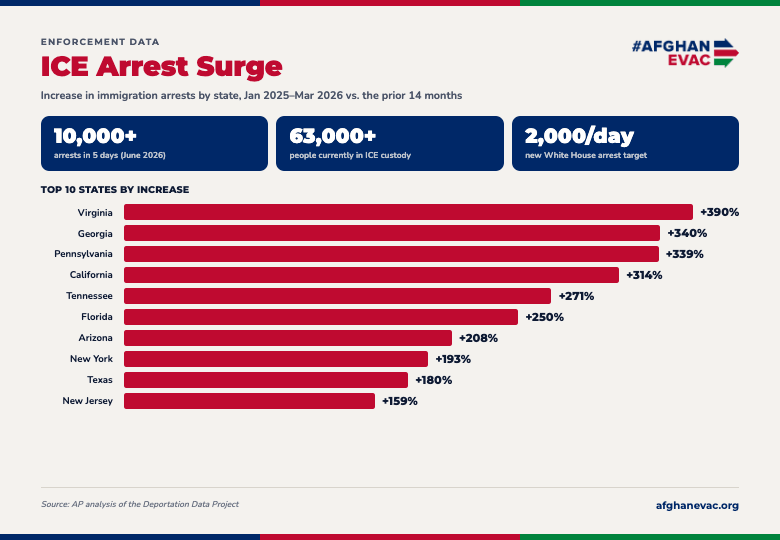
Federal immigration officials arrested more than 10,000 people in a five day stretch after the White House pushed enforcement toward a target of 2,000 arrests a day, roughly double the earlier pace this year. Unlike previous surges in Minnesota, Chicago, and Los Angeles, this one has come with no location, no announcement, and no publicity campaign from DHS. More than 63,000 people are now in ICE custody. A separate Deportation Data Project analysis of the first fourteen months of this term shows Virginia up 390 percent and Texas at 99,255 arrests, up 180 percent, with double and triple digit increases across nearly every state tracked.
Every increase in immigration enforcement increases the likelihood that Afghan allies with pending cases, mixed-status families, or unresolved paperwork will be caught in the same system.
Why this matters. Afghan allies live inside this dragnet the same as everyone else, and the courthouse arrest ruling we celebrated two weeks ago covers one narrow slice of how ICE operates, not the whole machine. A surge with no ceiling and no announcement is a choice about how much of the country the administration is willing to put in a cell, and it can be unmade the same way it was made.
Pakistan strikes inside Afghanistan, and a deportation directive still looms
Pakistan carried out airstrikes inside Afghanistan on June 29 in response to militant attacks the day before. Afghan officials report at least 36 civilians killed and more than 160 wounded. Pakistan says the strikes hit fighters, not civilians. The unverified June 28 directive we flagged last week, reportedly ordering the arrest of any Afghan in Pakistan without a valid visa starting July 10, has still not been confirmed or withdrawn by any government source, though members of our own community are already treating it as real and organizing around it.
Why this matters. Afghans in Pakistan are caught between a military escalation and a possible mass arrest order, in a country the United States has largely stopped pressing on their behalf. Under Secretary Blinken, State engaged Islamabad directly on the treatment of pipeline Afghans. Under Secretary Rubio, it has not. That is a choice, not a fact of geography, and the people paying for it are allies with nowhere else to wait.
Dorcas back in court July 8, and a fourth circuit pushes back on ICE detention
On June 5, a federal judge struck down four USCIS policies that had frozen or delayed immigration benefits for Afghans and nationals of dozens of other countries. The government asked for an emergency stay. The hearing is set for Wednesday, July 8. Separately, a fourth federal appeals court has now rejected an ICE mass detention policy, adding to a growing stack of rulings against the administration’s detention practices.
We are hearing directly from advocates, attorneys, and impacted people themselves that this ruling is already moving cases. Asylum grants, green card approvals, and EAD issuances tied to the four vacated policies are coming through for people whose cases had been frozen with no movement at all. We do not have a scale yet, and it is slow, but it is real, and it is happening in cases that had none of this before June 5.
Why this matters. This is the same administration now trying to accomplish through the EAD rule what these four policies did through memo. Watch what happens on the 8th, and keep your comment on the EAD rule moving regardless of the outcome. We are continuing to watch this case because of its far-reaching implications on many policies affecting our Afghan allies.
Battle Buddies, still undefeated
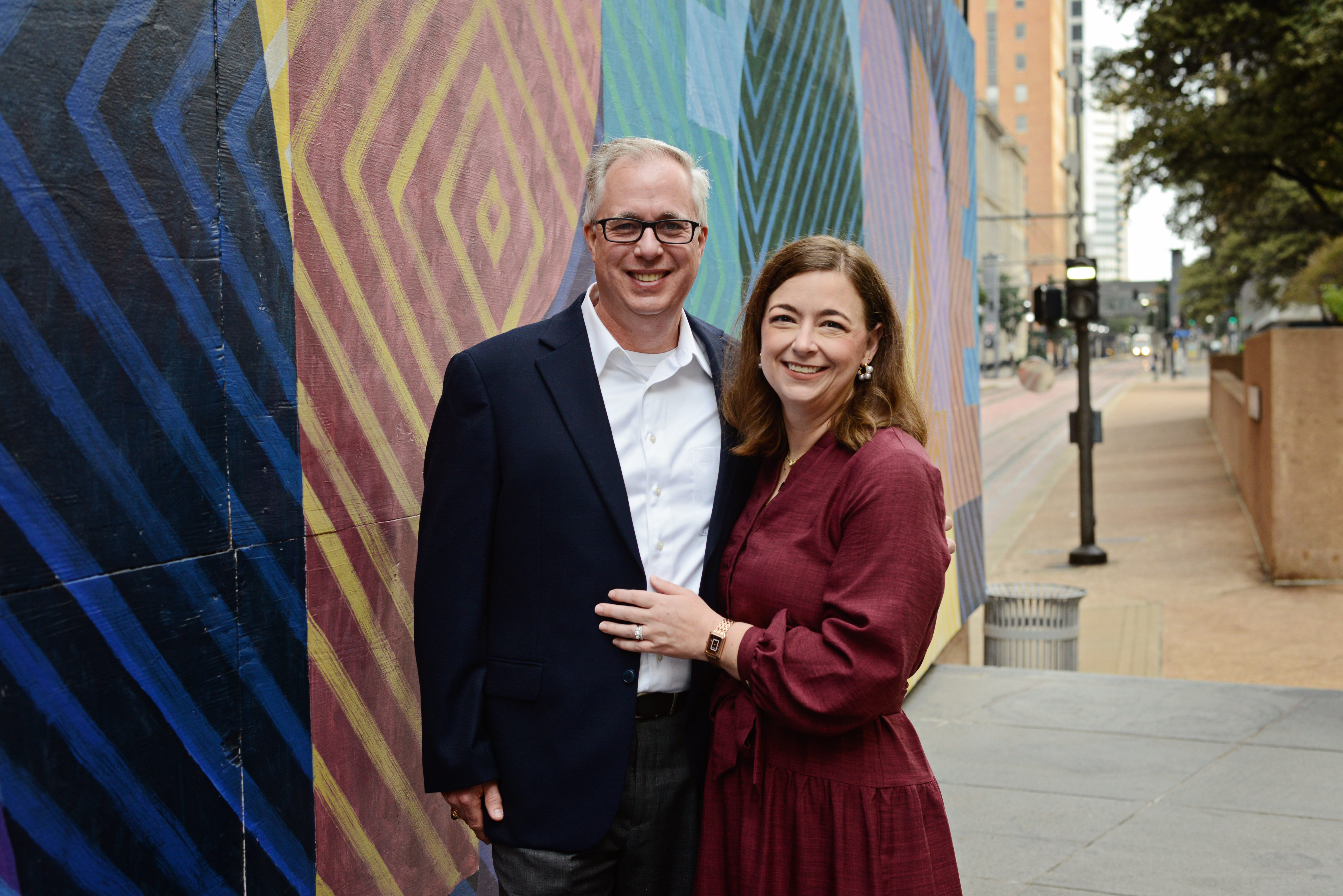
Battle Buddies continued to show up for our Afghan allies in Dallas this week. Maryn Taylor, a Pat Tillman Scholar who first heard about the program from other Tillman Scholars volunteering elsewhere, and her husband Steve, a Navy veteran who served in Afghanistan, answered the call for an Afghan family at their asylum master hearing. “Never having been an immigration hearing, I wasn’t sure what to expect,” Maryn said afterward. “I am proud of the way every person at the Dallas federal courthouse treated the family we accompanied with kindness and respect.”
Steve’s presence, and his service in the same country their family fled, gave the family reassurance through the hearing. Everyday Americans like the Taylors keep showing up for the people who stood with us. Our track record of 100 percent non-detentions when Battle Buddies are present remains unbroken.
Why this matters. A hearing is not just paperwork. For a family navigating a system built to be confusing, a familiar face in the room is the difference between fear and dignity. If you want to do what the Taylors did, sign up today.
IF YOU GET A WEIRD CALL
The Office of Refugee Resettlement has started making outreach calls to Afghans without durable status. Know your rights before you pick up.
You do not have to answer questions about where you live, your status, or your case or family.
You can say no to participating. It will not affect your existing ORR benefits.
If you have a legal case pending with DHS, talk to a trusted attorney or advocate before responding to anyone.
Coming This Week
Press briefing on Mohammad Nazeer Paktiawal
July 8 Dorcas hearing
Continued advocacy for Camp As Sayliyah
EAD rule comment campaign
Additional V-PRIC improvements
In the Press
An Afghan Man Who Aided the U.S. Died in ICE Custody. His Family Is Waiting for Answers. -- Texas Monthly
New ICE document sheds light on March death of Afghan asylum seeker -- Houston Public Media
Supreme Court upholds birthright citizenship on constitutional grounds -- NPR
Takeaways from the Supreme Court’s rebuke of Trump on birthright citizenship -- CNN
A fourth appeals court rejects ICE mass detention policy -- Politico
Deportation Data Project analysis -- Associated Press
A man died and his family is still waiting for the truth. Employers continue turning away people who already have the legal right to work. Congress is beginning to act, but Camp As Sayliyah still lacks the protections its residents need. Across the country, Afghan families continue showing up, organizing, and refusing to give up.
We are focused.
We are growing.
And we are not going anywhere.
We hope the SIV visa process will resume and move forward quickly, and that the travel ban will be lifted. Afghan allies have been waiting for a long time, and we urge the U.S. government to honor its commitments.
Thank you.