

We are publishing this update one day after the three-month mark of a great American tragedy.
Three months have passed since Mohammad Nazeer Paktiawal died in ICE custody in Dallas, Texas. The Paktiawal family will be joining us on Tuesday for a press conference to share their experience and continue to demand accountability.
That is where last week ends and where this update begins.
In between, 83 members of Congress sent a letter demanding answers on Camp As Sayliyah, the government appealed the Dorcas ruling, the EU’s migration and asylum pact went into effect, and AfghanEvac traveled to Brazil to meet the Afghan community there.
Here is your rundown.
Action Items
Comment on the proposed EAD rule changes. The administration is moving to strip work authorization from Afghan parolees. It takes five minutes. It matters.
Share The New York Times piece on the Tahiri family. It puts a face on the travel ban for an audience that needs to see it.
Share this week’s update. Tag @AfghanEvac and use #StillWithUs and #AfghanEvac.
Take our survey. Help us improve these weekly updates!
The Updates
Three Months
Sunday, June 15 marks three months since Mohammad Nazeer Paktiawal, a former Afghan Special Forces soldier who served alongside U.S. Army Special Forces for more than a decade, died at Parkland Hospital in Dallas less than 24 hours after being taken into ICE custody. His wife is raising six children alone. His family still has no answers. No one has been held accountable.
On Tuesday, June 16, AfghanEvac will hold a press conference with the Paktiawal family. Press should contact press@afghanevac.org to register.
We have more to say. We will say it Tuesday.
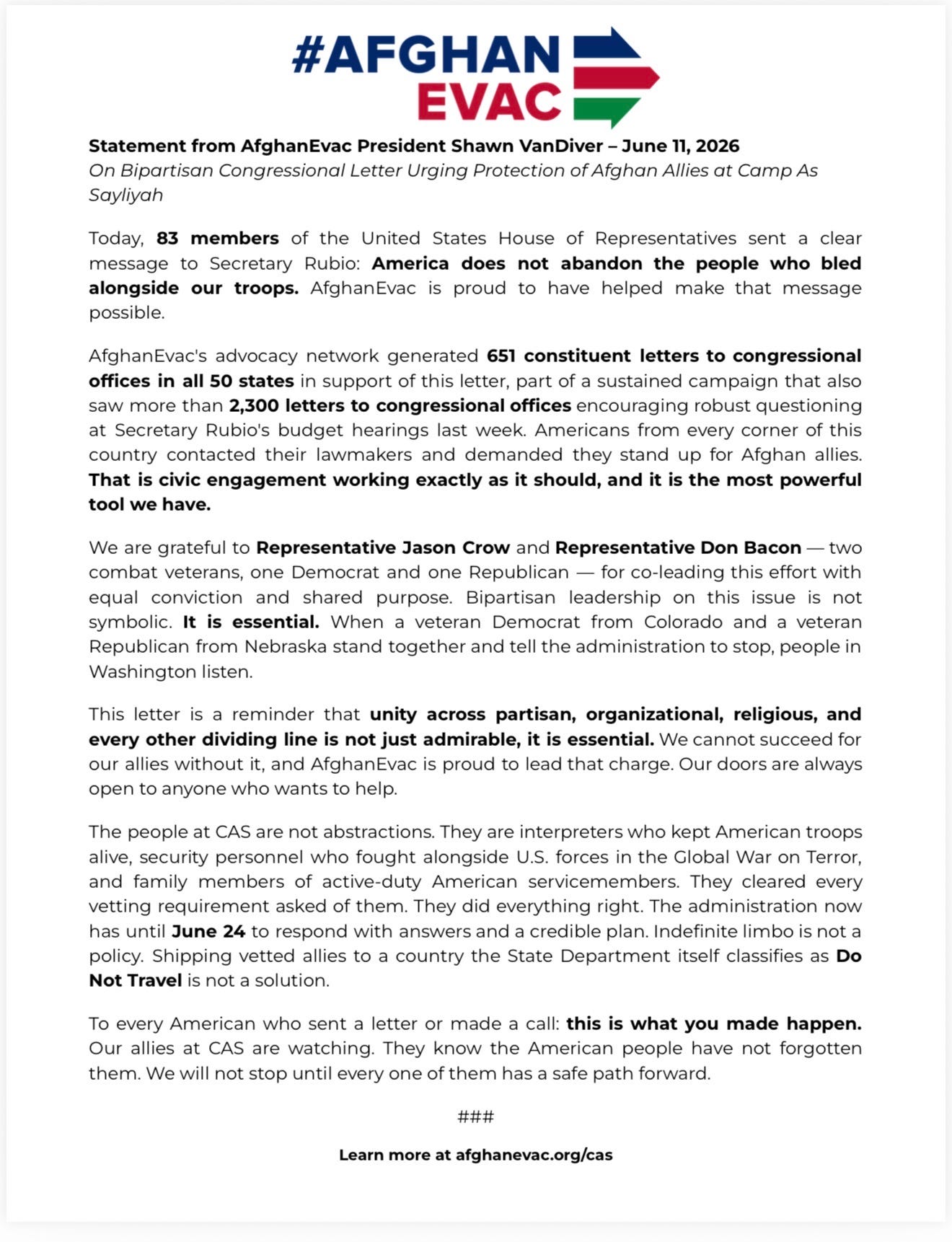
83 Members of Congress. 651 Letters. 50 States.
On June 11, 83 members of the House sent a letter to Secretary of State Marco Rubio demanding answers on the roughly 1,100 Afghan allies stranded at Camp As Sayliyah. The letter was co-led by Representative Jason Crow and Representative Don Bacon, two combat veterans, one Democrat and one Republican. It was authored with the support of No One Left Behind, and we are glad to lift up that work. The administration has until June 24 to respond.


This did not happen on its own. AfghanEvac’s network generated 651 constituent letters to congressional offices in all 50 states in direct support of this effort, on top of the 2,300 letters our network put in front of Secretary Rubio’s budget hearing offices last week. Americans in every corner of this country contacted their elected officials and demanded they stand up for Afghan allies. That is civic engagement working exactly as it should, and this week, it worked.
Letters Are Important. Letters Are Not Enough.
This letter is worth celebrating. And then we have to say this plainly. Congress has sent dozens of letters on behalf of Afghan allies. Bipartisan letters. Letters with specific demands and signatories. The letters have been excellent. What has not followed is legislation that materially changes anything. What has not followed is policy that opens a pathway, restores a program, or ends the limbo.
The bare minimum right now is not another letter.
It is action.
AfghanEvac is now working directly with congressional offices to introduce legislation that would provide real protections for Afghan allies, both inside the United States and abroad. We will have more to share on that work as it develops. In the meantime, every organization that cares about this issue should hold the line on the same standard. No ground on anything less than meaningful legislative or policy action that changes the lives of the people waiting.
A letter is a promise to do more. We are watching to see if that promise gets kept.
Camp As Sayliyah — The Five Countries
The Crow-Bacon letter asks six specific questions and demands a briefing by June 24. Among them: the status of third-country negotiations, the legal authority the administration would assert to compel relocation, and how many children are at CAS. That last one deserves a number. The answer is more than 460.
At last week’s hearings, Rubio was asked directly whether the administration still intended to send the Afghans to the Democratic Republic of Congo, a country his own department classifies as Do Not Travel amid an active Ebola outbreak. He said the U.S. was in discussions with “multiple countries.” He did not name them.
AfghanEvac has learned those countries include Malaysia, Cambodia, Laos, Kosovo, and Morocco.
None has meaningful Afghan resettlement infrastructure.
None is the United States.
None is the destination these allies were promised.
The people at CAS are people who kept American troops alive. They are security personnel who fought alongside U.S. forces. Approximately 150 are immediate family members of active-duty American servicemembers. They cleared every vetting requirement asked of them. Shipping them to countries they have never been to, with no legal status and no support infrastructure, is not processing. It is abandonment with extra steps.
Afghans Among Those Deported to the Central African Republic
On June 12, a deportation flight landed in Bangui carrying at least two dozen people, including Afghans, Iranians, Armenians, and Iraqis. Among them was an Iranian Christian convert who fled religious persecution. The Central African Republic is plagued by armed conflict, the active presence of Russian Wagner Group mercenaries, and an elevated regional Ebola risk.
This is not incidental. It is the mechanism.
Under both U.S. and international law, the government cannot send a person back to a country where they face persecution, torture, or death. The principle is called non-refoulement. It is codified in the Refugee Convention, the Convention Against Torture, and U.S. statute. The third-country deportation strategy exists to evade it. The administration cannot legally deport an Afghan back to Taliban-controlled Afghanistan, so it sends them to the Central African Republic instead. The destination changes. The result is the same. The legal protection survives on paper. The person does not.
This is the same administration that, days earlier, was reported to be considering sending Afghan allies from Camp As Sayliyah to countries with no resettlement infrastructure. It is not enforcement. It is exile, by design, around the law.
AfghanEvac and HIAS in Brazil
From June 8 to 11, AfghanEvac President Shawn VanDiver and HIAS President and CEO Beth Oppenheim traveled to Brazil. The trip included a town hall that drew more than 100 attendees, including leaders from Afghan-led organizations across the country.


Brazil has become a significant destination for Afghan allies cut off from U.S. pathways. The community there includes SIV applicants, USRAP cases, and families navigating Brazil’s humanitarian visa framework with limited support. The questions reflected what AfghanEvac hears everywhere. What is happening to my case? How do I keep my family safe? Is anyone in Washington still paying attention?
We met with UNHCR Brazil, Panahgah, Rede Sem Fronteiras, Pathways International, and others. It was incredibly important to learn from Afghans in Brazil what welcome looks like. Brazil has been supportive of resettlement in the past, and we want to keep that momentum going, while also reminding the world that the needs, voices, and promises of the Afghan community matter.
Dorcas Update — A Real Win, And the Routine Pushback
We said they would fight it. They are, and the court has held its ground.
To recap: on June 5, Chief Judge John J. McConnell Jr. of the U.S. District Court for the District of Rhode Island vacated and set aside four unlawful policies that had been warehousing immigration benefit cases for Afghans and nationals of 38 other countries. The Global Asylum Hold, the Benefits Hold, the Comprehensive Re-Review policy, and the Country-Specific Factors Policy.
Here is what happened next.
On June 9, the government filed a motion asking Judge McConnell to enter judgment under Rule 54(b), so it could appeal, and at the same time asked the court to “clarify” the scope of the vacatur. That second piece was the government trying to narrow the order before it went up.
On June 11, Judge McConnell granted the Rule 54(b) motion and entered partial final judgment for the plaintiffs, but he rejected the government’s effort to muddy what June 5 already said. His order is worth reading in full. The plain-language portion includes this: court orders vacating and setting aside agency policies have immediate effect once they are issued. And then this: “To be perfectly clear, this means that the Challenged Policies are vacated, set aside, cancelled, annulled, revoked, and voided.” He closed the order with a sentence the government can read on its own: “There is no excuse this time; the Government has an obligation to immediately comply with this Order.”
On June 12, USCIS confirmed it is complying. The agency filed a status report and posted a public web alert, and the Deputy Director’s declaration states that internal guidance is being circulated and IT systems are being updated to remove the vacated policies. This is real-world compliance. It should help thousands of people retain durable status in the United States.
Now, about the appeal. The same day USCIS confirmed compliance, the government filed a Notice of Appeal to the First Circuit Court of Appeals, where the case is now docketed as No. 26-1703.
We have heard from a lot of you who saw the appeal headline and felt the ground shift again. We want to be direct with you. This is normal. When the government loses a major case at the district court level, it appeals. That is what governments do. It is what this government will do every single time it loses, and it does not change the fact that the June 5 ruling is in effect today. The policies are vacated. USCIS is complying. The order stands.
The appeal proceeds on its own track. The first round of appellate filings is due June 26. We are watching for two things in particular. The first is a motion to stay the order, which is the only thing that would actually put the unlawful policies back in place while litigation continues. We do not currently expect one to succeed if it is filed, but we will tell you the moment it happens. The second is the date for argument. AfghanEvac will keep you updated at every step.
A court win is never the end of the fight. It is the beginning of the next one. This is a real win. Hold onto it.
A Note on Chief of Mission (COM) Approval and Interviews
If you have received COM approval on your SIV case, that is a real milestone. The Afghan SIV unit is processing because a federal court ordered it to. That matters.
You also need to understand what is happening at the interview stage.
Every Afghan SIV applicant going to a visa interview right now is being denied. Not because of anything in their case. They are being denied because Presidential Proclamation 10998 suspends visa issuance to Afghan nationals, and consular officers are bound by that suspension. The interview is happening. The visa is not. That is the design.
We also believe these denials are being used to artificially lower the number of COM-approved Afghans awaiting interviews and visas. When the travel ban is eventually rescinded, the administration will likely point to that smaller number to justify under-resourcing the program. They are building the case, right now, for fewer staff, fewer slots, and a smaller pipeline tomorrow. We are raising it with Congress.
A denial today is not just a denial today. It becomes part of your permanent immigration record. When the travel ban is eventually rescinded, the government may point to that prior denial as a reason to deny you again.
That is why immigration attorneys and organizations like the International Refugee Assistance Project (IRAP) are advising Afghan SIV applicants to postpone interviews where possible. A delay you control is far better than a denial that follows you for the rest of your case. Do not walk into an interview right now without legal advice.
The EU Pact on Migration and Asylum Goes Into Effect
On June 12, the European Union’s Pact on Migration and Asylum went into effect across all 27 member states of the European Union, completing the bloc’s most significant overhaul of asylum policy in a generation.
The pact introduces mandatory border procedures, clarification on processing for asylum, and prioritization of certain countries for asylum status. Afghan nationals still have a high rate of successful asylum claims in the EU, but the issue really relates to getting to the EU, and the risk it poses for people who attempt it.
Traveling to the EU through pathways that are closing is extremely dangerous for everyone, and represents a desperate last resort for safety for many. As the United States closes pathways and ships allies to third countries with no infrastructure, Europe is closing the back doors that families have been forced to use because the front doors were locked. The doors are closing in both directions at once.
A Note on Those Stuck in Limbo in Pakistan
We see your messages. We read your emails. We need to be honest with you.
There is very little any organization can do right now to move individual cases in Pakistan. The pipeline is frozen by Executive Order 10163 (USRAP) and Presidential Proclamation 10998 (all). USRAP, SIV processing, humanitarian parole, all shut down or suspended. No amount of case-by-case advocacy changes that while the pipeline remains closed.
That is why our advocacy is focused where it can have the most impact, reopening the full pipeline. Letters to Congress. Comments on proposed rules. Constituent calls to senators. These are the things that build pressure to restart processing at scale. That is what would help the people in Pakistan, and that is what we are fighting for.
No One Left Behind has been providing direct financial support to Afghan SIV applicants in Pakistan. This support is specific to SIV cases. AfghanEvac is not a pathway into that support.
We recorded a video this week on the situation in Pakistan. Watch it. Share it.
EAD Rule — Comment Window Still Open
The comment window on the administration’s proposed rule to strip work authorization from Afghan parolees remains open. This is not a technical regulatory matter. It is a direct attack on the ability of Afghan allies in this country to support their families. If finalized, the rule would remove employment authorization from people who have no other pathway to work legally while they wait on cases that are not moving.
As of this morning, 299 comments have been submitted to the proposed rule from the AfghanEvac community, plus our own organizational comment. That is what a real campaign looks like. We need more. Every comment becomes part of the public record the administration is legally required to consider, and every one of them strengthens the case against the rule when it is challenged.
If your organization has not submitted, do it this week.
For Afghan Friends and Allies — A Note on Travel
We need to say something directly to the Afghan community, and we need you to hear it with respect, solidarity, and urgency.
Please stop traveling to Afghanistan.
We know many of you have made the trip and returned safely. We are not dismissing that. But two separate forces are using those trips against you, and the combination is dangerous.
The first is the United States government. DHS is actively citing return travel to Afghanistan as evidence that conditions have improved enough to justify stripping Temporary Protected Status, denying asylum claims, and deporting Afghan nationals. It does not matter that you went for a funeral. It does not matter that you went to see a parent you had not seen in years. The administration is taking the fact of the trip and using it as a policy argument. Every return becomes a data point in an effort to remove the legal protections standing between Afghan allies and deportation. Do not hand them more.
The second is the Taliban. Mohammad Ali Atayi, an Afghan-born Australian citizen, was shot and killed in Jaghori district in Ghazni province after returning to Afghanistan for the first time in years. He is the latest in a series of unexplained killings reported across the country. These are not random. They are a pattern targeting Afghans with connections abroad. This is why the State Department maintains a Level 4: Do Not Travel advisory for Afghanistan. Level 4 is the highest warning issued. It means do not go.
The cruel irony is that the administration is citing return travel as proof Afghanistan is safe enough to send people back, while its own State Department maintains that no one should go there at all. Both things cannot be true. We know which one is.
We are asking for patience we know is already stretched thin. Stay where you are. Let us elevate the policy fights that need fighting. The legal tools are moving. The courts are listening. The coalition is not going anywhere.
You stood with us. We are standing with you.
Chutkan Enforcement Order — Still in Effect
The enforcement order in Afghan and Iraqi Allies v. Rubio remains in effect. Judge Tanya Chutkan’s order requires the State Department to meet monthly SIV processing benchmarks. The department has a documented record of non-compliance. If you have a pending SIV case with unexplained delays, document everything and contact a legal aid organization. IRAP remains lead counsel.
In the Press
Democrats, Republicans ask Trump administration not to ship Afghan allies to unsafe countries — Reuters
‘Cannot escape’: Afghan girl held at US military base in limbo amid Trump immigration policies — ABC News
America’s Afghan allies in limbo in Qatar — NBC News
An Afghan Family Shattered by Trump’s Visa Ban — The New York Times
Taliban forces open fire on rare protest sparked by women’s arrests in Herat — BBC
Taliban forces in Afghanistan open fire on rare protest sparked by women’s arrests over dress code — CBS News
‘Grave concern’ after dozens of women arrested in Afghanistan for dress violations — UN News
Australian-Afghan man killed during visit to Ghazni, sources say — Amu TV
“No One Cares About Us Anymore”: How U.S. Aid Cuts Have Intensified the Crisis for Women and Girls in Afghanistan — Refugees International
Migrants Deported From US, Including an Iranian Woman, Arrive in Central African Republic — AP via U.S. News
US-Central African Republic Deportation Agreement Escalates Attack on Immigrants and Puts Lives at Risk — Just Security
Three months. Six children without a father. More than 1,100 allies in Qatar with nowhere to go. Families in Pakistan watching a frozen pipeline. Families in Brazil and across the world searching for safety as legal pathways narrow. Allies already in the United States waiting on cases that still do not move.
This week, 83 members of Congress signed their names to a bipartisan demand for answers. Americans in all 50 states helped make that happen. Courts continued to push back against unlawful policies. AfghanEvac was in Brazil listening directly to Afghan families navigating uncertainty far from home. And on Tuesday, we will stand beside the Paktiawal family as they continue their search for accountability.
The obstacles remain enormous. But the coalition is growing. The courts are acting. Congress is paying attention. Afghan allies continue to have advocates in every corner of this fight.
Letters matter. Oversight matters. Public statements matter. But none of them are the destination.
The people waiting have done everything America asked of them. They served alongside our troops. They passed the vetting. They followed the rules. They kept their promises.
Now America must keep ours.
The ask is simple: do something real.
Legislation. Policy. Protection. A pathway forward.