

This week handed us a rare thing, a court win with real teeth, and it landed in the middle of a stretch of news that shows exactly why it was needed.
A federal judge struck down ICE’s courthouse arrest policies across the entire country.
New data revealed how immigration judges are being handed more than a hundred cases in a single morning to push removal orders through faster than anyone can defend against them.
An Afghan ally died after less than a day in ICE custody, and the government ruled it an accident while refusing to release the autopsy.
A scam is circulating that targets the very volunteers who stepped up to help Afghans.
Women in Herat were arrested and then shot at for protesting.
And the EU sat down with the Taliban.
We have a mixture of positive momentum and several reminders of just how much Afghans are being shut out of real protection options around the world.
Start with the ways you can take action, then read on.
ACTION THIS WEEK
Comment on the EAD rule before August 4. The administration is trying to do by regulation what the courts already struck down by memo. Public comments carry weight, and detailed, specific comments carry the most. File yours at https://afghanevac.org/ead-action
Share the mega masters series. We have broken down what these mass hearing dockets are, how to prepare, and what to do if you miss a hearing. Read it and send it to anyone with a case at afghanevac.org/mega-masters, and amplify our three-part series across social.
Join us in Sacramento on July 3. A town hall at 2:00 PM and a women and girls listening session at 5:00 PM, with NorCal Resist. RSVP at afghanevac.org/sac-town-hall. The address comes after you RSVP.
A FEDERAL JUDGE SHUTS DOWN ICE COURTHOUSE ARRESTS, NATIONWIDE
On June 24, a federal judge in California struck down the policies that turned immigration courthouses into ICE trapping grounds. In a 71-page ruling, U.S. District Judge P. Casey Pitts vacated ICE’s 2025 courthouse arrest policies and the waiver that let agents detain people for up to twelve hours without the usual safeguards. The ruling applies nationwide, and the court certified a class, which means the protection reaches everyone the policy targeted, not just the people who sued.
For more than a decade, across administrations of both parties, ICE reserved courthouse arrests for genuine high-risk cases. The 2021 policy narrowed it further, to national security threats. Then in May 2025 the administration tore that down and authorized agents to grab anyone they believed might show up to court. Judge Pitts found the government offered no sound reasoning for the change, describing a complete lack of decision-making behind a dramatic expansion of arrests. That is the legal core of it. The administration made a sweeping choice and could not explain why.
Why it matters
Afghan allies are in immigration court right now. They are showing up for asylum hearings, status check-ins, and the appointments the system requires of them. A policy that punishes people for obeying the law is not enforcement, it is a trap, and it teaches the most vulnerable people in the system that the safest thing they can do is disappear. This ruling pulls that trap up by the roots.
It is also not the finish line. The government is appealing, and a ruling means nothing until it is obeyed. We have watched this administration treat court orders as opening offers. Similar cases are still moving in Baltimore, Chicago, Minnesota, and New York. We will be watching, because compliance is always the next question. This is a real win. It is not a resolution.
ALSO THIS WEEK, A NEW ICE NOMINEE
On June 27, the President nominated Lance Schroyer to lead ICE. Schroyer is a former Oklahoma state trooper and Marine with 29 years in state law enforcement, and he currently advises Homeland Security Secretary Markwayne Mullin, a fellow Oklahoman who pushed for the pick.
His calling card is the 287(g) program, the mechanism that deputizes state and local police to act as immigration agents. ICE has not had a Senate-confirmed director since 2017. If confirmed, he would run the agency at the center of everything below.
AN AFGHAN ALLY DIED IN ICE CUSTODY, AND THE GOVERNMENT CALLS IT AN ACCIDENT
Mohammad Nazeer Paktiawal served alongside U.S. Army Special Forces in Paktika province. He was a father of six living in Richardson, Texas. On March 13, ICE agents took him outside his home as he left to drop his children at school. Less than 24 hours later, he was dead.
The Dallas County medical examiner ruled it an accident. The autopsy still has not been released, and the 90-day window the office typically works within has come and gone.
There are significant developments underway in this case. We will have more to report soon.
Why it matters
Nazeer’s death is not an isolated tragedy. A new report from Physicians for Human Rights and Human Rights Watch, Dying in Detention, documents 52 deaths in ICE custody over the first 500 days of this administration, with the annual death rate up 140 percent over the prior year, even as oversight was dismantled. A man who survived our war deserved to live. His family deserves the autopsy. What are they hiding. Stay tuned.
TWO SUPREME COURT DECISIONS, BOTH BAD FOR AFGHANS
On June 25, the Supreme Court handed the administration two immigration wins, each by a 6-3 vote, each written by Justice Alito. Both reach Afghan allies, and not in the abstract.
In the first, Mullin v. Doe, the Court let the administration terminate Temporary Protected Status for Haiti and Syria, and went further. It held that courts cannot review whether the Secretary of Homeland Security followed the procedures Congress required before ending a country’s TPS. Read that again. Even an openly unlawful termination is now insulated from judicial review. Afghanistan’s TPS has already been terminated, and this ruling clears the path for the administration to lock in terminations elsewhere without a court ever asking whether it followed the law.
In the second, Mullin v. Al Otro Lado, the Court blessed the practice of turning away asylum seekers who have not physically set foot on U.S. soil, drawing a distinction between someone who “arrives in” the country and someone who “arrives at” the border. An officer can now block a person from stepping across the line and, by doing so, block the asylum claim before it can be made.
Why it matters
Afghan allies live inside both of these holdings. Some are in the United States on protections that can now be stripped with far less recourse than a week ago. Others are outside, waiting at borders and in third countries, in a system that already treats reaching American soil as the one thing standing between them and the law’s protection. Justice Sotomayor read her dissent from the bench, a step the justices reserve for the cases they find most alarming.
Step back and the pattern is bigger than two rulings. Across the United States and around the world, the protections that shield refugees and asylum seekers are being narrowed in ways that break from international law. It is worth remembering why those protections exist. The modern refugee and asylum framework was built in the years after World War II, here and globally, because there had been no system to protect European Jews fleeing the Holocaust, and the world had watched what that absence cost. The Refugee Convention, the principle that you do not return people to persecution, the very idea of asylum as a legal right, all of it was a promise made over the bodies of people the world failed. Chipping away at it now, ruling by ruling and country by country, is not a technical adjustment. It is the slow unmaking of one of the few good things humanity built from its worst chapter.
THE DATA BEHIND THE MANUFACTURED REMOVAL ORDERS
Austin Kocher published the numbers this week, and they confirm what advocates have been seeing in courtrooms since May. Immigration judges are being assigned more than one hundred cases in a single morning. A judge in New York was handed 121 cases in one day. A judge in Baltimore got 120. A judge in Minneapolis who had never been assigned more than 73 was given over 100. Do the math on a three-hour morning and you get less than two minutes per case.
No one adjudicates a person’s future in under two minutes. That is the point. When people are not properly notified, miss a hearing they never knew about, and are ordered removed in absentia, the docket is not a court schedule. It is a machine for producing removal orders at scale.
Why it matters
This is the other half of the courthouse story. ICE used physical presence at courthouses to frighten people away from their own hearings. The mega masters dockets ensure that missing a hearing carries a permanent penalty. One mechanism just got struck down. The other is running at full speed. Afghan allies with pending cases are exposed to both.
Over the weekend we published a three-part series for anyone with a case of their own. It walks through how these hearings work and how to protect yourself. See the action items for links.
A WELCOME BAG FOR SOME, YEARS OF VETTING FOR OTHERS
The New York Times reported on June 23 what the United States government is preparing for white South African refugees arriving in the country. The welcome bags include an Android tablet, an American flag, a copy of the Constitution, the Declaration of Independence, the administration’s 1776 Commission report, and PragerU materials, among them a children’s story that recasts Nelson Mandela and warns of reverse discrimination against white South Africans. That is what the government chose to put in the bag.
Afghan allies did not get a bag. They got years of vetting, repeated security screenings, biometric checks, and paperwork without end. Many are still waiting. Roughly 1,100 remain stranded in Qatar. More than 250,000 Afghan allies and family members are trapped in a system that has been slowed, restricted, or shut. Over 200,000 came through the most rigorous vetting on earth, the standard we were told protected the country.
Why it matters
This is a statement about who the government believes deserves welcome and who deserves suspicion. One group is handed a tablet and a flag on arrival. The other is told the vetting can never be thorough enough, the timeline can always be longer, and the door can always be narrower. As Shawn said in our statement on June 24, Afghan allies did not ask for gift bags. They asked America to keep its word. The contrast is not subtle, and we will not let it pass unremarked.
A SCAM IS TARGETING THE PEOPLE WHO HELPED
A fraudulent email is circulating that impersonates the Financial Crimes Enforcement Network, a part of the U.S. Treasury, and it is aimed at the community of volunteers who stepped up to help Afghans. The email claims the recipient is tied to a criminal investigation, threatens frozen assets and travel restrictions, and pressures the target to respond and pay. It is a fake. A redacted copy is below so you know what to look for.
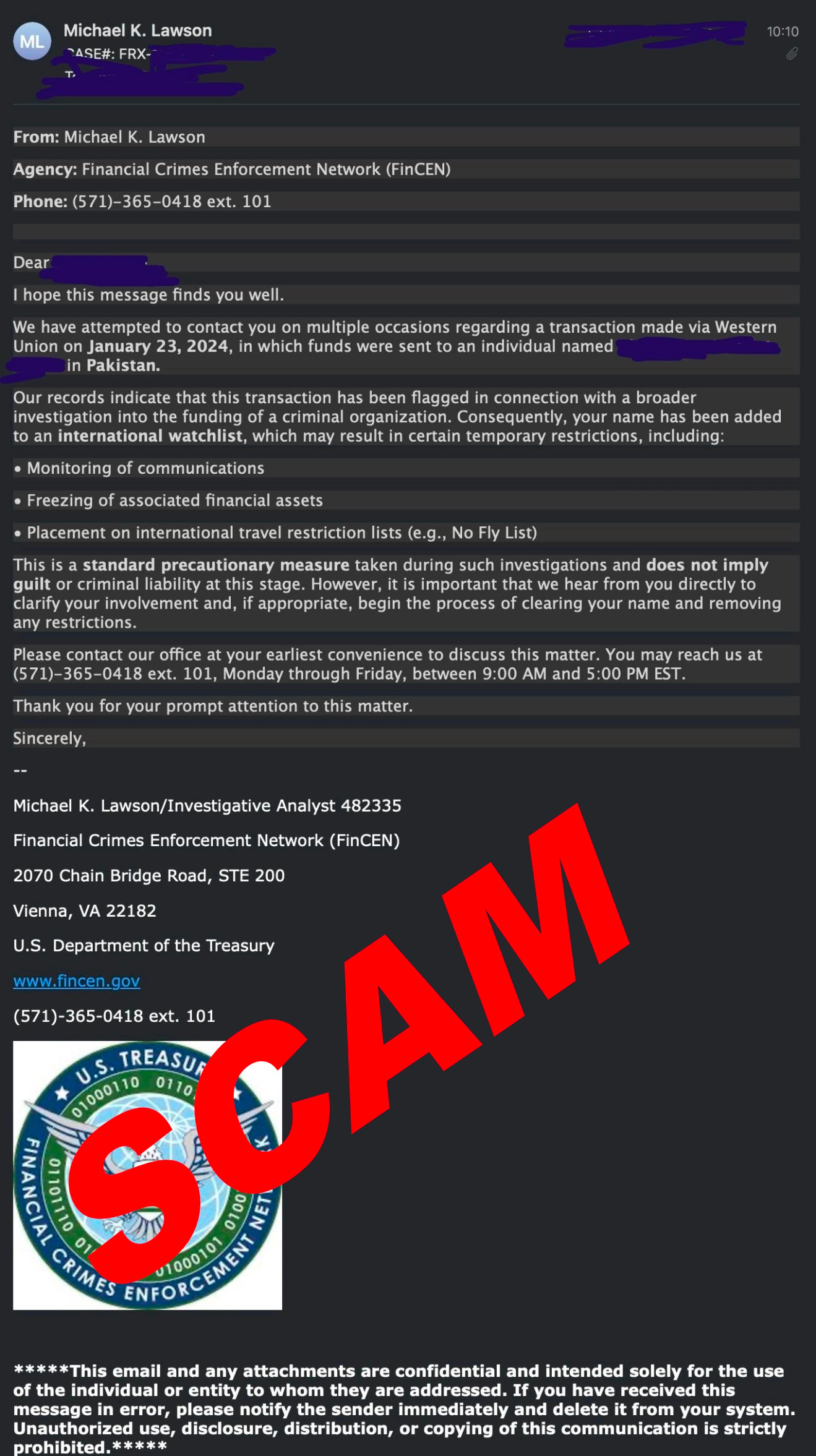
FinCEN does not email the public to demand payment, freeze your accounts, threaten to put you on a no-fly list, or order you to prove your innocence. Any message that does any of those things is a scam, full stop. Do not call the number in the email. Do not reply. Do not send money or personal information.
Why it matters
The people behind this are exploiting the exact instinct that makes this community what it is, the willingness to take a problem seriously and respond. If you receive something like this, stop, do not engage, and report it. You can report fraud to the FTC at reportfraud.ftc.gov and to the Treasury Inspector General. Warn the people around you, especially anyone who may be newer to navigating U.S. systems and more likely to believe a threat dressed up as official.
A NEW ARREST DIRECTIVE OUT OF PAKISTAN
A document is circulating that appears to be a June 28 directive from Pakistan’s Ministry of Interior, ordering that any Afghan national found without a valid visa be arrested immediately starting July 10, with daily arrest reports to the Ministry beginning July 11. We have not independently verified it, and we are sharing it as something moving through the ether rather than as confirmed government policy. We flag it because it is entirely consistent with how Pakistan has treated Afghans, including our allies, under the Illegal Foreigners Repatriation Plan. More than 146,000 Afghans have been deported from Pakistan this year alone, and police have been detaining people with valid visas alongside the undocumented for months.
Why it matters
Many of the Afghans exposed by a directive like this are people the United States promised to protect, allies waiting in Pakistan for relocation that the American government has slowed to a trickle. Engagement with Islamabad on their behalf is exactly the kind of diplomacy that can buy time and prevent returns. Under Secretary Blinken, the State Department pressed Pakistan directly on the treatment of Afghans in the pipeline. Under Secretary Rubio, the State Department has been unwilling to engage Pakistan on this in the same way. That is a factual change in posture, and the people who pay for it are the allies left without an advocate at the table. If this directive is real, the clock is already running. We are working to verify it, and we will report what we learn.
WOMEN ARRESTED IN HERAT, THEN SHOT AT FOR PROTESTING
Between June 6 and 7, Taliban authorities arrested at least 30 women in Herat for allegedly violating dress code rules, including requirements to wear a burka or chador with a face mask. The women were released on June 8. On June 9, when residents gathered in the Jibreil area of the city to protest the arrests, Taliban forces opened fire and beat people with sticks. At least one boy was killed, more were injured, and the UN is verifying reports of a second death.
Why it matters
UN Women noted that a woman’s detention in Afghanistan carries enormous stigma that can put her at risk of further violence and isolation inside her own family and community long after she is released. This is the country the United States and its partners keep treating as a place people can simply be returned to. It is not. What happened in Herat is what return looks like.
THE EU SAT DOWN WITH THE TALIBAN
On June 23, the European Union hosted a Taliban delegation in Brussels for talks on migration and the return of Afghan nationals whose asylum claims were rejected. The meeting drew sharp objection from inside the European Parliament. Rochelle García Hermida, a Spanish member who chairs the Parliament’s delegation for relations with Afghanistan, apologized on the floor, saying she was sorry the Parliament had not stopped the meeting, and that the talks risk handing the Taliban international legitimacy. Another member, Hannah Neumann, warned that hosting the Taliban in Brussels would legitimize a regime that systematically oppresses women.
Why it matters
The conversation in Brussels was about sending Afghans back and about who still counts as protected. When a government that fled its responsibilities starts treating durable protection as negotiable, people who were promised safety discover that the promise had an expiration date no one told them about. The Herat news and the Brussels news are the same story told from two ends. One government is doing the harm. Another is preparing to return people into it.
DORCAS GOES BACK TO COURT ON JULY 8
On June 5, a federal judge struck down four USCIS policies that had frozen or delayed immigration benefits for Afghans and nationals of dozens of other countries. The government has asked for an emergency stay of that ruling, and the hearing is set for July 8. We will be tracking it closely.
Why it matters
Watch what the administration does next, because it is already running a second play. The proposed EAD rule aims to accomplish through regulation exactly what those struck-down memos did through policy, restricting work authorization for parolees and others by rewriting the rules instead of issuing a memo a court can vacate. That is why the comment period matters.
CROW AND BERA PUSH NDAA AMENDMENTS
Representatives Jason Crow and Ami Bera are pushing amendments to the National Defense Authorization Act aimed at our allies, including a provision requiring the administration to report to Congress on the state of the SIV program and a provision extending the program. These are good things, and we support them.
Why it matters
We want to be straight about what these amendments do and do not do. Neither would deliver immediate relief to the allies waiting right now. We support the reporting provision without reservation, because at this point we have no reliable picture of what this administration has done to the SIV program from the inside, and Congress is owed that accounting. On the extension, our honest read is that most people who need to apply have already applied. We support extending the program anyway, precisely because the administration has been so opaque that we cannot rule out that people have been wrongly shut out. When the government refuses to show its work, keeping the door open is the responsible call. We are grateful to Representatives Crow and Bera for continuing to push.
THE AFGHANISTAN WAR COMMISSION WANTS YOUR STORY
The Afghanistan War Commission is collecting firsthand accounts from people who took part in the war, humanitarian, or withdrawal efforts in Afghanistan between 2001 and 2021. They are asking for anecdotes, unresolved questions, accounts of powerful moments, and reflections on the war’s impact. Sharing these experiences is often painful, and the Commission says it reads every submission in that spirit. The accounts inform their research and analysis, some will be quoted in the final report, and where an in-depth interview would fill a gap, they may reach out directly. This is a rare chance for the people who lived the twenty years of war, from civilians to government officials to members of the US, NATO, and Afghan militaries, to put their stories into the official US accounting of it.
There are three ways to share, depending on who you are.
Afghans. For Afghans who lived through the war, served, or worked alongside coalition forces, civilian or military. afghanistanwarcommission.senate.gov/afghans
Veterans. For US and coalition veterans who served in Afghanistan over the two decades of war. afghanistanwarcommission.senate.gov/veterans
Foreign policy and national security professionals. For diplomats, officials, and the civilians who took part in the relocation and evacuation efforts. afghanistanwarcommission.senate.gov/foreign-policy-and-national-security-professionals
Why it matters
The official record of this war is being written right now. Who tells it, and what gets left out, will shape how the country remembers what happened and what it owes the people who were there. If you lived it, your account belongs in that record. Silence cedes the story to the people with the most reason to sanitize it.
WELCOME, JEREMIAH JOHNSON
AfghanEvac is glad to welcome Jeremiah Johnson to the team as Senior Adviser. Jeremiah is an immigration and refugee law and policy expert whose career spans four administrations. He has served as an Immigration Judge with the Department of Justice and as an Asylum Officer with the Department of Homeland Security, and before that he practiced immigration law representing migrants and asylum seekers before the agencies and the federal courts. He is Counselor at Law at Johnson Law and Consulting, and he serves as Executive Vice President of the National Association of Immigration Judges. He has represented Human Rights Advocates before United Nations bodies and has met firsthand with refugees, officials, and humanitarians around the world.
In a week defined by courthouse arrests, mass hearing dockets, and a Supreme Court narrowing the law from the top, having someone of Jeremiah’s depth inside the tent matters. He knows this system from the bench, from the asylum office, and from the other side of the table. He is exactly the kind of person this fight needs.
CALLING LAWYERS, WE HAVE A NEW LIST FOR YOU
We have launched a lawyers list. If you are an immigration attorney, or a lawyer in any other field who cares about these issues and wants to help, we want you on it. The legal fights ahead are only getting bigger, from courthouse arrests to the mass hearing dockets to the cases of people like Nazeer Paktiawal, and we are building the bench to meet them.
Sign up today and share it with every attorney you know who might answer the call.
COMING TO SACRAMENTO ON JULY 3
We are coming to Sacramento on Friday, July 3 for two events, hosted with our partners at NorCal Resist. A town hall at 2:00 PM, and a women and girls listening session at 5:00 PM.
The first is a town hall open to the broader Afghan community. We will answer questions, hear what people are facing, and carry those voices back into Congress, the press, and the rooms where decisions get made. RSVP at afghanevac.org/sac-town-hall. For security reasons, the address is provided only after you RSVP.

The second is a women and girls listening session at 5:00 PM. After everything happening to women in Afghanistan right now, and everything our community is carrying here, this conversation matters more than ever. If you are an Afghan woman or girl and want to be part of it, join our Women and Girls engagement list at afghanevac.org/women-and-girls. This list is for women and girls only.
Want us to come to your community next? Sign up at afghanevac.org/town-hall. The more interest we see from a region, the faster we can build a visit around it.
IN THE NEWS
Stories from the past week.
The refugee double standard
A Look Inside the Welcome Bags Planned for White South African Refugees -- The New York Times
Refugees Question Trump Admin’s Welcome Gifts for ‘Favored’ South Africans -- Newsweek
Courthouse arrests
Federal judge rules ICE can’t make arrests at immigration courthouses -- Courthouse News
The Supreme Court
Supreme Court allows Trump to strip TPS, turn away asylum seekers arriving at the border in pair of new immigration rulings -- American Immigration Council
Supreme Court gives Trump major wins on two immigration cases -- CNN
Death in ICE custody
Dying in Detention, rising deaths in an expanding US immigration detention system -- Physicians for Human Rights and Human Rights Watch
Trump Taps Former Oklahoma Trooper as New ICE Director -- The New York Times
The mass hearing dockets
Mega Masters, the data behind the mass hearing dockets -- Austin Kocher
Europe and the Taliban
Afghan Taliban hold first, closed-door talks with EU on deportations -- NPR
EU lawmaker apologizes to Afghans over Brussels talks with Taliban -- Amu TV
EU to hold migration meeting with Taliban officials in Brussels -- Al Jazeera
Inside Afghanistan
A court told this administration it cannot turn the place people go to follow the law into the place they get taken away. That happened because people refused to accept that a trap was just how things are now.
The same refusal is what stands between Nazeer's family and a sealed file, between an Afghan ally and a two-minute hearing, between a promise made and a promise abandoned.
From a courthouse in California to a hearing room in Washington to a negotiating table in Brussels, the protections built for people fleeing danger are being tested all at once, and the people testing them are counting on us to look away.
None of it is fate. All of it is a choice, and choices can be unmade.
We are furious. We are focused. And we are not going anywhere.
This week, the country turns 250 years old.
Some of us will spend the Fourth the way I will, with family, a grill, and at least one Afghan friend at the table who is here because the promise held for them.
That is worth celebrating.
Not the people currently breaking faith with our allies, but the country itself, the idea of it, and the people across 250 years who pushed it closer to its own stated ideals when it fell short.
America has done hard and good things. It has taken people in. It has kept its word more often than not. The fight in these updates is a fight to make it do that again, because we believe it can.
So light the grill. Wave the flag. It belongs to you as much as anyone, and no administration gets to take that.
Happy Fourth. We will be right back at it on Monday.
We are waiting for restating the immigration program from Afghanistan .