

A federal court struck down four unlawful USCIS policies.
The same day, DHS proposed to strip tens of thousands of Afghan parolees of their right to work.
Members of Congress named names, pressed cabinet secretaries, and put commitments on the record.
And in Texas, 160 Afghan allies showed up and asked the question we couldn’t fully answer: if Congress cares so much, why haven’t they introduced or passed meaningful legislation?
We’ll get to all of that, but first we need you to take action.
Action Items
TODAY IS THE LAST DAY for your member of Congress to sign onto the Crow-Bacon letter on Camp As Sayliyah. Afghan allies in Qatar are running out of time. It takes 60 seconds and is the most important action you can take today. Email them and ask them to sign on now at afghanevac.org/cas-action
Comment on the proposed DHS rule that would strip work authorization from Afghan parolees. The comment window closes August 4, 2026. Read our explainer at afghanevac.org/ead-rule-change and submit your comment at afghanevac.org/ead-action.
Share the Dorcas decision explainer with your networks. A federal court struck down four unlawful USCIS policies this week. Tell people what it means and who won it. Tag @AfghanEvac and use #StillWithUS
Donate to support this work. Showing up, the Texas town halls, the Hill engagement, the new EAD explainer — all of it is possible because of your support.
A Federal Court Strikes Down Four Unlawful USCIS Policies
On June 5, 2026, a federal district court issued a landmark ruling in Dorcas International Institute of Rhode Island v. USCIS, striking down four USCIS policies that had frozen immigration benefit adjudications for Afghans and nationals of 38 other countries. Chief Judge John J. McConnell Jr. vacated the Global Asylum Hold, the Benefits Hold, the Comprehensive Re-Review policy, and the Country-Specific Factors Policy — all four policies, nationwide, effective immediately. The judge wrote that these policies threw the lives of countless immigrants into “indeterminate legal limbo,” found that USCIS had claimed authority it does not possess, and concluded that the agency had acted on “anti-immigrant sentiments that it is forbidden from letting influence its decision-making.” In legal terms: arbitrary, capricious, and contrary to law.
The relief is nationwide. Vacatur means the policies are off the books, not merely paused. The administration will almost certainly appeal and may seek a stay pending that appeal. But as of this writing, USCIS is required to resume adjudicating cases that had been warehoused under these holds: green cards, work permits, asylum applications, naturalization, and more. For Afghan allies who have been waiting, in some cases for years, for benefit decisions withheld without legal authority, this ruling matters. We said these holds were unlawful. A federal court agreed.
When we circulated our Hill explainer on June 5, the first response arrived within 90 seconds. Senate Judiciary staff called it “huge.” House staff immediately asked whether the relief was nationwide. It is. Credit where it is due: Dorcas International and their litigation partners built this case. The Afghan allies and other immigrants who served as plaintiffs put their names on a lawsuit against the federal government while living inside a system that government controls. That took courage, and this ruling is theirs.
Why it matters. The administration will fight this ruling. Compliance is never automatic, and AfghanEvac will be tracking every deadline and every filing that follows. A court win is the beginning of a new battle, not the end of one. We have seen that before. We are ready for it again.
Afghan and Iraqi Allies v. Rubio: The Court Is Watching State This Month
In May 2026, Judge Tanya Chutkan found that the State Department had “woefully failed” to meet its obligations under the court-ordered Revised Adjudication Plan for SIV processing in Afghan and Iraqi Allies v. Rubio. She responded with binding monthly benchmarks.
This month, State is required to process at least 1,000 Chief of Mission applications. It must also report to plaintiffs the total number of Afghan class members who have been stuck at Step 4 of the adjudication plan for 120 days or more. Beginning in July, State must file a public notice on the court docket each month showing how many CoM applications it processed the prior month. If it misses a benchmark, it must explain why and identify concrete steps to comply. A joint status report on overall compliance is due August 28, 2026.
Judge Chutkan also ordered State to notify Afghan SIV applicants that being a class member in this case does not protect them from Presidential Proclamation 10998. Afghan allies who are scheduled for visa interviews should know: the court-ordered adjudication process means State must schedule and conduct your interview. It does not guarantee you will receive a visa or be admitted to the United States. The travel ban still applies.
Why it matters. The Chutkan enforcement order covers the SIV pipeline only. It does not address Camp As Sayliyah, refugee admissions, or parole. But it is one of the few places where the administration faces binding legal consequences for non-compliance, with a public reporting requirement and a judge who has already found them in violation. We are watching the June numbers. So is the court.
DHS Is Dismantling the Right to Work
This did not start on June 5. The administration has been eliminating Afghan allies’ legal right to work in stages, and both moves need to be understood together.
The first rule, Employment Authorization Reform for Asylum Applicants, was published February 23, 2026, with a comment period that closed April 24. That rule targeted asylum-based work authorization: extending the waiting period to apply from 180 days to a full year, stretching processing timelines from 30 to 180 days, and creating an automatic pause mechanism that stops new work permit applications entirely whenever USCIS asylum processing times exceed 180 days. DHS acknowledged in that rulemaking that current processing times already exceed that threshold, meaning the pause would likely trigger immediately upon implementation and could, by the agency’s own estimate, last between 14 and 173 years.
On June 5, 2026, DHS published a second proposed rule that goes further and hits Afghan allies more directly. This rule targets the three specific EAD categories through which most Afghan allies currently work legally in the United States. Nearly every Afghan ally who arrived through Operation Allies Welcome entered on humanitarian parole, holding work authorization in the (c)(11) category — the category this rule targets most aggressively. Under the proposed rule, parolees must prove economic necessity for employment and demonstrate they warrant a favorable exercise of discretion, a standard USCIS can apply or deny with wide latitude. Work permits are capped at one year. Renewals require an E-Verify-participating employer — many Afghan allies work for small businesses that do not use E-Verify. An arrest is sufficient to create a presumptive disqualification. Not a conviction. Not a charge that resulted in prosecution. Not a guilty verdict. Dismissed charges, acquittals, and sealed records offer no protection. DHS’s own analysis excludes Operation Allies Welcome cases from its historical approval-rate averages because OAW approvals were so numerous they skewed the data upward. This rule was constructed knowing who it would hit.
If you came through CARE relocation after 2022 as an SIV or refugee, this rule should not directly impact you. Afghan allies with current work authorization should consult an immigration attorney about their specific situation.
AfghanEvac has made it easy to be heard. We have built a guided comment tool that walks you through submitting a formal public comment on this proposed rule, and it only takes a couple of minutes.
This is not a petition. It is a submission to a federal rulemaking docket, and DHS is legally required to read and respond to every substantive comment before it can finalize this rule. Your comment will be a part of the official record, so feel free to share your experience.
We submitted AfghanEvac’s own organizational comment, laying out the legal, operational, and human consequences of this rule for Afghan allies specifically. You can read what we said and submit your own comment below.
The comment period closes August 4, 2026.
Why it matters. Two rules. One systematic effort to make it impossible for Afghan allies to support themselves while waiting for a government that invited them here to process their cases. This is a choice. It can be unmade. The comment period is not a formality. It is a legal mechanism that constrains the agency’s options and lays the groundwork for litigation. Use it.
Congress Shows Up: Three Days of Testimony
Ten days ago, AfghanEvac launched a campaign asking the Afghan community and their advocates to demand answers from Secretary Rubio and other administration officials during this week’s budget hearings. 2,250 letters went into congressional offices on Capitol Hill. Congress heard our community.
Last week brought three consecutive days of congressional hearings in which members of Congress named Afghan allies by name, pressed cabinet secretaries for answers, and put commitments on the record. We are grateful. And we are tracking every one of those commitments.
On day one, Senator Chris Coons raised Camp As Sayliyah during the Senate Foreign Relations Committee Fiscal Year 2027 State Department Budget Hearing, pressing the administration on the situation facing Afghan allies still living at the transit camp in Qatar, where a September 2026 deadline looms and no credible relocation plan has been confirmed. He secured a commitment from the administration to work together toward a solution. We take that commitment seriously, and we will be back if it goes unmet. Representative Grace Meng raised CAS the same day in the House Appropriations Committee’s National Security and Related Programs Subcommittee Fiscal Year 2027 State Department Budget Hearing. Two members, two committees, one day, the same message. Thank you to both.
On day two, Representative Julie Johnson appeared in two separate hearings and did not pull her punches in either. In the House Homeland Security Committee Fiscal Year 2027 DHS Budget Hearing, she raised the death of Nazeer Paktiawal and pressed Secretary Mullin directly, securing a commitment to find out what happened to Nazeer and why he died in DHS custody. His brother, widow, and children were in our town hall in Dallas this week. They are not looking for sympathy. They want answers, and they want assurance that another Afghan family will not go through what they have endured. Secretary Mullin now has an opportunity to provide that. Representative Johnson then raised Paktiawal’s case again in the House Foreign Affairs Committee Fiscal Year 2027 State Department Budget Hearing, putting the same question directly to Secretary Rubio. That is sustained accountability. Thank you, Representative Johnson. Senator Coons also returned on day two, this time in the Senate Appropriations Committee’s State Department, Foreign Operations, and Related Programs Subcommittee Fiscal Year 2027 State Department Budget Hearing, pressing the broader situation of Afghans throughout the world, including those stranded in Pakistan, those still inside Afghanistan, and those in processing pipelines across the globe.
On day three, Representative Jason Crow came to the House Armed Services Committee Fiscal Year 2027 National Defense Authorization Act markup with an amendment that would have reopened the SIV application window and kept it open through December 2027. The amendment was withdrawn before a vote. We appreciate that Representative Crow fought to include it, and we will continue working with his office and others on the path forward.
Why it matters. 2,250 letters. Three days of hearings. Commitments secured on the record from two cabinet secretaries. This is what sustained community pressure looks like when it works. Hearings create a record. That record has to be enforced. We are doing that work.
This video is a full compilation of the questions / responses.
Action required today. Representatives Crow and Bacon are circulating a letter to their colleagues on Camp As Sayliyah. Today is the last day to contact your member of Congress and ask them to sign on. Every signature matters.
Texas: Town Halls, a Mosque, and a Ruling That Landed at the Right Moment
AfghanEvac was in Texas from June 3 through June 5. What we experienced across those three days was the full weight of this crisis in real time, and then, unexpectedly, one of the clearest signs yet that the legal strategy is working.
On June 3, we held a town hall in Fort Worth. More than 40 people attended. The questions were consistent: family reunification, stalled benefit adjudications, and the fear that relief was not coming. In the margins of that event, and in a separate meeting with resettlement agency staff from all five resettlement agencies serving the Dallas-Fort Worth area, we talked about Dorcas as the most promising avenue for near-term relief. We didn’t know when the ruling would come. We told people it was in the pipeline and that we believed it would matter.
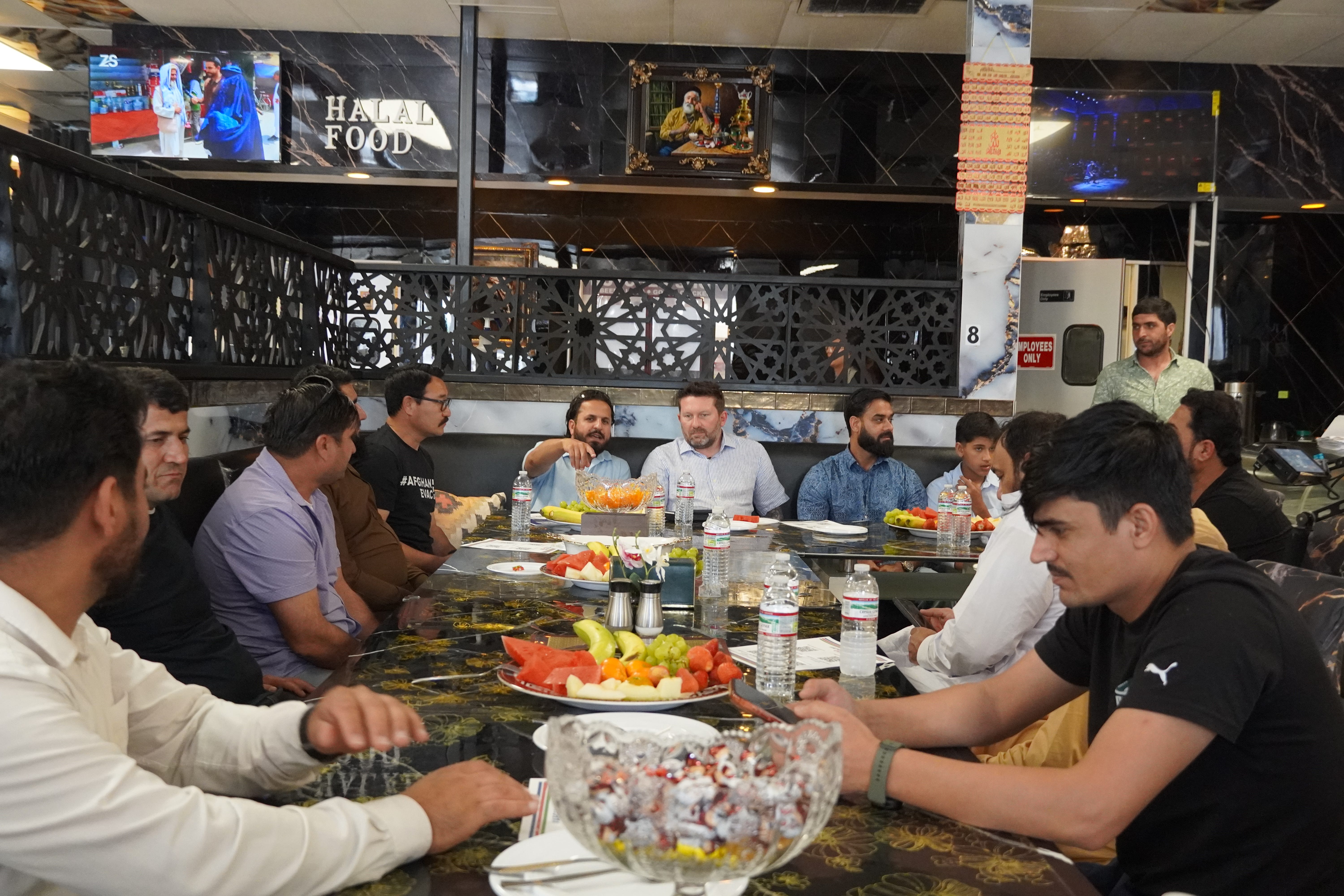
On June 4, we were en route to the Dallas town hall at Abu Hanifa Mosque when the new DHS proposed rule on work authorization hit. Dozens of people were waiting for us. We had to explain what the rule meant in real time, to a room full of people who hold work permits in the exact category the rule targets. The EAD proposed rule would strip legal work authorization from Afghan humanitarian parolees, the largest group in that room.
The questions that followed were familiar because the challenges are familiar. Families asked about reunification. Applicants asked about stalled USCIS cases. Women whose husbands remain in detention described trying to keep their households together while navigating an increasingly uncertain immigration system. The frustration was palpable, but so was the determination to keep fighting for a future here.
After the mosque, we sat down with resettlement agency staff of Afghan heritage who shared with us the other side of the story. Having to serve a greater need even as funds are being drastically cut. Many of those staff are still waiting on their own family to arrive.
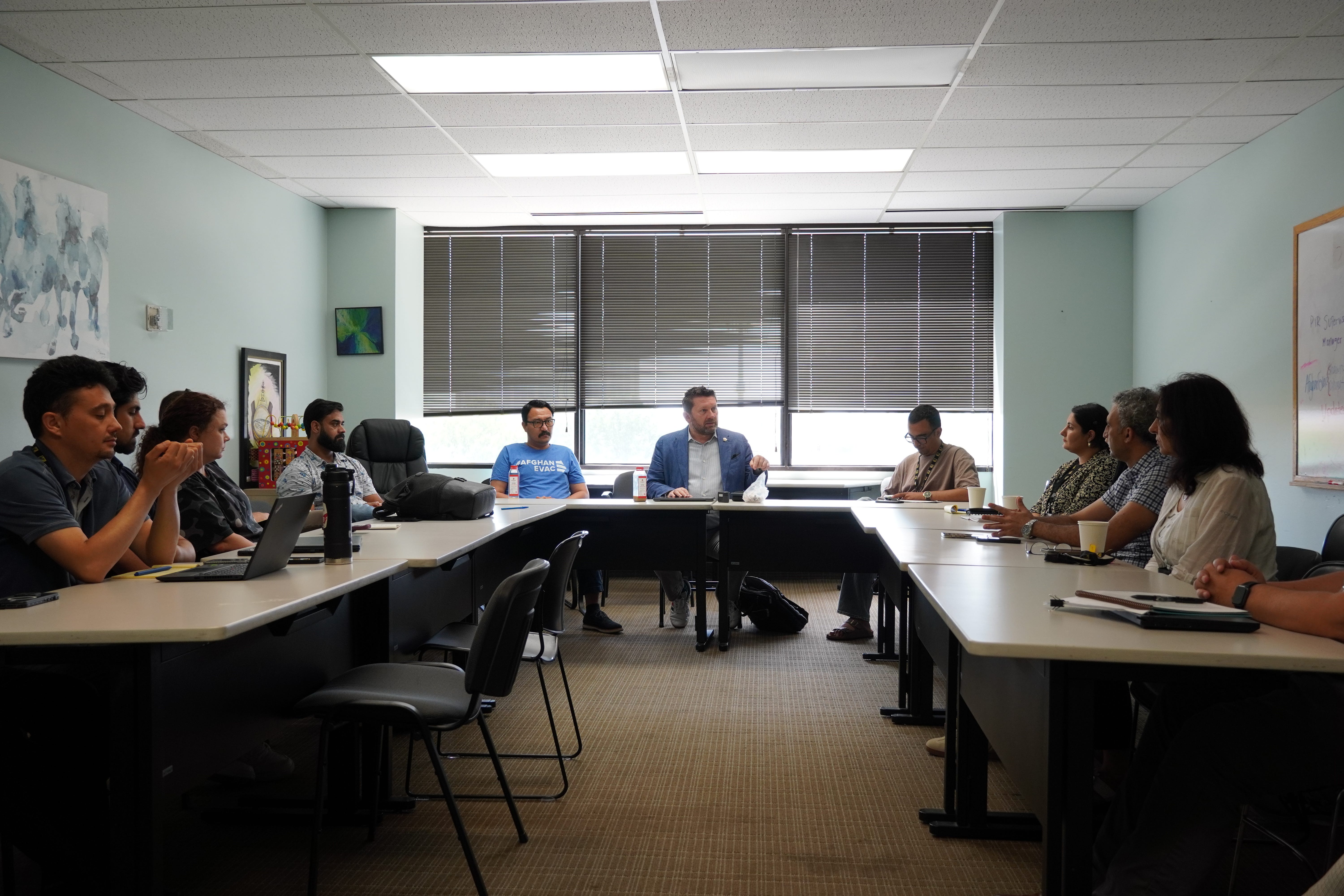
And then the question that has really stuck out, said plainly by a man in that room:
“AfghanEvac is the biggest name in this effort and has the most trust of Afghans. You tell us all the time that Congress cares deeply, both Republicans and Democrats. If that’s true, how come there has been no meaningful legislation introduced or passed since everything overseas and with USCIS started getting shut down and Afghans started getting detained?”
We did not have a satisfying answer. We sent that question to Capitol Hill the next morning and haven’t yet heard back.
We capped that evening by sharing a meal with executives from the resettlement agencies serving the DFW area. Dorcas came up again. Everyone in the room agreed it was the best legal avenue available. No one knew it would land the next day.
On June 5, we were visiting the George W. Bush Presidential Center — an extraordinary partner in this work — before flying back to San Diego, when the Dorcas ruling dropped.
Standing in President Bush’s Oval Office, we got word that Chief Judge McConnell had vacated all four unlawful USCIS policies, nationwide, effective immediately. It was the ruling we had been tracking for months. The people we had sat with in Fort Worth and Dallas — the families waiting on frozen benefit applications, the allies who feared losing their jobs, the resettlement staff who had been telling clients to hold on — they were the people this ruling was for.
Why it matters. The Texas trip was three days of community intelligence, coalition building, and direct accountability. What we heard in those rooms shapes what we say in Washington. We are grateful to the George W. Bush Presidential Center for their continued partnership, to Abu Hanifa Mosque for hosting us, and to everyone in Fort Worth and Dallas who showed up and told us the truth.
Battle Buddies
More than 1,000 veterans are signed up for Battle Buddies across the country and our 100% no-detention record holds when volunteers are present.
This week in Michigan, Representative Joe Tate — a Marine veteran of the war in Afghanistan, former NFL player, and former Speaker of the Michigan House of Representatives — showed up as a registered Battle Buddies volunteer. That is who this program attracts. That is who stands with Afghan allies.
What We Are Seeing: Mega-Master Calendar Hearings
After reporting on the expected rollout of mega-master, or “balloon docket,” hearings, we are now seeing implementation in immigration courts in Chicago, Indianapolis, and San Diego. These hearings schedule as many as 120 individuals before a single judge at the same time. Most respondents arrive without lawyers. In that environment, rights can be waived unintentionally, and the consequences can be severe and permanent.
At these hearings, respondents are being pressured to complete a form called the “Respondent’s Pleading Declaration.” Signing this form without understanding it could result in a judge finding you removable. If you receive a pleading declaration, you still have the right to due process and to fight your case with legal representation. For guidance on your rights, see the National Immigrant Justice Center’s guidelines.
If you have an upcoming immigration court date:
Check your case status daily at the EOIR website. You will not know your hearing is a mega-master until you arrive at court.
Arrive on time. Respondents who arrive late are being treated as absent and issued deportation orders in absentia.
Be prepared for long wait times.
Seek legal representation before your hearing if at all possible.
For more on what to expect, see this resource from Immigrant Help NY. We will share updates as we receive more information.
A Note on Volunteer Standards and Community Safety
AfghanEvac’s work depends on trust. The Afghan community trusts us to show up with accurate information, no hidden agenda, and deep respect for who they are and where they are. That trust is fragile, and it is everyone’s responsibility to protect it.
We need to address something that happened at one of our Texas town halls. An individual who is not an AfghanEvac volunteer, not affiliated with our organization, and who has a known history of spreading misinformation in Afghan advocacy spaces attended uninvited and began providing “assistance” to community members. This is not the first time concerns have been raised about this individual in Afghan advocacy spaces. We are not naming him here because doing so would give him a platform he has not earned and create a public dispute that serves no one in this community. But we are not pretending this did not happen, and we are not pretending he is welcome.
This was not one of our volunteers. We are proud of the people who show up for this work.
The standard is not complicated. Show up with accurate information. Leave your agenda at the door. Treat every Afghan ally in the room with the dignity they are owed. Proselytizing in our spaces or in community spaces where we are guests, including mosques and cultural centers, is against our organizational ethics and will not be tolerated. If you cannot commit to that standard, this is not the right space for you.
If you see someone at an AfghanEvac event who is not part of our team and is sharing unverified information or behaving inconsistently with our values, find a staff member or organizer immediately.
Important Information for Afghan Allies in the United States and Their Advocates
Resettlement agencies have flagged something we need to share with the community who are already present in the United States.
The federal government is preparing a new outreach initiative that will specifically seek out Afghan allies in the United States who do not yet have durable immigration status and conduct outreach interviews.
We do not know exactly how or when this will happen. What we do know is that the initiative is being designed right now, that it is coming before the end of this fiscal year, and that it is being built specifically for this population in a way that departs significantly from how similar efforts have been conducted in the past.
We are not in a position to say this is malicious. We are in a position to say that in this environment, with this administration’s track record toward Afghan allies, any federal effort to identify and make contact with the most vulnerable people in the pipeline warrants extreme caution.
If someone contacts you about a new federal survey or outreach effort, you are not obligated to participate without understanding exactly what will be done with your information. Talk to a lawyer. Contact us.
We will share more guidance as it becomes available.
In the News
A federal judge strikes down Trump administration immigration policy affecting 39 countries — Associated Press
Judge blocks series of Trump policies halting immigration processing — The Hill
US Judge Invalidates Trump Policies Targeting Immigrants From 39 Countries — Reuters
Judge strikes down Trump policy that halted asylum decisions for 39 countries — PBS NewsHour
Federal judge strikes down Trump immigration policy imposed after National Guard members shot in DC — WTOP
Capital Tonight Texas — Spectrum News
Episode 143: Shawn VanDiver on Camp As Sayliyah Future, Legal Updates — The Afghanistan Project Podcast with Beth Bailey
This week brought both warning signs and reasons for optimism.
A federal court rejected unlawful policies that had frozen immigration benefits for thousands of people. At the same time, DHS proposed new restrictions that could make it harder for Afghan parolees to work and support their families. Congress secured commitments from administration officials, but many Afghan allies continue asking when oversight will become action.
Across Fort Worth and Dallas, Afghan allies showed up not because they wanted another meeting, but because they wanted answers. They wanted to know whether anyone was still paying attention. We told them the truth: the challenges are real, the road ahead will be difficult, and none of this will be solved quickly.
We also told them something else: This community remains engaged. The courts are listening. Advocates are showing up. Veterans are standing beside their wartime allies. And Afghan families continue demonstrating extraordinary resilience in the face of uncertainty.
That work continues next week, and the week after that. Thank you for being part of it.