


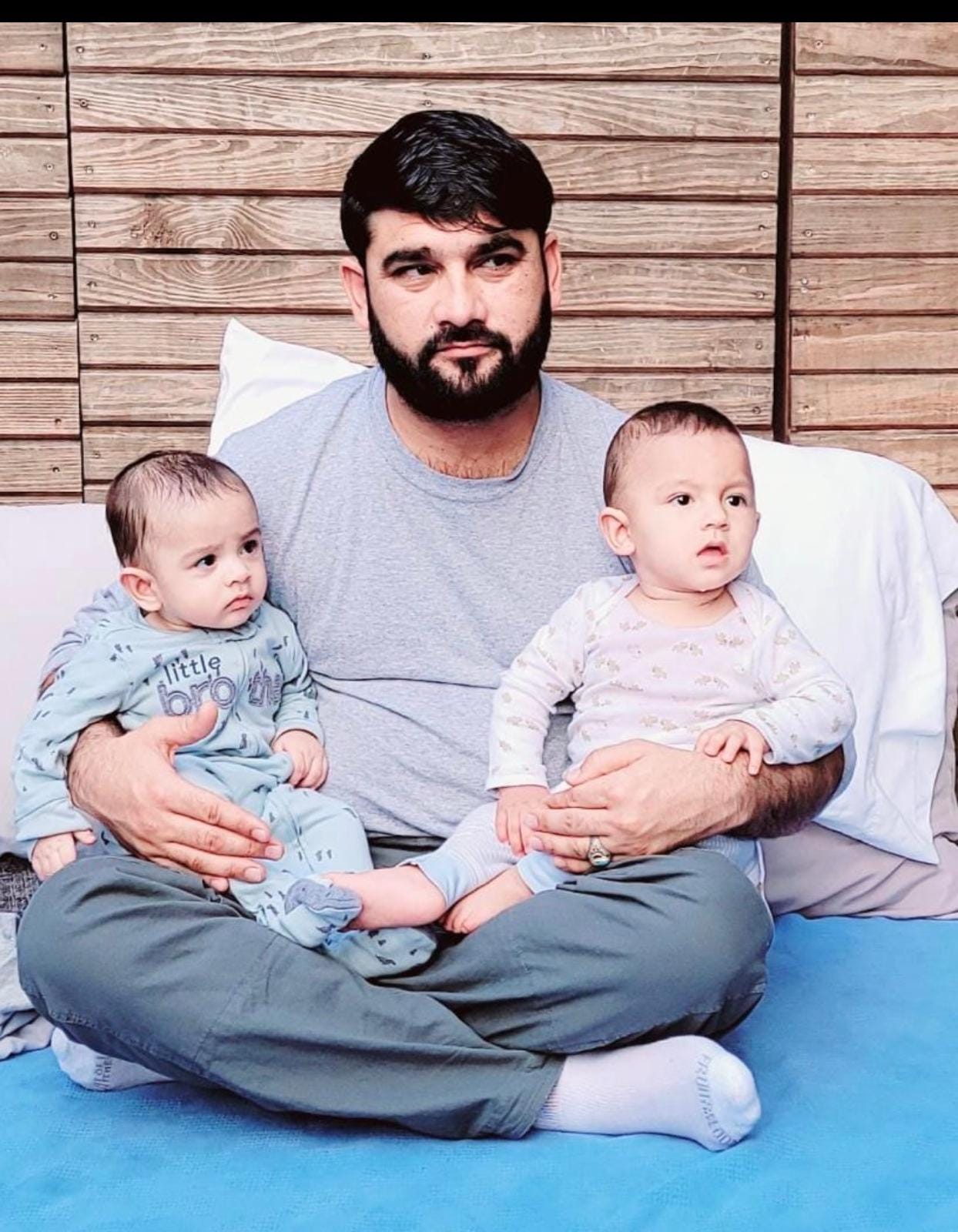
Last week, six children in Texas lost their father. This week’s update focuses on two urgent issues affecting Afghan allies: the death of Mohommad Nazeer Paktyawal less than 24 hours after entering ICE custody in Texas, and the ongoing danger facing families still waiting at Camp As Sayliyah.
Both situations raise serious questions about how the United States treats the people who stood alongside us.
Action items
Share coverage of Mohommad Nazeer Paktyawal’s death so more people understand what happened
Read and share our fact sheet about his death in ICE custody.
Read and share our fact sheet about the situation at Camp As Sayliyah
Donate to AfghanEvac so we can keep driving the conversation about our wartime allies at home and abroad.
Death of Afghan Wartime Ally in ICE Custody
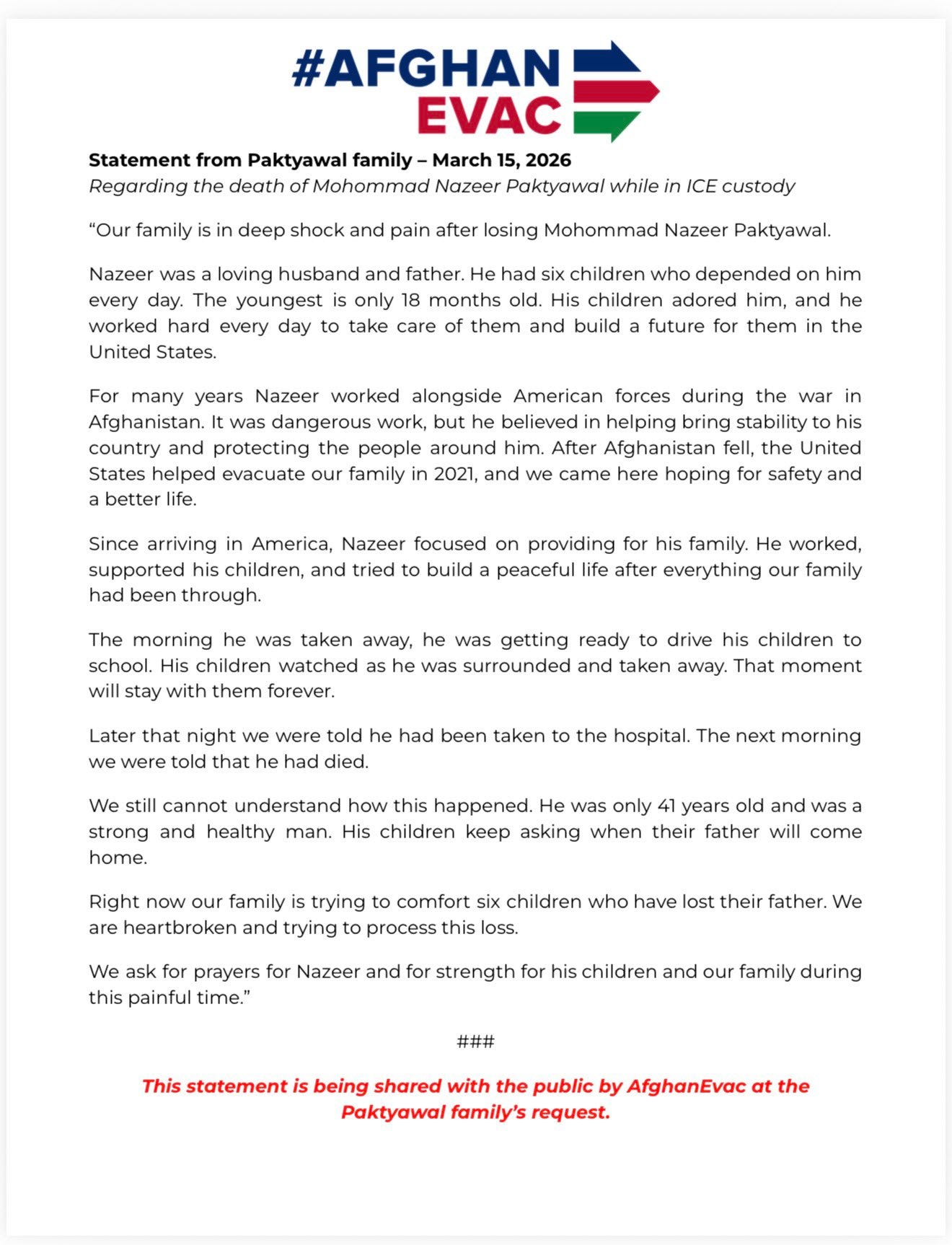
Over the weekend we learned that Mohommad Nazeer Paktyawal, an Afghan wartime ally evacuated to the United States in August 2021, died less than 24 hours after being taken into ICE custody in the Dallas area. Paktyawal worked alongside U.S. Army Special Forces beginning in 2005 and was living in Richardson, Texas with his wife and six children while his asylum case remained pending. According to family accounts, he was detained outside his apartment while preparing to take his children to school. He was later admitted to Parkland Hospital around 11:45 p.m. Friday and died Saturday morning. The cause of death remains unknown.
ICE has since issued a statement emphasizing past allegations and claiming Paktyawal complained of shortness of breath while in custody before being transported to the hospital. Those claims do not change the central fact: a 41-year-old father of six died less than 24 hours after entering government custody. Much of the timeline remains based on family accounts, and a medical investigation into the cause of death is still pending.
His family deserves answers.
Camp As Sayliyah Update
Conditions at Camp As Sayliyah (CAS) remain deeply concerning as Afghan families continue living in an environment where missiles pass overhead on a near-daily basis.
In recent days, large precast concrete culverts have been installed around the site and are being presented to residents as places they may use for cover during alarms.
Structures like these have been used on U.S. military bases in Iraq and Afghanistan as improvised protection from indirect fire, primarily to reduce exposure to falling debris and fragmentation from distant blasts when people take “duck and cover.”
We understand the installations will be configured with additional barriers at the openings to reduce blast effects, and we have been assured that residents will receive training and familiarization on how to use the structures appropriately. These steps follow sustained advocacy raising concerns about the safety conditions facing families at the site.
Photos and video from CAS show children climbing on these installations, underscoring both the limited protective value of the setup and the broader reality that families, including young children, remain in a location exposed to active missile threats. While these measures may help mitigate certain risks, they do not change the fundamental concern that civilians are living under ongoing danger.
We understand there are active efforts underway at the State Department to move residents out of Camp As Sayliyah as quickly as possible.
Our advocacy remains focused on ensuring families are relocated somewhere genuinely safe and that all individuals who have cleared security vetting and completed the required processing are able to travel to the United States. More information about conditions at CAS is available at afghanevac.org/cas.
You can watch the full clip of our partner Sean talking about his brother, who remains stuck at Camp As Sayliyah, on this weekend’s Sunday morning MS Now
Press
Afghans stranded for a year by Trump’s refugee freeze now caught in new war – PBS Newshour
Afghan asylum-seeker dies in ICE custody, US advocacy group says – Reuters
Afghan who fought with US special forces dies in ICE custody as Trump on track for deadliest year of detention in more than two decades – The Independent
Afghan man with pending asylum case dies in ICE custody in Dallas — Texas Tribune
Dad, 41, Who Fought With U.S. Troops Dies Hours After Being Detained by ICE — The Daily Beast
Afghan War Veteran Dies After One Day in ICE Custody — Newsweek
Among the people caught in the danger zone from the Iran war – Afghan allies waiting to relocate to the U.S. – MS Now the Weekend
Politically Speaking: CA is ‘ground zero’ for refugee resettlement efforts amid immigration crackdown – NBC 7 San Diego
Afghan Allies Stuck in Limbo at Qatar Refugee Camp – Scripps News
Our wartime allies risked their lives beside American service members. That commitment does not end when the war does.
We owe them safety, dignity, and answers.
We will continue pressing for accountability in Nazeer Paktyawal’s death and for the safe relocation of families still waiting at Camp As Sayliyah.
This is devastating. I worked on the Afghan evacuation pipeline, and what’s reflected here is how much of that pipeline has largely disappeared — leaving many evacuees in prolonged uncertainty with no clear path forward, along with a broader shift toward detaining people while their asylum cases are still pending. Cases like this shouldn’t be happening.
Hello Mr. Shawn
I hope you are doing well
What you see in the text below are news items that have been circulating in Afghan migrant groups residing in Pakistan, which are very concerning. Although I am fully aware that you work tirelessly day and night to assist Afghan allies, especially SIV applicants, I am sharing this with you out of necessity and stress. I hope that, if possible, you can speak with the Government of Pakistan—either through the Embassy of Pakistan in the United States or by contacting local authorities in Pakistan—to request that, under these difficult and dangerous circumstances, they refrain from deporting me, my family, and other Afghan SIV applicants who are in a similar situation in Pakistan.
My family and I have received a letter from the U.S. Embassy in Islamabad, in which the Islamabad Police have been requested to cooperate with us. However, it is unclear whether the Pakistani police will honor this after the temporary suspension of the SIV process. The letter was issued on September 4, 2025.
Me and my family are waiting for scheduling our interview in US Embassy In Islamabad .
Announcement:
«Major Change in Government Policy:
Regarding Undocumented Afghan Refugees
A major change has been made in the government’s policy concerning undocumented Afghan refugees in Pakistan. Previously, Afghan nationals without visas or passports were detained and sent to holding centers before being repatriated to Afghanistan through the border.
However, following recent tensions between Pakistan and Afghanistan and the expiration of the government’s deadline, this procedure has been altered. Under the new policy, instead of sending undocumented Afghan refugees to holding centers, formal legal cases will be filed against them, and they will be transferred to police stations or prisons.
According to sources, some Afghan nationals have been successful in obtaining bail from the courts, but a large number of applications have been rejected. In this context, the Peshawar High Court, in a significant decision, has annulled the bail of Afghan nationals arrested under the Foreigners Act and ordered their transfer to prisons.
The court also stated in its order that as soon as the Pakistan-Afghanistan border reopens, the relevant authorities must immediately inform the court so that the process of repatriating detained Afghan nationals to Afghanistan can proceed according to the law. Following this change in government policy, problems for Afghan refugees who have not yet voluntarily returned have increased and are expected to worsen further»