


Last week didn’t just bring developments. It brought alignment.
Across the courts, the camps, the budget, and now in public debate, the same pattern is emerging: decisions are being made that slow progress, reduce clarity, and leave Afghan allies carrying the consequences.
In one case, a judge ordered the government to act. In another, the court said it could not intervene. In a third, the government is being called out for failing to follow a clear directive.
At the same time, deadlines passed without explanation, a new budget signaled reduced investment, and voices from within this community are speaking plainly about the gap between rhetoric and responsibility.
These are not isolated issues. They are connected.
Here’s what happened this week and what it means.
Action Items
Submit a public comment on proposed EAD changes before April 8.
Share Pete Lucier’s op-ed on why leadership from Secretary Mullin matters right now
Get your special edition Save Enduring Welcome shirt from the AfghanEvac online store. All proceeds help support our mission.
This morning, longtime AfghanEvac team member Pete Lucier published a powerful op-ed in The Washington Post calling out the gap between rhetoric and responsibility when it comes to Afghan allies.
Pete draws a clear line between rhetoric and responsibility. It’s easy to speak forcefully about standing with Afghan allies when you’re in the Senate. But now, Secretary Markwayne Mullin is in a position to make decisions and own the consequences.
That’s what this moment requires. Not statements. Not positioning. Action.
For Afghans, this is about whether the commitments made in public are carried through in practice. Whether leadership means something when it counts.
Secretary Mullin: you’ve talked tough, but talk is cheap. Will your actions back up your words?
Deadline Approaching – Comments on EAD Changes
The administration is considering changes to Employment Authorization Documents that could impact how quickly and reliably people receive or renew their work permits. Public comments close April 8, and the rule could shape processing timelines, renewals, and stability for people already here.
For Afghans, this is about basic stability. Work authorization is the difference between independence and vulnerability. Delays or uncertainty can mean lost jobs, missed rent, and families pushed into crisis. If we want people to rebuild their lives, we have to make it possible for them to work.
Update on Camp As Sayliyah
A self-imposed March 31 deadline for movement out of Camp As Sayliyah came and went last week. Families at the camp were holding onto that date, and the Department was aware of it, but it passed without clear communication or updated guidance.
In response, we issued a public statement calling out the missed deadline and the lack of urgency and communication with families on the ground.
At the same time, we sent a detailed letter to congressional offices outlining what happened, why it happened, and what needs to come next, including the need for sustained oversight and accountability from both Congress and the administration.
That letter made clear what many already know: this was not an unavoidable outcome. A deadline was announced without a plan, and more than 1,100 Afghan allies and their families remain in limbo under U.S. authority.
We are continuing to track developments closely. Current indications suggest movement may not occur until May or June, though that remains uncertain.
For Afghans at CAS, this is about more than timing. It is about trust and predictability. These are families who believed they were on a defined path forward. When deadlines pass without explanation, it reinforces a pattern of uncertainty that makes it harder for people to plan, prepare, or feel secure. At a minimum, people deserve clear communication about what to expect and when.
Sileiri Doe v. DHS (CBP One Parole Termination Case)
A federal judge ruled that DHS acted unlawfully when it terminated parole for individuals who entered the United States through the CBP One process. The court found that while the government has broad discretion over parole decisions, it cannot terminate parole without first making the required determination that the purpose of parole has been fulfilled and without following its own procedures.
As a result, the court vacated the terminations and ordered the government to restore individuals to the parole status they held before the April 2025 termination notices.
This issue hits especially close to the Afghan community. Many Afghans, facing years of delays and uncertainty in Enduring Welcome, made the difficult decision to come through the southern border. AfghanEvac did not encourage that path, but others did, and the U.S. government itself pointed to CBP One as a lawful way to enter and seek protection.
Now, many of those same individuals have been targeted by ICE, with the current administration retroactively labeling them “illegal” despite following the process that was put in front of them.
This ruling matters because it draws a clear line. The government can change policy, but it cannot ignore the law or skip required steps to get there. For Afghans who relied on a pathway the U.S. government itself created, this is a meaningful check on arbitrary action and a reminder that due process still applies.
A.M.S. v. Edlow (Humanitarian Parole Case)
In a separate case, a federal judge dismissed a lawsuit brought by Afghan families seeking faster processing of humanitarian parole applications. The court ruled that it does not have jurisdiction to review how the government prioritizes or delays these cases, because parole decisions are discretionary.
The case involved Afghan applicants in hiding, facing Taliban threats, whose applications have been pending for years.
For Afghans, this is a difficult but important reality. Unlike the SIV program, humanitarian parole does not come with enforceable timelines. The court made clear that even severe delays, even in dangerous conditions, are not something it can step in to fix under current law.
That means these cases will not be solved in court. They will be solved, if at all, through policy changes, advocacy, and sustained pressure on decision-makers.
Afghan & Iraqi Allies v. Rubio (SIV Case)
There were no new orders issued this week, but the court held a status conference that underscored a growing problem: the government is not complying with a clear February order.
That order was not ambiguous. The court directed the government to resume visa processing and move cases forward. Instead, the State Department has continued to stall, offering incomplete answers, unclear plans, and at times appearing unprepared to execute on the court’s directive.
At the hearing, the judge signaled increasing frustration and warned that the government appears to be out of compliance. The concern is no longer just delay, it is whether the government is taking the order seriously at all.
And the government’s own reporting helps explain why.
In its most recent progress report covering December through early March, the State Department acknowledged that it failed to meet key performance standards across multiple stages of the SIV process. Cases at the Chief of Mission stage are now averaging 669 days, with zero applications processed within the required 120-day timeframe.
At the interview stage, only 2 percent of cases were scheduled within the required timeframe, and average scheduling delays stretched well beyond stated targets.
These are not marginal misses. They are systemic failures to meet the timelines the government itself agreed to.
Assistant Secretary for PRM Andrew Veprek attended the hearing but was unable to provide clear answers on several key issues.
A few notable takeaways:
Individuals denied visa interviews due to the travel ban are being told their cases are closed and would need to restart
The government does not yet know what that restart process would look like
When asked how applicants are informed they will be denied due to the travel ban, the answer was: “through the website”
The Department stated it is hiring 65 new staff into the Afghan Special Immigrant Visa Unit (ASIV)
However, this comes after the unit was significantly reduced, with more than 65 positions lost
In practical terms, this is not expansion. It is a partial rebuild from a degraded baseline
That last point matters. You cannot slow a system, reduce capacity, and then present partial rehiring as progress.
That last point is worth sitting with.
Applicants are not being told at scheduling that they will be denied. They are finding out through a website, after navigating a complex and often dangerous process to get to an interview.
That is not transparency. It is avoidance.
The work driving accountability here is extraordinary. The team at IRAP has been relentless, strategic, and deeply committed to their clients, forcing the government to answer hard questions it would clearly prefer to avoid. This case has moved forward because of their leadership, their preparation, and their willingness to keep pressing when progress stalled.
We partnered with IRAP this week to share a short video update breaking down what happened in court and what it means going forward.
There are also fundamental questions that remain unanswered:
Why was the Assistant Secretary for Population, Refugees, and Migration sent to represent the Department on this issue, when the SIV program is managed by the South and Central Asia Bureau and Consular Affairs?
Why is the Department not executing against its own wind-down plan, briefed to Congress in 2024, which was designed to responsibly complete the program?
Instead, why has the Department taken actions that disrupted operations and are now extending the time required to meet congressional mandates?
For Afghans, the stakes are immediate. A federal court has ordered movement. Instead, families are seeing continued delays, unclear processes, and no reliable timeline. When the government slow-rolls compliance with a lawful order, it is not just bureaucracy, it is a choice that keeps people in danger longer than necessary.
White House FY27 Budget Request
The White House released its FY27 budget request, and it signals a clear shift away from sustained investment in the systems that support Afghan allies.
The proposal includes reductions or eliminations tied to refugee admissions, relocation infrastructure, and integration support, alongside broader cuts to foreign assistance that have historically underpinned relocation efforts. Taken together, these changes would reduce capacity at every stage of the process, from movement out of third countries to resettlement in the United States.
We’ve broken down the key provisions and what they mean.
This comes at a moment when the system is already under strain, and when the government is already failing to meet court-ordered obligations. Processing delays are growing, relocation pathways are narrowing, and families are facing increasing uncertainty both abroad and in the United States.
For Afghans, this is not abstract. Budgets are policy. These decisions will determine whether cases move faster or slower, whether pathways remain open or close, and whether families who have already arrived can stabilize and rebuild. If enacted as proposed, this budget would make an already fragile system more constrained, not more functional.
Expanding Global Partnerships
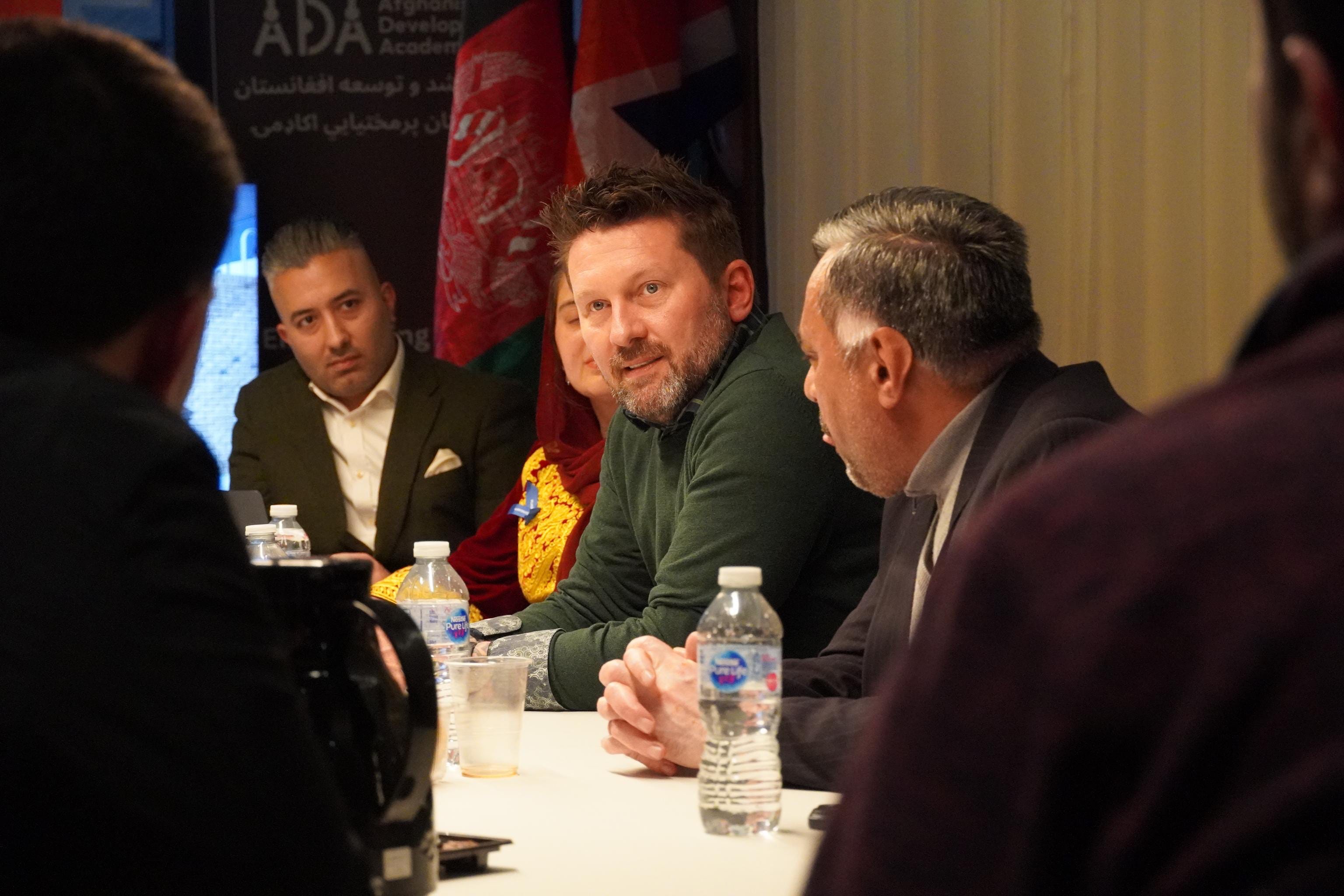
This week, we co-hosted an event in London alongside partners including the Afghan Development Academy and the Afghan British Council, as part of our ongoing effort to expand coordination beyond the United States.
The convening brought together leaders, advocates, and stakeholders working across relocation, resettlement, and long-term integration, with a focus on strengthening collaboration and identifying practical solutions across borders.
For Afghans, this matters because the challenge is no longer confined to any one country. Pathways, protections, and outcomes are increasingly shaped by decisions made across multiple governments. Expanding this work internationally helps ensure that Afghan families have more options, more coordination, and a stronger network of support wherever they are.
Coalition Letter to Cabinet Officials on Afghan Policy Changes
This week, we joined a broad coalition of veterans, faith groups, refugee organizations, and Afghan American leaders in signing a letter to senior cabinet officials raising urgent concerns about recent policy changes affecting Afghan allies.
The letter calls out the real-world impact of these decisions: halted pathways, increased uncertainty for families, and growing risk for those both in the United States and still waiting abroad. It also urges the administration to restore clarity, protect existing pathways, and ensure that policy decisions align with our commitments.
For Afghans, this reflects something important. This is not one organization raising concerns. It is a unified, bipartisan coalition, including veterans who served alongside Afghan partners, making clear that the current trajectory is not acceptable. That kind of alignment matters, and it increases pressure for change.
In the Press
Markwayne Mullin supported Afghan allies. Now he can prove he meant it. — Washington Post
Thousands of San Diego County residents impacted by CalFresh Changes – Yahoo News
‘We don’t have enough food’: Providers brace for thousands of San Diegans to lose SNAP benefits – San Diego Union Tribune
AfghanEvac Warns Trump Budget Could Shut Legal Pathways for Afghan Refugees – Khaama Press
This moment is not defined by a single decision. It is defined by direction, and by whether those in power are willing to meet it.
The courts are drawing lines, sometimes enforcing them, sometimes stepping back. The administration is making choices about capacity, urgency, and transparency. Congress is being asked, again, to do its job.
And increasingly, people are saying out loud what has been building for months: this is a moment for accountability.
For Afghan families, this is not abstract. It is about whether the promises made to them still mean something.
We are not stepping back. We are pressing forward, in court, with Congress, with the administration, and alongside partners here and abroad.
Stay engaged. Keep asking questions. Keep pushing.
Because what happens next will depend on whether people are willing to demand that words turn into action.
“If the president doesn’t take action, then in America, neither the law, nor Congress, nor any ministry has any real power. Everything is in the hands of the president. I don’t think any law there is effective. Is that the case? No one respects anything anymore.”