

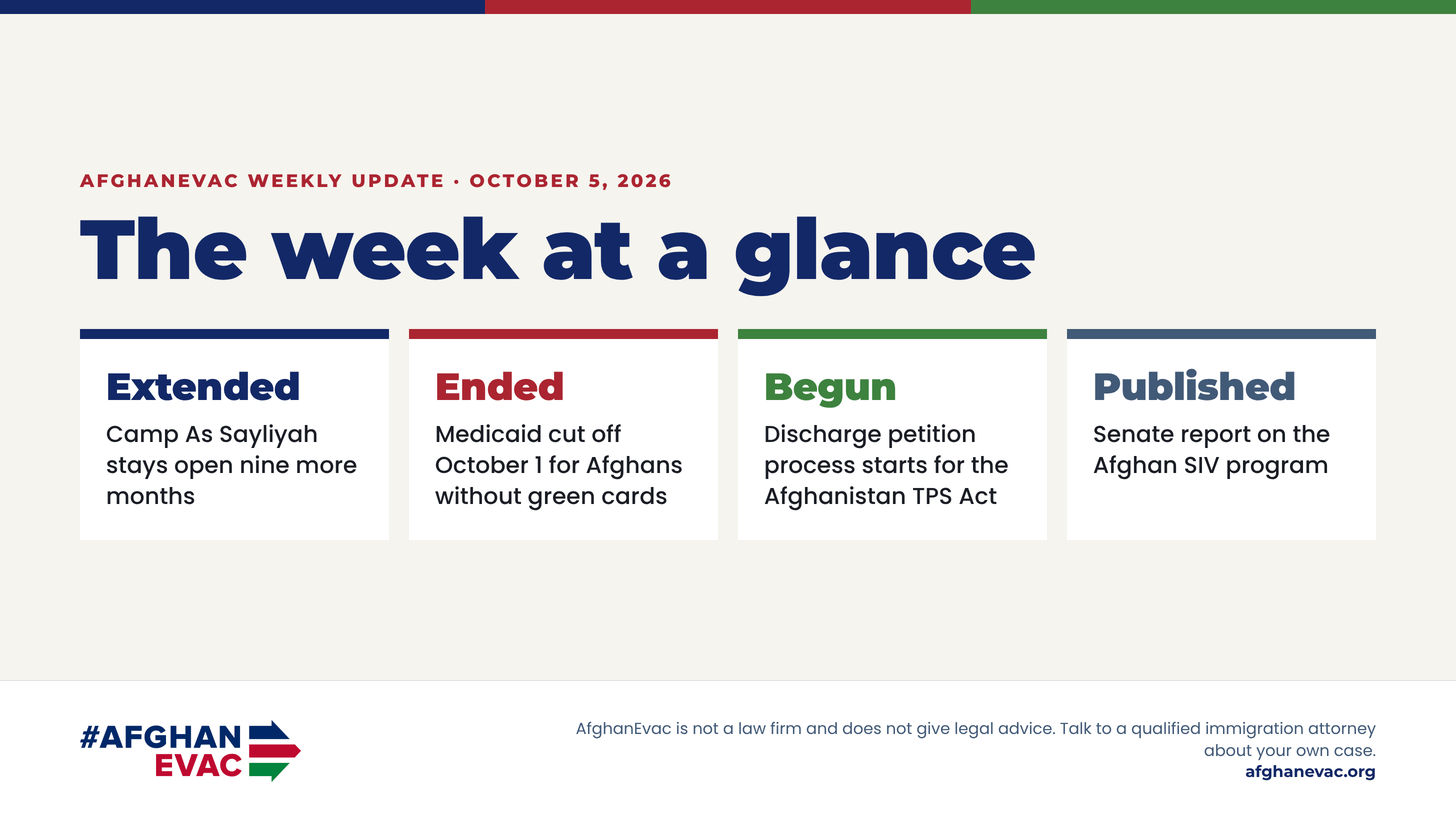
Last week, the government gave with one hand and took with the other. Camp As Sayliyah got nine more months. Afghan families here in the U.S. lost their health coverage. And two members of Congress filed the paperwork that could put Afghanistan TPS to a vote on the House floor, which is the thing we have been asking for since the day TPS was taken away.
ACTION THIS WEEK
Raise your hand for a Hill advocacy day. The discharge petition will need 218 signatures, and members sign when constituents show up in person. We are looking at three windows: November 8 to 10, November 16 to 20, and November 30 to December 3.
As of now, we cannot cover travel or lodging, but we will set up your meetings with your members of Congress and host a happy hour for everyone who comes.
Register for Know Your Rights, Saturday, October 10, 4:00 PM ET / 1:00 PM PT. Free, online, attorney-led, with live interpretation in Dari and Pashto. Register at afghanevac.org/kyr and share it with every Afghan family you know.
Ask your representative to commit to signing the discharge petition. Take two minutes on our website. If your member is already a cosponsor of H.R. 9899, thank them and ask them to sign as soon as it’s ready.
Thank Senator Shaheen and share the SIV report. Read “Standing Strong with Our Afghan Allies”, share it with your senators’ offices, and thank @SenatorShaheen on social media for seventeen years of leadership.
LAST WEEK
Camp As Sayliyah stays open. On September 29, Secretary Rubio signed a nine-month extension of operations at the camp with the government of Qatar. We covered it in a special edition, and I talked through what the extension means, and what has to happen next, with Beth Bailey on The Afghanistan Project podcast. 1,034 Afghan allies and family members, 72 percent of them women and children, including 150 family members of U.S. service members, are no longer facing a closure date with nowhere to go. We thank Secretary Rubio and our Qatari partners. Nine months is time, not a solution. It counts as a win only if the government uses it to redo medicals, finish processing, and move eligible cases now.
Medicaid benefits ended for many. On Thursday, October 1, federal Medicaid and CHIP eligibility ended for many Afghan parolees, refugees, and asylees who do not hold green cards, under last year's reconciliation law. In North Carolina alone, about 14,000 refugees and asylees lost coverage. Many Afghans affected by the change are eligible to adjust to permanent residence but remain without green cards amid prolonged adjudication delays. Applying for a green card does not restore eligibility; approval does. Emergency Medicaid remains available regardless of immigration status.
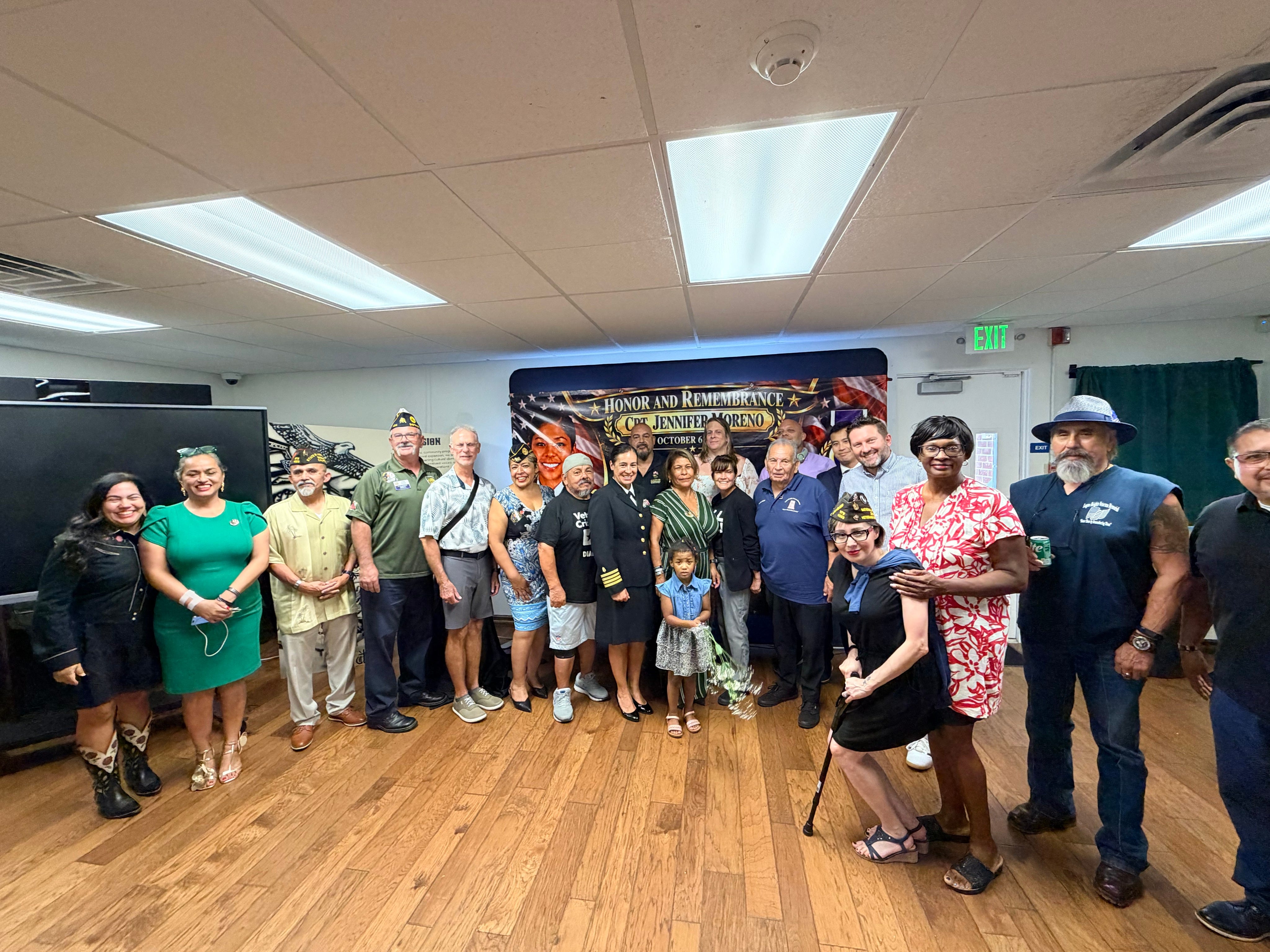
Honoring Captain Jennifer Moreno. On Sunday, members of the AfghanEvac team joined Maria Moreno at the Chicano Park Museum and Cultural Center to honor her daughter, Army Captain Jennifer Moreno. A San Diego native and Army nurse, she served on a Cultural Support Team alongside the 75th Ranger Regiment and was killed in Kandahar Province on October 6, 2013, while going to the aid of a wounded soldier. Thank you to Maria, to Livier Lazaro, and to everyone who keeps her story alive. Her service is part of the same promise we are fighting to keep.
The discharge petition process began. On Thursday October 1, Reps. Jason Crow and Sam Liccardo introduced the special rule that opens the door to a discharge petition on the Afghanistan TPS Act. More on that below, because it is the story of the week.
THANK YOU, REP. CROW AND REP. LICCARDO
On October 1, Rep. Jason Crow (D-CO) and Rep. Sam Liccardo (D-CA) introduced a special rule providing for consideration of H.R. 9899, the Afghanistan TPS Act of 2026. It is a quiet, procedural step, and it matters more than most press releases.
Make no mistake about it: this is the most consequential near-term protection Congress can enact for Afghans already in the United States, and it is within reach.
A discharge petition is how a majority of the House forces a vote on legislation leadership will not schedule. The rule introduced by Reps. Crow and Liccardo is the vehicle the petition rides on. Under House rules, the petition can open for signatures only after the required committee waiting period. Once it does, 218 signatures can force the issue onto the House floor. The sponsors expect that opportunity in the lame-duck session after the midterm elections. This same process brought Haitian TPS to a House vote this spring. Now it is the Afghan community’s turn.
AfghanEvac has called for this since the day Afghanistan’s TPS designation was terminated. We said it then, and we have said it in nearly every update since: the votes exist in the House if members are asked to cast them.
H.R. 9899 is bipartisan from the start, led by Reps. Jason Crow, Don Bacon, Sam Liccardo, and Maria Elvira Salazar, with a Senate companion, S. 5308, led by Sens. Chris Coons, Lisa Murkowski, Amy Klobuchar, and Bill Cassidy. It would designate Afghanistan for TPS through July 1, 2029, allowing eligible Afghans already in the United States to seek protection from removal and work authorization.
For many of the same families who lost Medicaid on Thursday, the ability to keep working can also mean keeping employer-sponsored health coverage.
So here is the plan. Between now and November, we are lining up commitments, not signatures, because the petition cannot be signed until the clock runs out. We want every member who cosponsored H.R. 9899 to pledge to sign the day it opens. And we want every member of Congress who says they support Afghan allies to get on this petition as soon as it is available. That is how they prove it.
Then we go to the Hill in person. If you are willing to come to Washington, let us know.
We are grateful to Rep. Crow and Rep. Liccardo for doing the hard procedural work. Now the rest of us have to finish it.
Why it matters: The House can force a vote on protection for Afghans that leadership has refused to schedule. This is the clearest legislative path to protection Afghans in the United States have had in nearly two years.
THANK YOU, SENATOR SHAHEEN
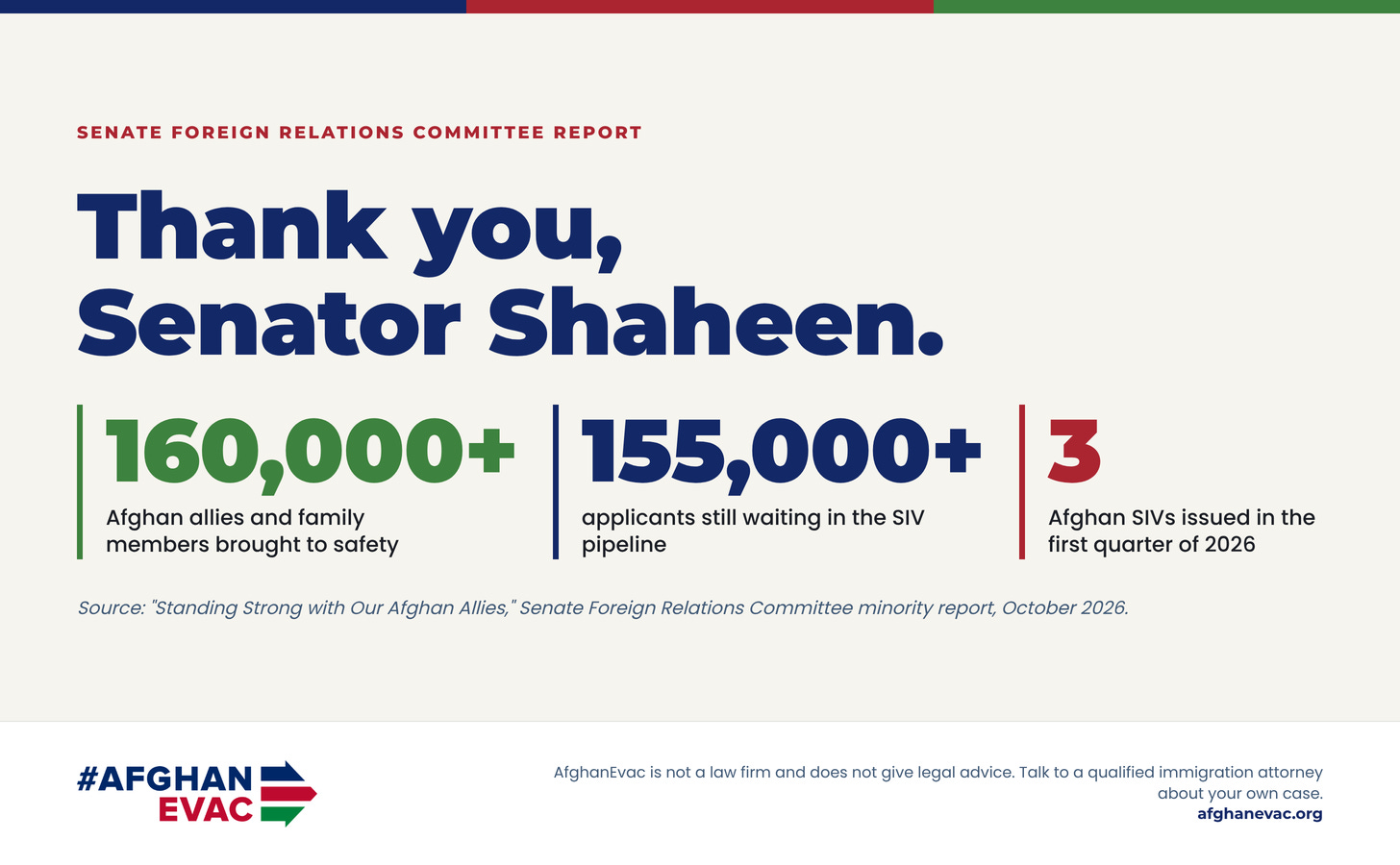
On October 2, Senate Foreign Relations Committee Ranking Member Jeanne Shaheen and nine Democratic colleagues published “Standing Strong with Our Afghan Allies,” a committee minority report on the Afghan Special Immigrant Visa program.
It is one of the most comprehensive congressional accounts yet of what this program was built to do and what has happened to it since. More than 160,000 Afghan allies and family members have reached safety through the program. More than 155,000 applicants remain in the pipeline. In all of 2026, the State Department issued three Afghan SIVs.
The report does not stop at numbers. It walks through the extraordinary vetting Afghan allies undergo and cites inspectors general who repeatedly found that process sound. It documents the elimination of the CARE office, grounded flights, stop-work orders, TPS termination, and arrests of SIV applicants at immigration appointments.
And it gives Congress a road map: resume SIV issuance immediately, authorize 100,000 additional visas, create a permanent program for wartime allies, and require meaningful reporting and inspector general oversight.
The report also puts people behind the numbers, including Sweeta Azimi, the women of the Female Tactical Platoon, and Janis Shinwari, while documenting AfghanEvac’s work on CARE and Battle Buddies. We are grateful to the committee staff who did the hard work of building it.
None of this is new for Senator Shaheen. In 2009, she worked with Senator John McCain to create the Afghan SIV program. For seventeen years, she has fought to extend it, fund it, and fix it under presidents of both parties, often when few others were paying attention.
As she finishes her final term in the Senate, this report is both a capstone and a road map for whoever picks up the fight next.
Thank you, Senator. America made this promise in large part because you insisted on it.
Why it matters This is now a formal Senate Foreign Relations Committee minority record, with specific recommendations attached. Read it, share it, and ask your senators which recommendations they will support. It also stands alongside the independent record AfghanEvac has built, including The Unfinished Mission, our accounting of the SIV pipeline.
COMING UP
Know Your Rights, Saturday, October 10. Free, online, 4:00 PM ET / 1:00 PM PT, with live interpretation in Dari and Pashto. Convened by AfghanEvac in partnership with the Afghan-American Community Organization, the South Asian Bar Association of San Diego, California Immigration Project, Afghan Refugee Empowerment Fund, Project ANAR, and Nowruz Media.
The faculty: Arwa Zakir Kakavand, Managing Attorney at Casa Cornelia Law Center and president of the San Diego South Asian Bar Association; immigration attorney Spojmie Nasiri, a member of AILA’s Afghan Response Task Force; Sweeta Azimi of the California Immigration Project; and Laila Ayub of Project ANAR.
The program will include presentations in English, Dari, and Pashto covering your rights during immigration encounters, preparing for appointments and interviews, what to do if someone is detained, family emergency planning, and how to find a qualified lawyer.
Topics include understanding your rights in an immigration encounter, preparing for appointments and interviews, what to do if someone is detained, family safety planning, and how to find a qualified lawyer.
AfghanEvac is not a law firm and does not give legal advice; this training is general information, and you should talk to a qualified immigration attorney about your own case.
Fee increases, October 16. New USCIS fees take effect for filings on or after October 16, including $570 for an initial work permit for certain asylum applicants, TPS holders, and parolees, and $1,050 for humanitarian parole. Immigration court fees went up October 1, including $1,590 for a green card application before EOIR. If you are planning to file, talk to your lawyer about timing this week.
SIV class action, November 6. The D.C. Circuit hears arguments in the appeal in Afghan and Iraqi Allies v. Rubio. The government’s own progress report shows zero SIVs issued to Afghan class members between June and September.
THE REFUGEE NUMBER IS SIGNED. AFGHANS ARE NOT IN IT.
The FY2027 Presidential Determination on Refugee Admissions, signed September 25 and published in the Federal Register on October 2, sets a ceiling of 17,500, “primarily” for Afrikaners from South Africa. It does not mention the Afghans who served beside American troops for twenty years. Before it closed, our Count Them In campaign sent more than 3,800 letters to Congress asking for at least 5,000 places for Afghan mission partners and U.S. military families. That ask stands, and 17,500 leaves room to meet it. The national interest exception that brought two Afghans here on September 22 remains in place. Our statement is at afghanevac.org/count-them-in.
Why it matters "Primarily" does not mean "exclusively." The administration has already shown that the national interest exception can work. Now it should use that authority at scale for Afghan mission partners and the families of U.S. service members.
A LETTER FOR MILITARY FAMILIES
On September 29, Rep. Scott Peters and 19 House and Senate colleagues wrote to Secretaries Rubio and Mullin asking them to prioritize refugee processing for immediate family members of U.S. service members stranded abroad, starting with Camp As Sayliyah, and to facilitate family reunification for Afghans with relatives lawfully in the United States. Thank you, Rep. Peters, and every member who signed.
Why it matters The record is building in Congress, in writing, with names attached. That record is what turns a promise into a vote.
THIRD-COUNTRY REMOVALS RESUME
On September 29, the Supreme Court, 6-3, stayed the lower-court judgment in D.V.D. v. DHS, allowing the administration’s third-country removal policy to remain in effect while the case proceeds. Lower courts had found that the policy failed to provide adequate notice and a meaningful opportunity to raise country-specific fears of persecution or torture. The Supreme Court will hear the case in December.
Afghans have been placed on these flights. If you or someone you know faces removal to a third country, tell your lawyer immediately and ask for a Battle Buddy.
Why it matters: Sending an ally to a country where they have no legal status and no future, knowing they may ultimately be pushed back toward the Taliban, risks becoming refoulement with a layover.
THE REGION
On October 1, Pakistani airstrikes hit Kunar and Helmand provinces. The UN Assistance Mission in Afghanistan (UNAMA) reported at least 10 civilians killed, mostly children. Pakistan said it struck militant camps; the Taliban called it aggression. The UN has documented more than 1,100 civilian casualties from cross-border violence in Afghanistan this year, while Pakistan and Iran continue mass deportations of Afghans back across those same borders.
Why it matters The P-1 and P-2 families who write to us every week are living between airstrikes on one side and deportation buses on the other. Every month the U.S. pipeline stays shut, that is where they wait.
IN THE NEWS
Stories from the past week.
Camp As Sayliyah
Trump is set to extend the Qatar camp housing more than 1,000 Afghans who helped the US war effort -- Associated Press
The Afghanistan Project Podcast, Episode 157: AfghanEvac’s Shawn VanDiver talks Camp As Sayliyah -- Beth Bailey, The Afghanistan Project
Afghan allies get reprieve as Trump admin agrees to keep Qatar refugee camp open -- Scripps News
Qatar camp to receive reprieve -- Los Angeles Times
US Extends Qatar Camp Housing More Than 1000 Afghan Allies for Nine Months -- Khaama Press
US extends Qatar camp stay for more than 1000 Afghans -- Ariana News
US still talking with countries to resettle Afghans as Rubio defends entry to white South Africans -- Associated Press
The refugee number
Congress
Ranking Member Shaheen and Senate Democratic Members Publish New Report on U.S. Commitment to Afghan Allies -- Office of Sen. Jeanne Shaheen
Peters Demands Answers for Afghan Allies and Military Families Stranded Abroad -- Office of Rep. Scott Peters
Benefits
Medicaid about to end in NC for thousands of refugees -- News From The States
Removals and the State Department
U.S. Supreme Court sides with Trump administration in third-country deportations -- NPR
Trump official central to deportation deals tapped for ambassadorship -- The Washington Post
The region
Pakistan launches deadly air attacks on Afghanistan -- Al Jazeera
Pakistani airstrikes in Afghanistan kill 10 civilians, Kabul and U.N. say -- NBC News
Pakistan’s army says Afghan Taliban governor hosted militants plotting attacks -- The Washington Post
Last week proved something we have said for five years.
When people in power decide to act, things move.
A camp got nine more months.
A refugee exception put two Afghans on a plane.
Two members of Congress opened a path to a vote.
None of it happened by accident, and none of it is enough.
Families here lost their doctors on Thursday because nobody would sign their green cards.
Families in Qatar still do not know where they will live in July.
Every one of those outcomes is a choice, and choices can be unmade.
The discharge petition is how Congress makes a different one, and it will only reach 218 signatures if members hear from you, see you in their offices, and know you are counting.
Sign up for the Hill day. Show up on Saturday. Bring someone with you.
We are furious. We are focused. And we are not going anywhere.