

Labor Day pushed us to Tuesday, so use the extra day to watch four minutes of television. A State Department official was asked on camera whether this country owes anything to the people who fought beside it. He said that was “not the right question.” Then he mischaracterized who is at Camp As Sayliyah and how they got there. He was wrong on every count. The government’s own Inspector General proves it, and today we are demanding a correction from the podium.
HERE’S WHAT’S IMPORTANT THIS WEEK
We are demanding a correction from the podium, and publishing the letter in full
Immigration judges were trained to deny more requests for additional time, known as continuances, and to grant shorter delays when they do
The State Department paused immigrant visa appointments globally after a court told it to restart processing, and two court-ordered filings land today, including the Department’s August processing numbers
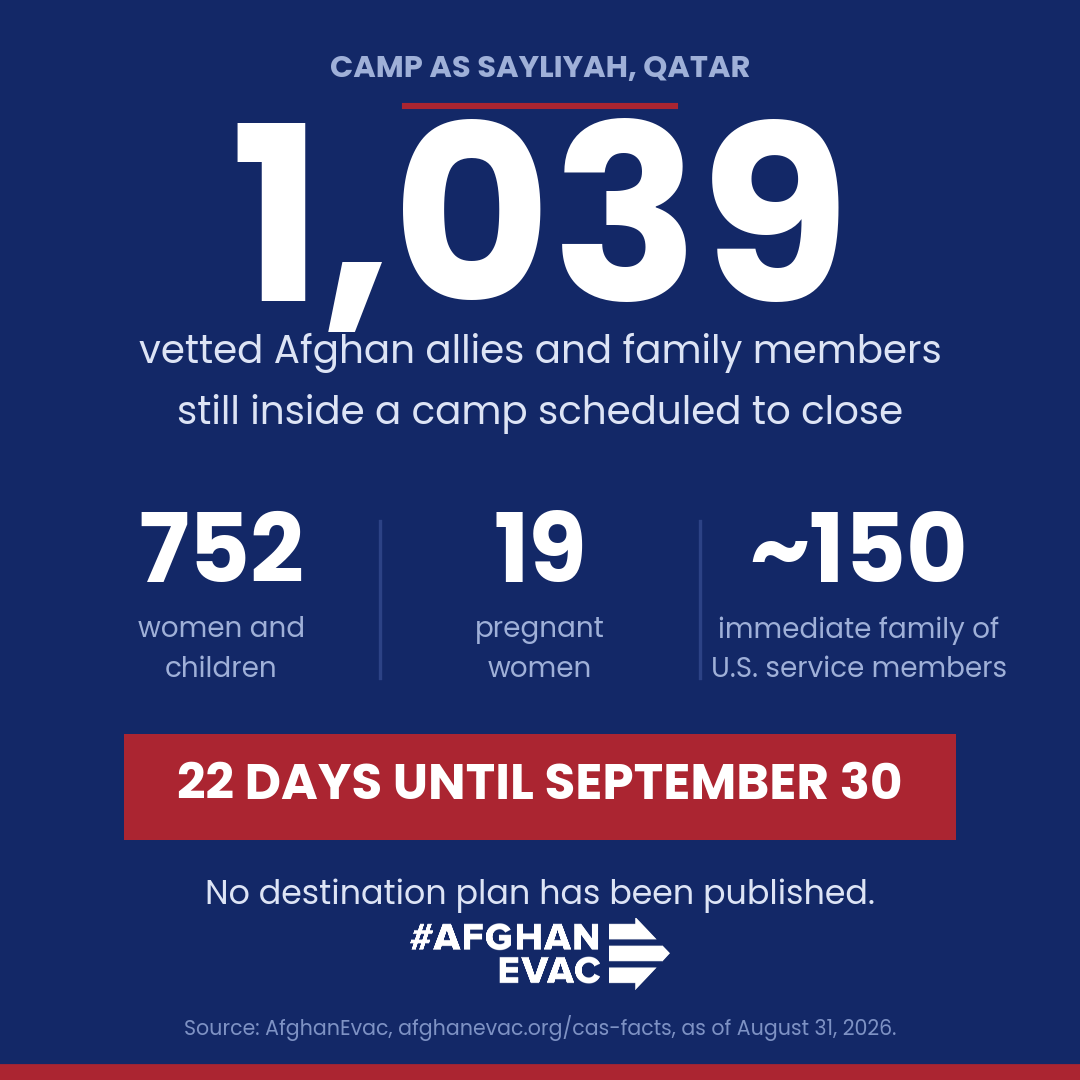
1,039 people are still at Camp As Sayliyah, with 22 days until the camp is supposed to close
USCIS is switching to new editions of several common forms with no grace period. File an outdated version of the form, and USCIS will reject your application
A pastor in San Antonio sat in a courtroom this week so an interpreter would not have to sit there alone
Start with the ways you can take action, then read the rest.
ACTION THIS WEEK
Read our letter to the State Department and share the clip. We are demanding a correction from the podium on four counts. Letter at afghanevac.org/correct-the-record, video here. Send both to your representative and both senators with one line: your constituents have answered this question.
Enroll as a Battle Buddy at afghanevac.org/battle-buddies. Immigration hearings resumed today under the new continuance standards, and accompaniment matters more this month than it did last month. We have over a thousand people signed up. We need more.
Write your members of Congress about the refugee admissions determination before October 1. The President is required by statute to set the fiscal year 2027 refugee ceiling before the fiscal year begins. Nothing has been announced with 24 days left. Ask that Afghans be included and that the number reflect the promise, not last year’s 17,500 floor. Visit afghanevac.org/count-them-in and let’s #CountThemIn
Contact Congress about Camp As Sayliyah before September 30. Demand resumed processing and a published destination plan before the camp closes. Facts and scripts at afghanevac.org/cas.
“NOT THE RIGHT QUESTION”
Watch this one. A State Department official is asked, on camera, whether the United States has an obligation to people who were willing to fight and die for it. He answers, “But that is not the question before us currently.” Pressed, he says, “But it’s not the right question.” Then he explains what he takes the right question to be. The people at Camp As Sayliyah, he says, are “primarily a group of people that were either unvetted, brought there by other contractors, not based off of promises made from the United States.”
Every element of that is wrong, and the government’s own records prove it. The State Department built Camp As Sayliyah, standing up CARE Doha there in October 2022 to support Enduring Welcome, and it has run the camp since October 2023. The site operates on a U.S. Army contract now worth roughly $411 million. Those are not our figures. They are the Defense Department Inspector General’s. And the Lead Inspector General told Congress these Afghans were “relocated by the U.S. Government to U.S.-managed platforms.” The contractors that official pointed at were executing an American government contract, because the American government wrote it, awarded it, and paid for it.
On vetting, the record is not complicated.
The camp exists to vet people. The Lead Inspector General called Camp As Sayliyah the place “where thousands of Afghans were processed en route to the United States.”
Most of them did not come out in the August 2021 airlift. They came later, through Enduring Welcome, which did not launch until October 2022. Anyone invoking the chaos of the withdrawal to describe this population is describing different people, in a different year, under a different process.
They were screened before they boarded. Vetting, biometrics, and medical screening were completed in Kabul, on the ground, before anyone got on a plane. The full process is laid out at afghanevac.org/vetting.
The screening worked. An Inspector General audit found a watchlist match rate of six hundredths of one percent among evacuees.
And residents of that camp have received denials. A denial is an adjudication. It is the finished product of a review this Department ran, in a file this Department opened. You cannot deny an application you never examined. Every denial issued there is proof the screening happened, which means the Department is either wrong about the vetting or it has been issuing determinations on people it never screened. There is no third option.
So today we are sending the Department a letter demanding a correction from the podium, and publishing it in full. We are asking for four things. Correct the Camp As Sayliyah characterization. Answer the obligation question the official refused. Stop blaming the November 2025 shutdown of Afghan processing on a prior administration’s vetting, when this administration approved that shooter’s asylum in April 2025. And disclose whether the Department has changed who counts as the family of an American service member. Parents and siblings were approved through a Defense Department program because their relationship to an American in uniform put them in danger. That danger did not change when the internal guidance did.
None of this is abstract. The same broadcast tells the story of Mohammad Nazeer Paktiawal, who served alongside U.S. Army Special Forces for nine years. ICE took him from outside his Dallas apartment in March as he was putting his children in the car for school. He was dead in American custody in under 24 hours, and six months on, no government agency has called his family.
Instead of asking the government what it thinks, we asked the country.
84% say the United States should keep its commitments to Afghan allies and their families
73% say Afghan mission partners should be allowed to remain here while their cases are processed
72% want a permanent wartime allies program rather than improvisation after the fact
63% oppose deporting them or shipping them to third countries
83% agree that no American in uniform should have to leave family behind, and among military households, 73% hold that view strongly
Why it matters A spokesperson’s job is to state the government’s position accurately. It is our job to remind them when they are doing the opposite.
THEY TOLD THE JUDGES TO RUN THE CLOCK
On September 2, the Executive Office for Immigration Review convened hundreds of immigration judges for a mandatory virtual training titled “Motions to Continue: Efficiently Advancing Cases to Completion.” The Guardian reported it on September 4. The American Immigration Lawyers Association obtained the slides, which the Department of Justice has not posted publicly. The instruction was straightforward. Grant fewer continuances, and grant them for less time.
Read what the slides actually say. Judges were told that “assertion alone that more preparation time is needed does not establish good cause,” and to be skeptical when someone asks for more time because another government application is still pending. They were also told that a lawyer who takes on more cases than she can responsibly handle may be referred to EOIR disciplinary counsel for possible sanction. One person familiar with the training described its message to The Guardian this way. “There is no room to be kind; there is only urgency to make them leave, one way or the other.”
Here is why that lands on Afghan allies. Thousands are in removal proceedings while the government sits on the very applications that would resolve their cases. USCIS froze adjudications. State stopped issuing visas. Chief of Mission decisions are running at a fraction of what a federal judge ordered. The continuance is the only tool a person has to say to an immigration judge, my case is pending, please do not deport me while the government finishes the work it promised to do. The administration froze the paperwork with one hand and is closing the escape hatch with the other. That is not a backlog. It is a vise, built on purpose.
The government’s own training says what this costs. Between 2019 and 2024, 25% of immigrants with a lawyer were ordered removed. More than 60% of those without one were. Judges have already begun applying the new standards, and the hearing calendar restarted today. We are asking Congress to demand the slides be made public, practitioners to preserve the record on every denial, and every one of you who can sit in a courtroom to sign up for Battle Buddies this week.
STATE ANSWERED A COURT ORDER BY PAUSING VISAS WORLDWIDE
Since August 21, the State Department and a federal court have been in a fast-moving back-and-forth over whether the Department is complying with an order to restart immigrant visa processing.
That day, Judge Jeannette Vargas of the Southern District of New York set aside the Department’s blanket suspension of immigrant visas for nationals of 75 countries as contrary to law, and judgment was entered August 24. The Department’s response was a new worldwide pause on immigrant visa appointments, which it attributed to consular officer training. Plaintiffs moved to enforce on August 26, and on August 31 Judge Vargas granted that motion in part and ordered the government to file a status report by today.
As of the end of last week, appointments were still paused. State told the Associated Press the pause was expected to be temporary and not to extend beyond early to mid-September. We have heard that kind of assurance before, from the same building, about the March 31 camp deadline that came and went.
Why it matters Afghans remain barred by the separate 39-country proclamation, which this ruling did not touch, so the effect here falls on family reunification. These are approved I-130 petitions filed by American citizens and lawful permanent residents for Afghan spouses, parents, and children. Those families won a court ruling and got a global pause instead.
TWENTY-TWO DAYS
September 30, 2026 is a Wednesday, and may just be one of the most important Wednesdays of the year. Camp As Sayliyah is scheduled to close. The fiscal year ends. And the President is required to have issued the fiscal year 2027 Presidential Determination on refugee admissions before October 1.
Inside the camp, per our own count as of August 31, there are 1,039 Afghan allies and family members. Of those, 752 are women and children. Nineteen are pregnant. Roughly 150 are the immediate family of American service members and recently separated veterans. Every one of them was vetted before the United States government put them on a plane to Qatar. There is still no published destination plan. Transparency and safety are what is owed to the men, women, and children who live there with no clear answers about the future many of them were promised.
Last year’s refugee admissions ceiling was 7,500, the lowest in the history of the program. In May 2026 the administration raised it to 17,500, with every additional slot allocated to white South Africans. The administration is poised to allocate all or nearly all to the same population this year. Congressional consultations start September 23rd and we all need to engage to make sure Afghans are added into the FY2027 determination. To do that, we all need to raise our voices.
Why it matters None of these three deadlines requires new legislation, new money, or a new policy. Each requires a person to sign something. If September 30 arrives with the camp closing, no destination plan, and no determination that includes Afghans, that will not be a system failure. It will be a set of decisions made by a small number of named people, and we will name them.
THE NUMBERS THAT SHOULD LAND TODAY
Judge Tanya Chutkan ordered the State Department to report, one week after each month ends, how many Chief of Mission cases it processed. June’s report arrived July 7, July’s on August 7. August’s is due now, and as of last night it had not hit the docket.
Here is the context for that number. The court set escalating monthly benchmarks in May, rising from 1,000 cases in June to 4,000 in October. State processed 916 in June, then 811 in July, fewer than the month before, in the month a federal judge ordered the figure to go up. More than 13,000 class member cases are already past the 120-day deadline the government’s own plan sets. We laid out how this pipeline was built and how it was shut off in The Unfinished Mission.
We are not going to render a verdict on a number we have not seen. Next Monday we will publish the August figure and the full trend line, whatever it says. Two other filings land alongside it. Judge Vargas’s status report in the visa case is due today, and the government’s opening brief in Dorcas International Institute v. USCIS, its appeal of the ruling that struck down USCIS benefit freezes, is due in the First Circuit on Thursday.
Why it matters Every one of these deadlines exists because a court had to compel this government to do something it would not do on its own. That is the actual state of play, and it is worth saying plainly. Watch what gets filed this week. Watch just as closely what does not.
USCIS CHANGED THE FORMS. THERE’S NO GRACE PERIOD.
The Affidavit of Support forms, I-864, I-864A, and I-864EZ, changed on August 31. Form I-765 and Form I-539 change on September 15. Form I-485 changes on September 18. None of them carry a grace period. File on the wrong edition and it comes back rejected, which for anyone with a filing deadline can be the whole case. One more thing worth knowing. The new I-864 lets USCIS pull a sponsor’s credit report directly from the bureaus, so sponsors with a credit freeze may need to lift it.
Why it matters A rejected filing is not a delay, it is a lost date. When an agency changes four forms in three weeks with no grace period and no outreach, the burden falls hardest on people filing without a lawyer, which describes most of the community we serve.
A FOURTH REPUBLICAN ON THE TPS ACT
Rep. Morgan Luttrell of Texas, a former Navy SEAL, signed on to the Afghanistan TPS Act of 2026. H.R. 9899, led by Rep. Jason Crow, now carries nine cosponsors. Four are Republicans, Reps. Salazar, Bacon, Wilson, and now Luttrell, and Rep. Kevin Kiley of California is listed as an independent. In the Senate, S. 5308, led by Sen. Chris Coons, has three cosponsors, including Sens. Murkowski and Cassidy. Neither bill has moved out of Judiciary and won’t unless we all ensure Congress views this as a priority.
This bill is the single most important thing we can get down now to help our mission partners who have already made it to the United States.
Since we opened the campaign, 1,786 of you have contacted Congress about this bill, from 49 states and the District of Columbia. North Dakota is the only state that has not sent one yet. California leads with 231, then Virginia with 184 and New York with 132. Texas, North Carolina, and Florida all sit in the top ten, which tells you something about who is asking.
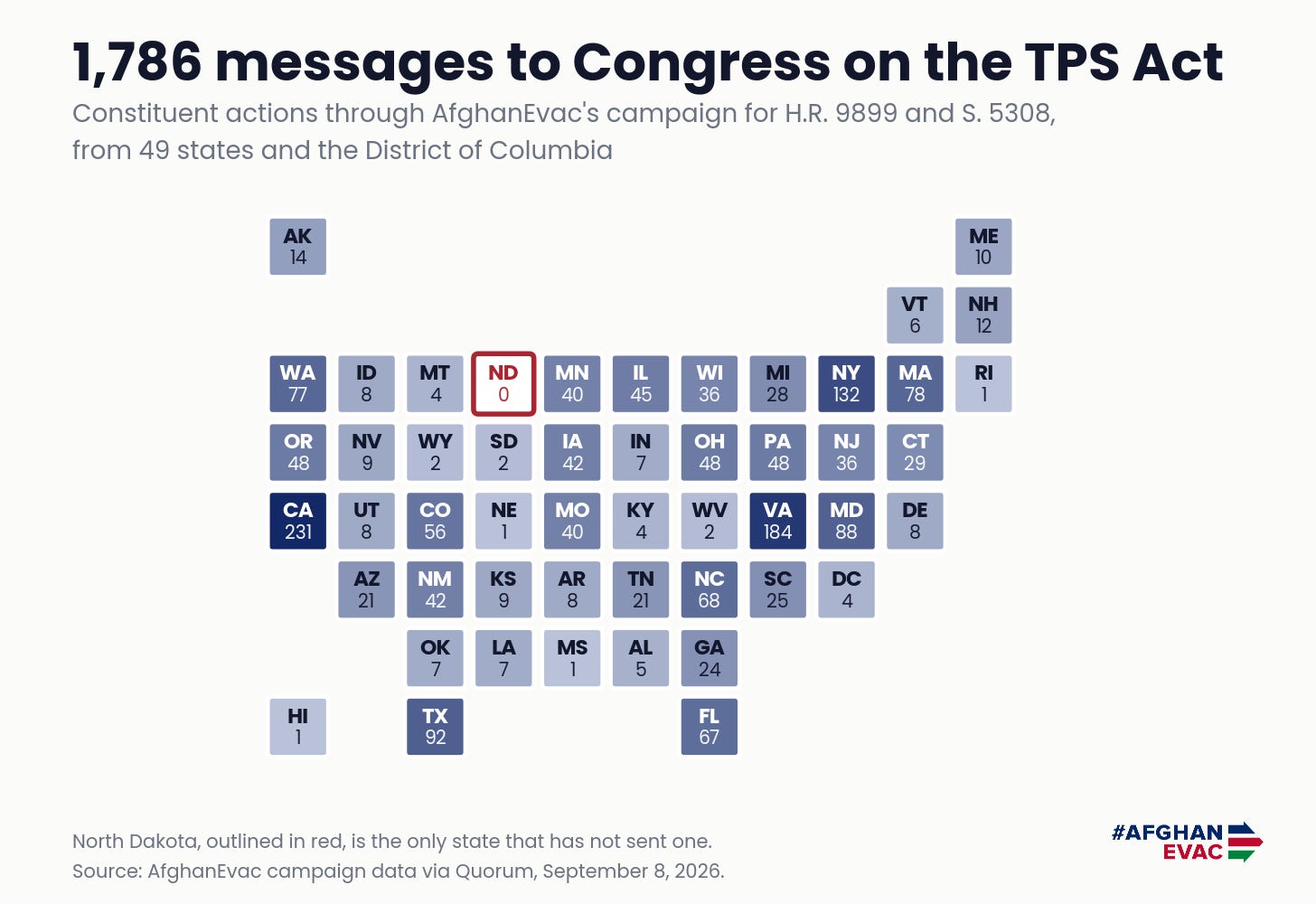
Why it matters 73% percent of Americans support letting Afghan mission partners remain here while their cases are processed. The bill is bipartisan. It has 1,786 constituent messages behind it from nearly every state in the country. It has not moved out of Judiciary since July. So what is Congress waiting for? Ask them at afghanevac.org/tps.
SPRINGFIELD
Pierre Damas Bel was 20, a Wright State freshman studying neuroscience, a Marine Corps JROTC cadet and varsity soccer player who graduated from Springfield City Schools in May. His Temporary Protected Status expired in late July, and ICE fitted him with an ankle monitor, as it did to hundreds of Haitians in Springfield, Ohio. He wrote online that he was “walking through the streets with a GPS monitor on my leg, carrying a feeling of shame and humiliation.” He died on August 31. Haitian leaders there are now demanding an end to the monitors.
Why it matters Afghan allies are not the only people whose families, futures, and dignity have been torn apart by policy decisions. The same enforcement machinery that put a GPS monitor on Pierre Damas Bel’s leg is being used against communities across the country, including Afghans. Different histories, same human cost. El Salvador’s TPS ends tomorrow for more than 200,000 people who have held it for 25 years. Sudan and Ukraine follow on October 19.
INTERNATIONAL: THE P-1 AND P-2 FAMILIES IN PAKISTAN
All week, Afghan families in the P-1 and P-2 refugee referral categories wrote to us from Pakistan with the same disciplined ask, repeated almost word for word by dozens of accounts. Restart the cases. They are right to be impatient. The U.S. Refugee Admissions Program has been suspended since January 20, 2025, which means people the United States government itself referred, journalists, human rights workers, and others targeted for their association with America, have now been waiting four years.
Their situation on the ground is getting harder on a separate track. UNHCR reports that more than 307,000 Afghans returned from Pakistan between January and July of this year, and roughly 1.6 million remain. Families in the U.S. pipeline are losing lawful status in Pakistan, and some have been detained while holding valid Pakistani documents. That is a Pakistani enforcement problem rather than a U.S. refugee-processing problem, and it is what makes the American delay dangerous.
Why it matters The ask is straightforward. Restart refugee admissions for people who have already been waiting in the U.S. pipeline, including P-1 and P-2 families. When you call Congress this week, say P-1 and P-2 out loud.
BATTLE BUDDIES: SAN ANTONIO
Chad is an Army veteran who deployed to Iraq twice as a human intelligence interrogator and now pastors Arsenal Church in San Antonio. This week he accompanied an Afghan interpreter for U.S. and coalition forces to immigration court. The man had followed every step the government asked of him and was in removal proceedings anyway, because he is still waiting on durable status the government stopped granting.
“Having a buddy that can navigate that was helpful,” Chad said, “since I don’t have the same stakes to lose, and can be more upfront in asking court staff questions.” On why he goes, he was blunter. “We have people coming over with promises of safety and security, promises that got pulled from them. This should piss all of us off. They put their lives on the line for us. I need to see that they are being fought for.”
The no-detention record where a Battle Buddy is present still stands.
NEEDHAM IS LIVE
We launched NEEDHAM, the News and Evidence Engine Documenting Historical AfghanEvac Media. It is a free research tool that searches the full text of every AfghanEvac publication, which means reporters, congressional staff, and advocates can now find what we said, when we said it, and what happened next.
IN THE NEWS
Stories from the past week.
The courts and the calendar
US immigration judges told to slash time given to people awaiting visas or green cards before being deported -- The Guardian
Immigration judges face tighter limits on case delays -- Elite
Enforcement at scale
ICE arrested 50,000 people in August, continuing record pace -- NBC News
ICE’s August Arrests Break Record for Number of Illegal Aliens Arrested -- U.S. Department of Homeland Security
Springfield
Remembering Pierre Damas Bel, an Ohio college student with great promise -- NPR
Trump Took His Status. ICE Took His Dignity. He Took His Life. -- The Bulwark
Springfield advocates demand end to ankle monitors after Haitian student’s suicide -- Journal-News
Five years on
Five years after Kabul’s fall, two Prince William Afghans recall their frantic escape, and the ensuing limbo -- InsideNoVa
Five Years After the Fall of Kabul -- Connection Newspapers
Third-country removals, still developing
ICE deports Afghans and others to Africa, expanding “third country” deportations -- CBS News
Relative of Afghans who aided US military deported to Africa -- Al Jazeera
Pakistan
Over 300,000 Afghans return from Pakistan this year amid repatriation drive, UNHCR -- Arab News Pakistan
One correction worth making An aggregator recirculated a June 2025 Military Times story this weekend under the headline “Trump issues travel ban, bars Afghans from entry into US,” and it moved through inboxes as if it were new. It is fifteen months old. No new travel ban proclamation was signed this month. The operative instrument is still Proclamation 10998, effective January 1, 2026. The real news is quieter and worse, and it is in the sections above.
They can call these people unvetted. They cannot make it true.
The screening happened, the American government paid for it, and its own inspectors wrote it down.
A definition changed quietly only works if nobody checks it, and checking is the whole job now.
Read the letter.
Watch the four minutes.
Send both to the people who represent you.
And if you can get to a courtroom this month, get to a courtroom. Show up. Bring a buddy.
We are not going anywhere.
Hi bro I have worked for ODA3235 Now I am trouble the Pakistan government deported us to Afghanistan
The hardest test of an alliance does not come when soldiers are fighting side by side.
It comes afterward—when the battlefield is quiet, the political attention has moved elsewhere, and the people who once stood beside you are no longer strategically useful.
Afghanistan should have taught the United States and its allies a fundamental lesson: promises made during war do not disappear when the war ends.
For an Afghan who served alongside American forces, the question is not simply about immigration policy. It is about whether partnership has meaning beyond the moment of shared military necessity.
A military alliance is ultimately built on trust. If local partners conclude that they can be asked to risk their lives when they are needed, but forgotten when the political environment changes, future partnerships become more difficult—not only morally, but strategically.
This is why the Afghan case matters far beyond Afghanistan.
Every military power that operates through local partners is making an implicit promise: “Your risk will not be forgotten.”
If that promise collapses, the damage does not end with one group of interpreters, soldiers, families, or visa applicants.
It becomes a lesson that the next generation of potential partners will remember before deciding whether to stand beside you.
The credibility of an alliance is not measured only by how a country treats its soldiers.
It is also measured by how it treats the people who fought beside them when they no longer have anything to offer.
That is not charity.
It is the long-term strategic value of keeping one's word.