

Twenty-five years after the towers fell, the country spent Friday remembering. We spent it doing both jobs at once: honoring the dead, and telling the truth about who has paid for what came after. No Afghan was among the nineteen hijackers. Yet Afghans have borne an extraordinary share of the cost of the war that followed, including the people who fought alongside us and whom we promised not to abandon. This week, some of those promises came due on paper.
We committed last week to publishing the August Chief of Mission decisions number. That number was supposed to be 3000 but the Department said they took a summer vacation and only processed 752.
Read to the end to make sure you catch our correction from last week.
The August Chief of Mission figure landed, and it is the worst month since the court started counting
The fiscal year 2027 refugee number is coming, consultations with Congress start next week, and Afghans are not included in the draft
The Afghanistan TPS Act has a path, but it’s narrow and we need you to act today
We went to Washington and asked State for a correction in person, and got silence
USCIS reversed itself on a form deadline, and Medicaid changes hit October 1
An incredible town hall in Sterling, VA
Sixteen days until Camp As Sayliyah is supposed to close, with 1,039 people inside and no destination plan
ACTION THIS WEEK
IF YOU DO ONE THING THIS WEEK: COUNT THEM IN.
This is the single most time-sensitive thing on this list. Consultations between the administration and Congress begin this week, and staff need the information in hand before they walk into the room, not after. 1,183 letters have gone to congressional offices since we opened this campaign. That is a start. It is not enough to move a number. If you are in the United States, take three minutes and send one. Then send the link to five people who will.
Ask your representative to cosponsor the Afghanistan TPS Act. H.R. 9899 has nine cosponsors, four of them Republicans. S. 5308 has three. 2,077 of you have written Congress on this bill.
Check your Medicaid status before October 1. Refugees, asylees, and humanitarian parolees without green cards may lose eligibility that day. Afghan and Iraqi SIV holders remain eligible and do not face the five-year wait. If you get a termination notice and you hold an SIV, that notice may be wrong. Appeal before coverage ends, and call your resettlement agency to ask about deadlines and waiver options. Not all states have these options, but some may, and local resettlement offices are your best connection to those resources.
Share our letter to the State Department at afghanevac.org/correct-the-record. We are still waiting on an answer and we know that Tommy and his team are VERY sensitive about this topic.
752
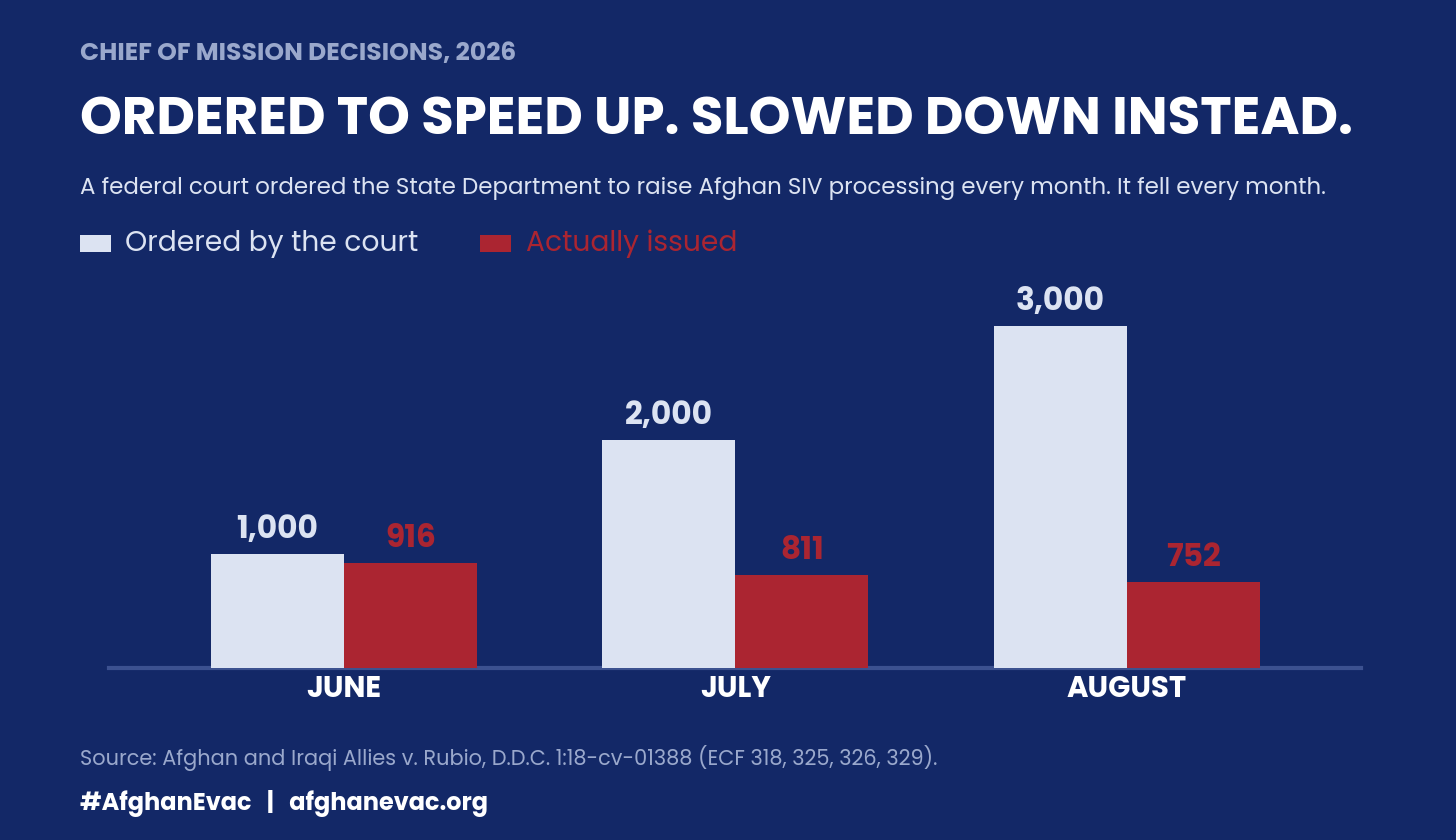
The State Department filed its August report with Judge Tanya Chutkan on September 8. It issued Chief of Mission decisions in 752 cases for the entire month. But the court ordered 3,000.
Note the trend, because the trend is the story. The court set escalating monthly benchmarks in May, rising from 1,000 in June to 4,000 in October. State delivered 916, then 811, then 752, three consecutive months of decline in the exact period a federal judge ordered the number to rise. Here is the comparison that matters. Before this administration cut the staff who did this work, the Department was issuing more than 1,000 of these decisions a week. It is now issuing fewer than 200 a week. Nobody inherited this. The capacity existed, and it was purposely dismantled.
The Department told the court that August fell off because of “seasonal fluctuations in staffing during August, in which many staff took summer vacation and Foreign Service Officers routinely transfer between positions.” Its legal position in the same case is that “failure to meet the numerical interim benchmarks is not, in itself, noncompliance,” because the order said “endeavor.” So the government’s argument is that a court’s numbers are aspirational, and that the reason it missed them by 75 percent is that people were on vacation. Plaintiffs answered that in the August 28 filing. State has “failed the Court’s benchmarks in each of the months since they were ordered,” and its performance “deteriorated over the same time period the Court has ordered Defendants’ performance to improve.” More than 13,000 class member cases are already sitting past the 120-day standard in the government’s own plan.
Here is the part that should worry anyone waiting. State’s fix is a hiring and training pipeline that runs 12 to 13 months, which by the Department’s own account will reduce processing capacity for at least the next year. As of September 4, only 3 of the 20 officers it needs to do this had onboarded. And the Department told the court that at 150 fully trained staff it could issue 1,000 cases per week. Read that again. The number State is promising a federal judge it might reach after a year of hiring is the number it was already producing before it cut the staff. Every month this continues, the gap gets structurally worse, because roughly 178,000 people held already Chief of Mission approval over a year ago and fewer than 6,000 principal SIVs remain in the congressional allocation.
We hope Judge Chutkan will treat three straight months of decline as what it is. We are asking Congress to ask the Department, in writing, why a court order produced a slowdown. And we are asking you to read The Unfinished Mission, which documents how this pipeline was built and how it was shut off, and to send it to the people who represent you. This is no longer simply a backlog. It is a policy-created choke point. And it can be undone.
COUNT THEM IN
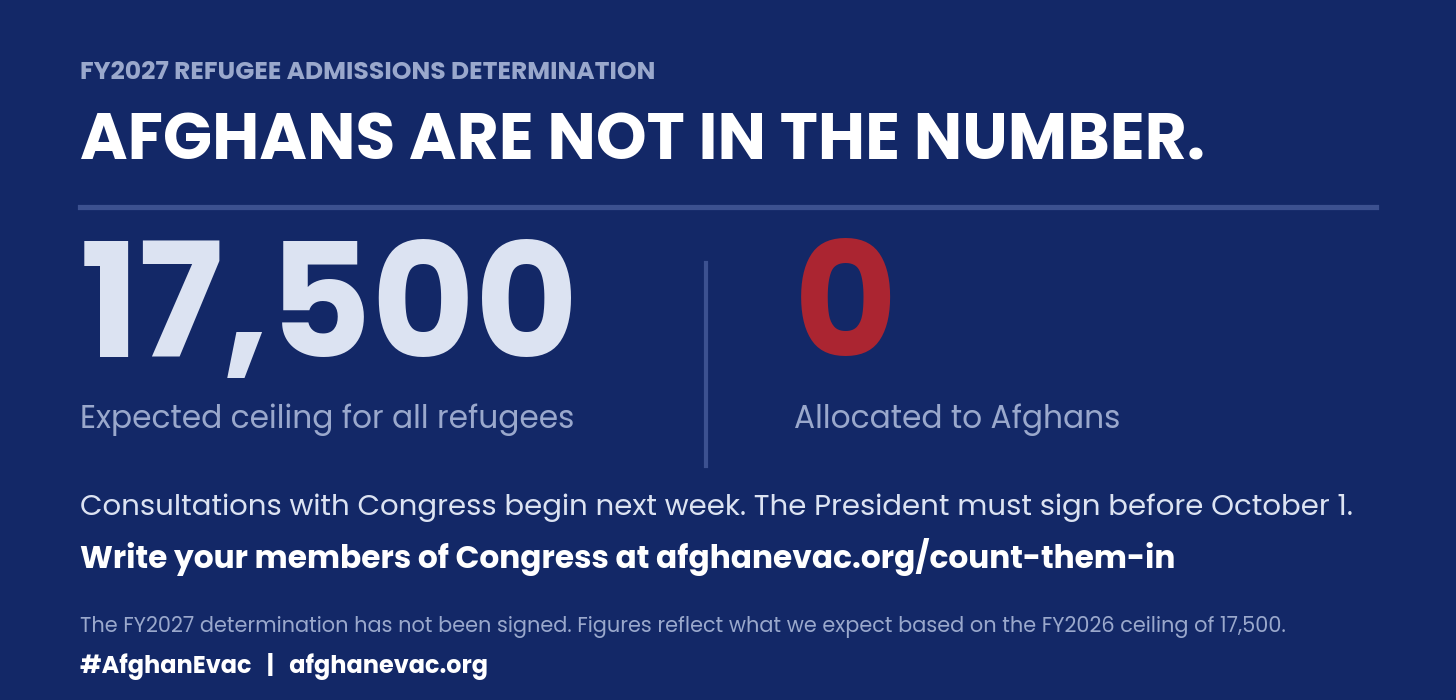
Before October 1, the President must set the fiscal year 2027 refugee admissions ceiling. Consultations with Congress begin next week. The number we expect is 17,500. The number we anticipate to be allocated to Afghans is zero.
That is not an accident of drafting. Last year’s ceiling was 7,500, the lowest in the history of the U.S. Refugee Admissions Program. When the administration raised it mid-year to 17,500, the Federal Register notice allocated every additional admission to “Afrikaners from South Africa.” That is the document’s own language. The United States has not admitted Afghan refugees since the program was suspended on January 20, 2025. Families the United States government itself referred, journalists, human rights workers, women’s rights defenders, and the relatives of American service members, have now been waiting four years in Qatar, Pakistan, Afghanistan, and in places where a referral from the American government is itself a death sentence if the wrong person finds it.
Another refugee determination with no Afghans is a statement that this country has decided the war it fought for twenty years produced no one worth protecting. We are asking for a dedicated allocation of at least 5,000 in fiscal 2027 and at least 5,000 in fiscal 2028, and we are asking members of Congress to say so out loud during consultations, by name and by category: Afghans at Camp As Sayliyah, P-1 and P-2 cases in Pakistan, the partnered units that Secretary Mullin’s own team has said it wants prioritized, and family reunification for American citizens and service members.
Why it matters Consultations happen in a room, and what is said in that room is shaped by what staff hear from home in the days before it. We have 1,183 letters. We need thousands.
The Afghanistan TPS Act still has a path
I am going to speak very plainly about how the Afghanistan TPS Act gets done, because the answer is narrower than it was in July. Between the calendar and the committee of jurisdiction, this bill is not moving the ordinary way. House Judiciary is not going to mark it up, and there is not enough runway left to wait for that to change. That leaves one route. A discharge petition forces a bill to the floor over a committee’s objection once 218 members sign it, and under House rules a bill has to sit in committee for 30 legislative days before a petition can be filed against it. That clock has not run out yet.
So the work between now and then is the list. H.R. 9899 has nine cosponsors, four of them Republicans. S. 5308 has three. 2,089 of you have already written Congress about this bill, and that number needs to go far higher before the clock runs out. When the bill becomes eligible, the number of cosponsors we walk in with is the best predictor of how fast we get to 218, and we should be counting signatures that week instead of starting from zero. Here is the part we did not expect. In office after office, we are finding that members of Congress do not know this bill exists. Not opposed to it. Unaware of it.
Why it matters A bill nobody has heard of does not get 218 signatures. Every office that hears from a constituent between now and the day that clock runs out is an office that knows the bill by name when it matters. We made this easy. Go to afghanevac.org/tps, enter your address, and the tool routes your message to your representative and both of your senators. It takes two minutes, the letter is already written, and you can edit it to say whatever you want.
SHOWING UP IN STERLING
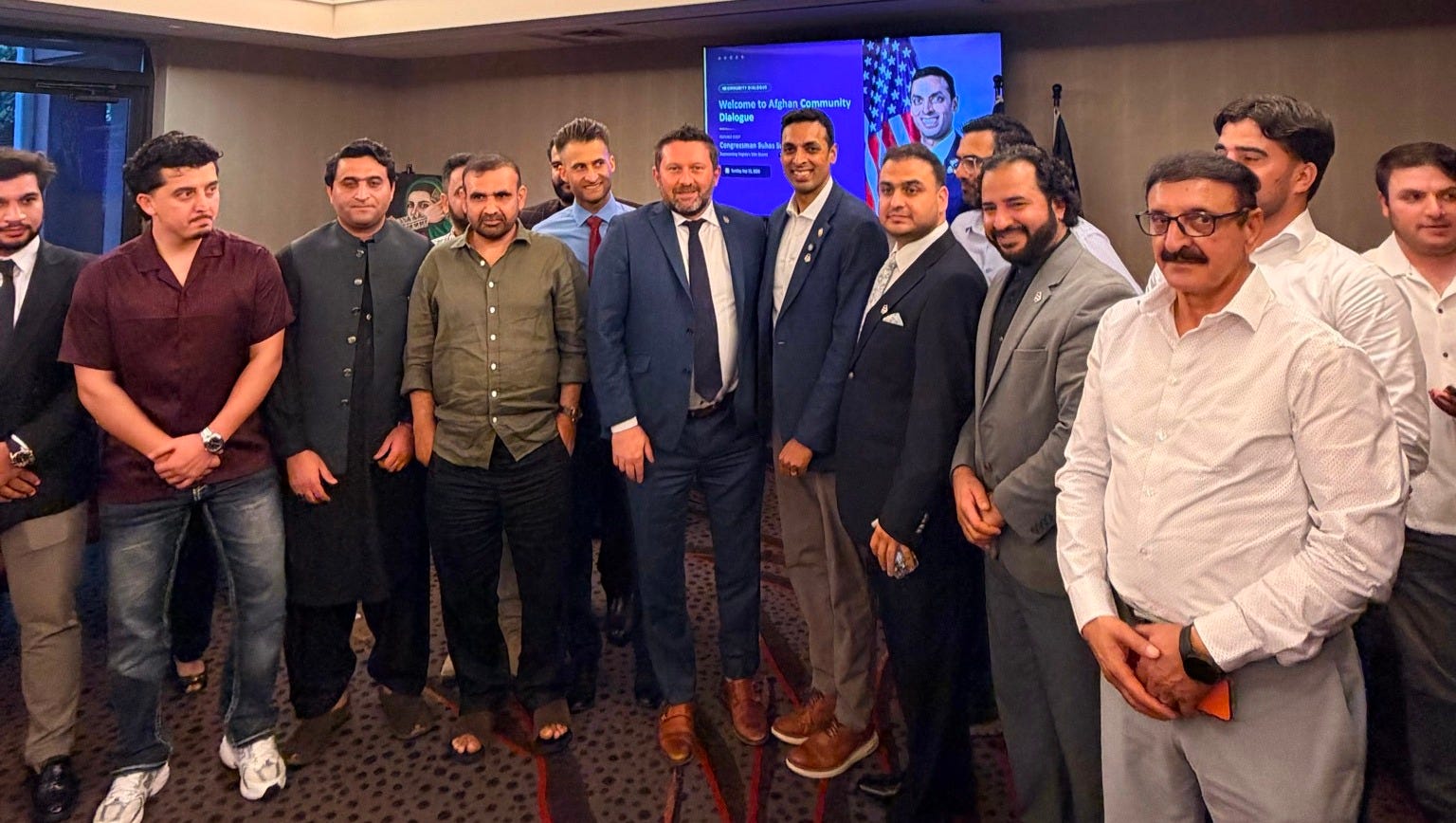
Sunday afternoon, I went out to Sterling for a community dialogue with Rep. Suhas Subramanyam, convened by the Afghan community of Loudoun County and organized by Rafiullah Samim. Loudoun is home to one of the largest Afghan communities in the country, and the questions in that room were the ones we hear every day. Where is my brother’s case? Why did processing stop? What do I tell my mother?
The difference was the answers. Subramanyam worked through Afghanistan TPS, the Enduring Welcome Act, and a long list of other issues without hedging and without needing the file explained to him. He knew what H.R. 4995 would actually do, which is codify the Coordinator for Afghan Relocation Efforts and stand up the case-tracking system that should have existed from the beginning. He knew where the bills sit and what moving them would take. I have been in a lot of these rooms. A member of Congress who can speak about Afghan policy with that kind of clarity and command of the detail is rare, and the people in that room could tell.
Why it matters If your representative cannot tell you what the Enduring Welcome Act does or where Afghanistan TPS stands, that is a fixable problem, and you are the person who fixes it. Ask them. Then ask them to cosponsor.
WE WENT TO WASHINGTON AND ASKED IN PERSON
On September 8 we sent the State Department a letter asking for a correction from the podium, and published it in full. A Department spokesman had told ABC News on camera that the people at Camp As Sayliyah are “primarily a group of people that were either unvetted, brought there by other contractors, not based off of promises made from the United States,” and that whether this country owes those people anything is “not the right question.” We asked for four things: correct the Camp As Sayliyah characterization, answer the obligation question, stop attributing the November 2025 shutdown of Afghan processing to a prior administration’s vetting, and disclose whether the Department has quietly changed who counts as the family of an American service member.
We have received no response. Not a call, not a statement, not a correction. The letter went to the spokesman, to five senior Department officials, and to a press list that includes most of the reporters who cover this beat.
So this week, after the Villanova panel, I went to Washington and asked in person. I requested a meeting with Tommy Pigott to correct the record directly. I also tried to get on the calendars of Andrew Veprek, the Assistant Secretary of State for Population, Refugees, and Migration, and Christian Ehrhardt. None of the three meetings happened. No one said no. No one said anything.
Why it matters The Department’s own contract records and the Defense Department Inspector General contradict what its spokesman said on national television. A correction costs nothing and takes eleven seconds at a podium. Refusing to issue one is a choice. And note who was on that list. Veprek runs the bureau that administers the refugee admissions program, in the week before the administration consults Congress on next year’s number. An organization representing Afghan wartime allies asked him for a meeting and got silence. That is the posture. The letter and the full record are at afghanevac.org/correct-the-record.
Secretary Rubio’s Prison Camp for Women and Children
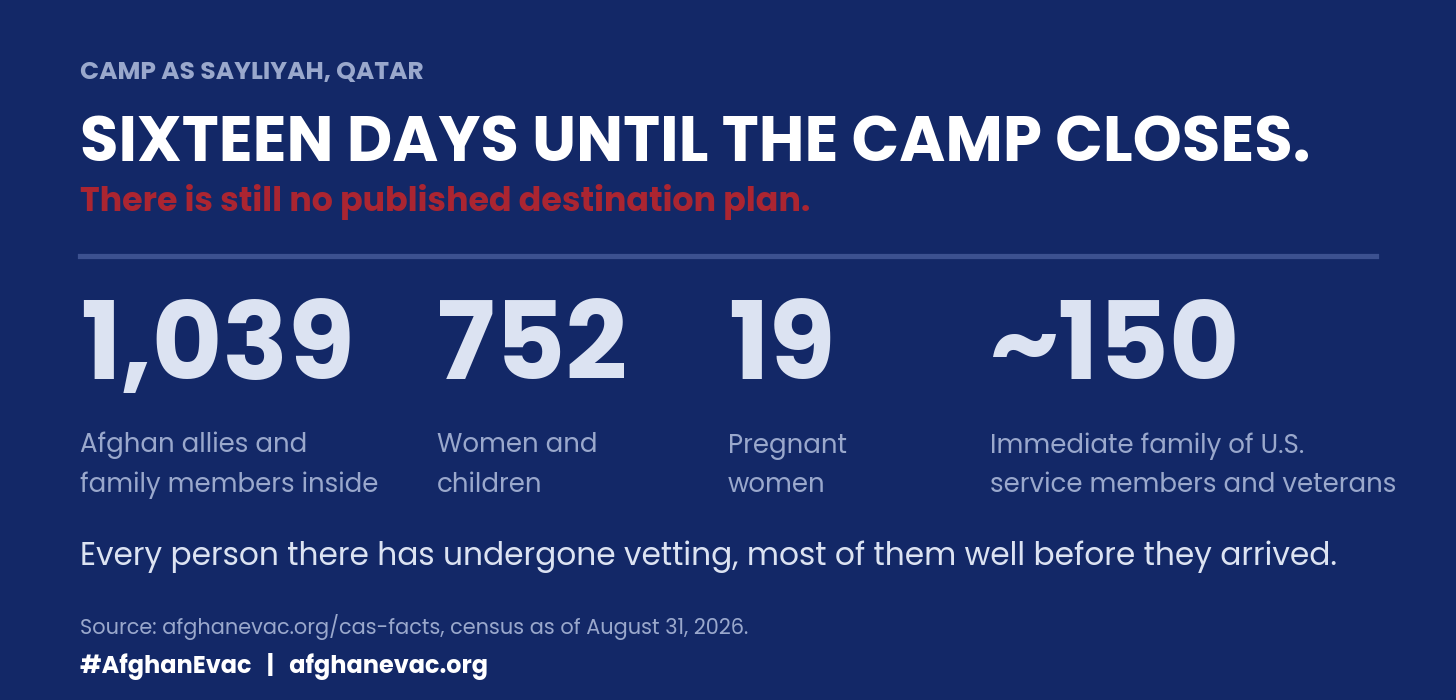
Camp As Sayliyah is scheduled to close on September 30. As of our count on August 31 there were 1,039 Afghan allies and family members inside. 752 are women and children. Nineteen are pregnant. Roughly 150 are the immediate family of American service members and recently separated veterans. More than 400 children have been out of school for years. Every person there has been vetted, the vast majority well-before the United States government put them on a plane to Qatar, and there is still no published destination plan with sixteen days to go.
Watch for two things this month. A quiet extension, which is a small relief but only means more months in a camp. Or a third-country announcement, which has a record: 27 Afghans transferred from Abu Dhabi to Rwanda in August 2025 were promised onward relocation within three months, and eight months later not one had moved.
ANSWERING A COURT ORDER WITH MORE RED TAPE
The government filed its court-ordered status report in CLINIC v. Rubio on September 8, and it is worth reading closely. The Department disclosed that more than 43,000 immigrant visa applications were refused solely under the vacated 75-country pause and are therefore subject to Judge Jeannette Vargas’s vacatur and remand order. It then told the court it has rescheduled immigrant visa appointments globally through the end of September, having already rescheduled them through August 31. On timing, the filing states there is “no fixed date by which reconsideration of all affected applications will be completed.”
There is more. The Department deployed a new public charge worksheet to consular officers globally on August 15, and on September 1 it formally deployed four new training requirements including expanded managerial review of consular officer adjudications. Both apply to every immigrant visa adjudication worldwide, not just the remanded cases. So a court struck down one categorical barrier, and the Department responded by extending a global pause and installing a new discretionary screen that each of those 43,000 applicants must now pass individually.
Why it matters Afghans remain separately barred by Proclamation 10998, so the direct hit here lands on family reunification, on approved petitions filed by American citizens and lawful permanent residents for Afghan spouses, parents, and children. Those families won in court three weeks ago and have less access to an appointment today than they did before the ruling. Winning a case is not the same as getting relief, and compliance is always the next question.
USCIS CASE PROCESSING IN THE UNITED STATES
The government met its deadline in Dorcas International Institute of Rhode Island v. USCIS, filing its opening brief in the First Circuit on September 10 along with an appendix and an assented-to motion to supplement the record. This is the appeal of the ruling that struck down three USCIS policies, including the Comprehensive Re-Review Policy directing the agency to re-review already approved benefit requests for people from certain countries who entered on or after January 20, 2021. In August the First Circuit stayed the district court’s ruling only as to that re-review policy, finding that the government “has not met its burden to demonstrate entitlement to a stay” on the other two.
Why it matters This is the case that decides whether an approval from USCIS means anything durable. If the government prevails, a green card, EAD, asylum or another benefit granted years ago can be reopened because of where you were born and when you arrived. Every Afghan who came through Operation Allies Welcome and Enduring Welcome is inside that category.
STANDING SHOULDER TO SHOULDER WHEN IT MATTERS
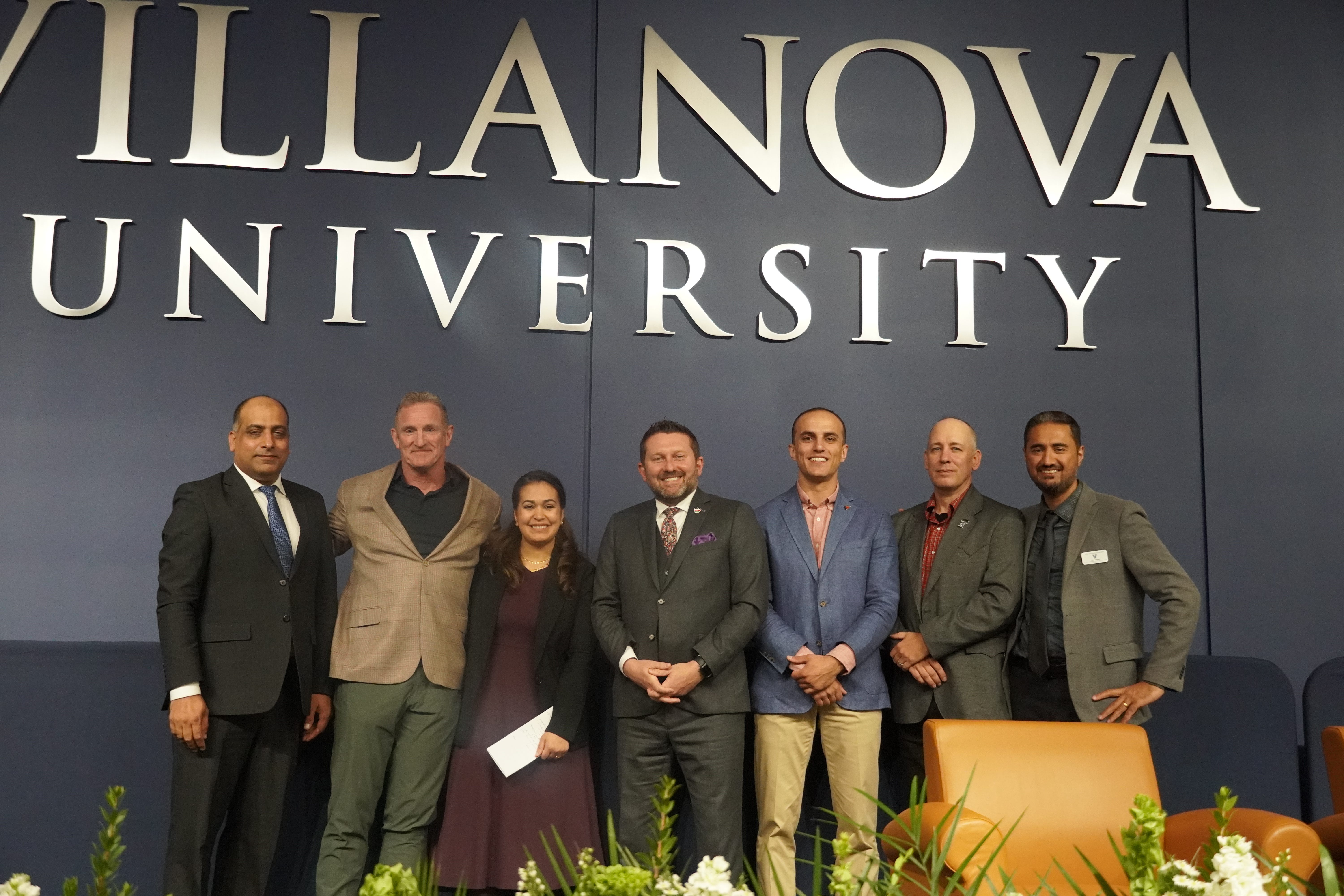
Villanova University marked the 25th anniversary with a full day: a moment of silence and the reading of the names of Villanovans killed on September 11, 2001, a flag planting by the Ryan Center and the Student Veteran Club, a memorial Mass, and an afternoon panel called The Global Legacy and Enduring Impact of 9/11, convened by the Center for the Common Good with the Center for Peace and Justice Education. I joined four other panelists with perspectives from Afghanistan, Pakistan, and the United States, including Asem Shukoori, Dr. Muhammad Farooq of Seton Hall University, and Nigina Abdul Moqim of HIAS. Joe Evans organized it and Farhad Wedee of Villanova hosted. Most of the students in the room were born after the attacks.
My remarks were short and they were not a policy brief. On the morning of September 11, 2001, I was seventeen years old and already in the Navy. In the weeks after, I was temporarily assigned as a Navy police officer. They gave me a squad car, a badge, and a gun. I did not have a driver’s license. I spent the rest of my naval career, and most of the career that followed it, in the field that day created. The argument I made to those students is the one I wrote down the same morning: that an honest accounting of the last 25 years is not disloyalty, that fear is a legitimate emotion and a terrible operating system for a republic, and that safety, security, prosperity, and honor were never the trade-off we were told they were. Those reflections are mine, not an AfghanEvac position, and if you want them they are here: Never Forget Means All of It.
THEY HAD NOTHING TO DO WITH 9/11 AND THEY HAVE PAID THE MOST
No Afghan was among the nineteen hijackers. Not one. Afghanistan was where the plotting happened and where the Taliban sheltered the men who did it, and the Afghans who then spent twenty years working alongside Americans were fighting the same enemy we were, in their own country, at closer range and at higher cost. Tens of thousands of Afghan soldiers and police were killed. Tens of thousands of Afghan civilians were killed. And the people who stood with us are the ones now sitting in a camp in Qatar, in a detention center in Texas, in a rented room in Islamabad waiting on a referral, or in front of an immigration judge in Van Nuys.
Why it matters At AfghanEvac we mark two dates in 2001: September 11, and October 7, the day the United States went to war in Afghanistan. The second date is the one that made promises. A country that keeps the first anniversary and forgets the second is not remembering, it is curating. Never forget means all of it.
A LETTER WE WERE ASKED TO CARRY
A letter arrived in our inbox this weekend from an Afghan mother. She sent it to our contact address and to our press address, and she asked us to help it reach people who need to hear it. She was careful to say what it was not. “I am not writing about my personal immigration case, and I am not asking for special treatment.” She signed it “An Afghan Mother,” and we are not naming her. It is addressed to the President of the United States.
Here is some of what she wrote.
“I believe people should be judged by their actions and character, not simply by their nationality. Every Afghan child has dreams, hopes, talents, and the desire to build a better future. My daughter dreams of becoming a doctor so she can receive a good education and help other people.”
“I would ask you to put yourself in our shoes. If you were born in another country and wanted to go somewhere to build a safer and better future, but someone stopped you simply because of where you came from, how would you feel?”
“So please look at us as human beings, not simply as migrants or as people of another nationality.”
“We are not all criminals. We are not all dangerous. We are human beings who want safety, education, peace, and a chance to contribute to the world. Please listen to the voices of Afghan mothers and the dreams of Afghan children.”
Why it matters She is asking for something smaller than what this country already promised her neighbors, and she is asking for it because the promise is the part nobody will say out loud anymore. The refugee admissions number that gets signed before October 1 is the government’s answer to her letter. Right now the answer is zero. You can help her and those like her by asking government to #CountThemIn
IN THE NEWS
Stories from the past week.
Detention and due process
Some Afghans are being detained by the same country that gave them new lives -- ABC News
This Afghan man helped Americans fight the Taliban. He’s suing the U.S. to protect his family -- KCUR
Immigration courts in unusual locations raise due process concerns -- NPR
Twenty-five years on
25 Years in Afghanistan in 25 Photos -- The New York Times.
That cloudless day -- GlobeTrot
Never Forget Means All of It -- Shawn VanDiver
Removals and enforcement
Deportation flight delays, ICE’s last-minute adds leave Haitian officials scrambling -- Miami Herald
She’s Helping Dems Take Back Congress. Trump Is Forcing Her to Self-Deport. -- The Bulwark
One correction worth making
Last Tuesday we told you there was no grace period on the new Affidavit of Support forms, and we said to ignore the claim that one existed. USCIS has since reversed course. The prior edition of Forms I-864, I-864A, and I-864EZ is accepted through September 30. We were reporting the agency’s position accurately when we published it, and the agency changed it. The rest of the form deadlines stand, and I-485 still changes on September 18 with no grace period. Separately, El Salvador’s TPS did not formally end on September 9. DHS posted an alert saying protections and work permits remain valid pending an announcement.
Two separate promises came due this week, and this country broke both of them.
The visas Afghan allies earned by their service are moving backward under a federal court order, three thousand ordered and seven hundred fifty-two delivered, with summer vacation offered as the reason.
The refugee program that would protect the families still stranded is about to get a number with no room for them.
Different programs, different laws, same answer. Neither is fate. Both are choices being made by people with names, offices, and authority. And those people can be reached.
Write the letter. Send the link. Show up to a courtroom.
We are not going anywhere.