

Some weeks the work happens in a courtroom or a committee room. This one ended in a church fellowship hall in North Raleigh, where Afghan families drove hours on a Saturday to tell us what the last five years have cost them. Then the week ahead arrived with a calendar that will not wait.
Refugee consultations Wednesday, a Supreme Court brief already on file, and Camp As Sayliyah is nine days from its stated closing date with no communication to residents about what comes next.
Everything we publish lives at afghanevac.org, and we keep it current. Our press archive, our searchable reports and litigation database The Ledger, our resources for families and advocates, our explainers, and our action center are free and open to anyone.
If this was forwarded to you, click the button below and get it free in your email inbox every Monday morning.
ACTION THIS WEEK
Write to Congress on the refugee admissions number before Wednesday, at afghanevac.org/count-them-in. Consultations are scheduled for Wednesday, September 23, which gives us two days. 1,415 letters have gone to congressional offices so far. Send yours, then forward the link to five people. The ask is simple: a dedicated allocation of at least 5,000 Afghans in fiscal 2027 and at least 5,000 in fiscal 2028.
Ask your representative and senators to cosponsor the Afghanistan TPS Act at afghanevac.org/tps. 2,263 of you have written Congress on this bill. It is Republican-led in both chambers, and the cosponsor list is what gets us to a discharge petition, so every name counts.
Read and share The Washington Post's investigation of the Office of Remigration, published today. David Nakamura and Adam Taylor document $410 million pledged across 31 countries to take deportees who are not their citizens. Send it to your member of Congress before Wednesday's consultations, and ask them to raise it in the room.
Share our Supreme Court brief in A.A. and F.A. v. Mast, an important case on what it means to keep promises to vulnerable people, at afghanevac.org/amicus. Post the statement and the brief, cite the public record rather than characterizing anyone in your own voice, and send any reporter who asks our way.
FOR OUR ALLIES: Check your Medicaid status before October 1, and your form edition before September 30. Afghan and Iraqi SIV holders remain eligible for Medicaid with no five-year wait. If you hold an SIV and get a termination notice, appeal it before coverage ends and call your resettlement agency. The prior editions of the Affidavit of Support forms, I-864, I-864A, and I-864EZ, are accepted only through September 30.
Chip in at afghanevac.org/donate. August and September were some of the biggest months for AfghanEvac. These efforts are all paid for by private funding and our supporters. Your support is how we keep going.
LAST WEEK IN BRIEF
Sept 14. We briefed Hill staff on three deadlines: Camp As Sayliyah’s September 30 closure, refugee consultations, and TPS cosponsors.
Sept 16. AfghanEvac filed an amicus brief at the U.S. Supreme Court in A.A. and F.A. v. Mast, alongside The Chamberlain Network and Professor Daniel Maurer.
Sept 17. Reason published Farzana’s story of removal to the Central African Republic, with AfghanEvac on third-country removals.
Sept 18. DHS’s expanded public charge rule was scheduled to take effect, with 22 states suing to block it. Humanitarian arrivals, including refugees and asylees, are not subject to it. Form I-485 changed the same day, with no grace period.
Sept 18. Our deadline for the State Department to correct the record on Camp As Sayliyah passed without a response.
Sept 19. Raleigh community town hall followed by Battle Buddies happy hour and karaoke at the local VFW.
Sept 21. The Washington Post published its investigation of the Office of Remigration inside the State Department's refugee bureau.
THE WEEK AHEAD
This week is a big one. Four things that matter critically to our work happen within the next nine days.
Tuesday, Sept 22. Battle Buddies deployment in the Dallas area.
Tuesday, Sept 22. Two speaking engagements at William & Mary.
Wednesday, Sept 23. Administration consultations with Congress on the fiscal 2027 refugee admissions ceiling.
Wednesday, Sept 30. Camp As Sayliyah is scheduled to close. The fiscal year ends, and it is the last day for prior editions of the I-864 Affidavit of Support forms.
Thursday, Oct 1. Deadline for the Presidential Determination on refugee admissions. Medicaid eligibility changes take effect under the One Big Beautiful Bill Act.
WHAT WE HEARD IN RALEIGH
On Saturday, AfghanEvac held a community town hall at Redeemer Presbyterian Church in North Raleigh. Over 65 people came, some of them driving several hours, with children in tow. We chose Raleigh on purpose, because it sits within reach of the Afghan communities in Charlotte, Greensboro, Durham, and the Triangle, and because North Carolina’s veterans and Afghan allies have a lot to say to each other.
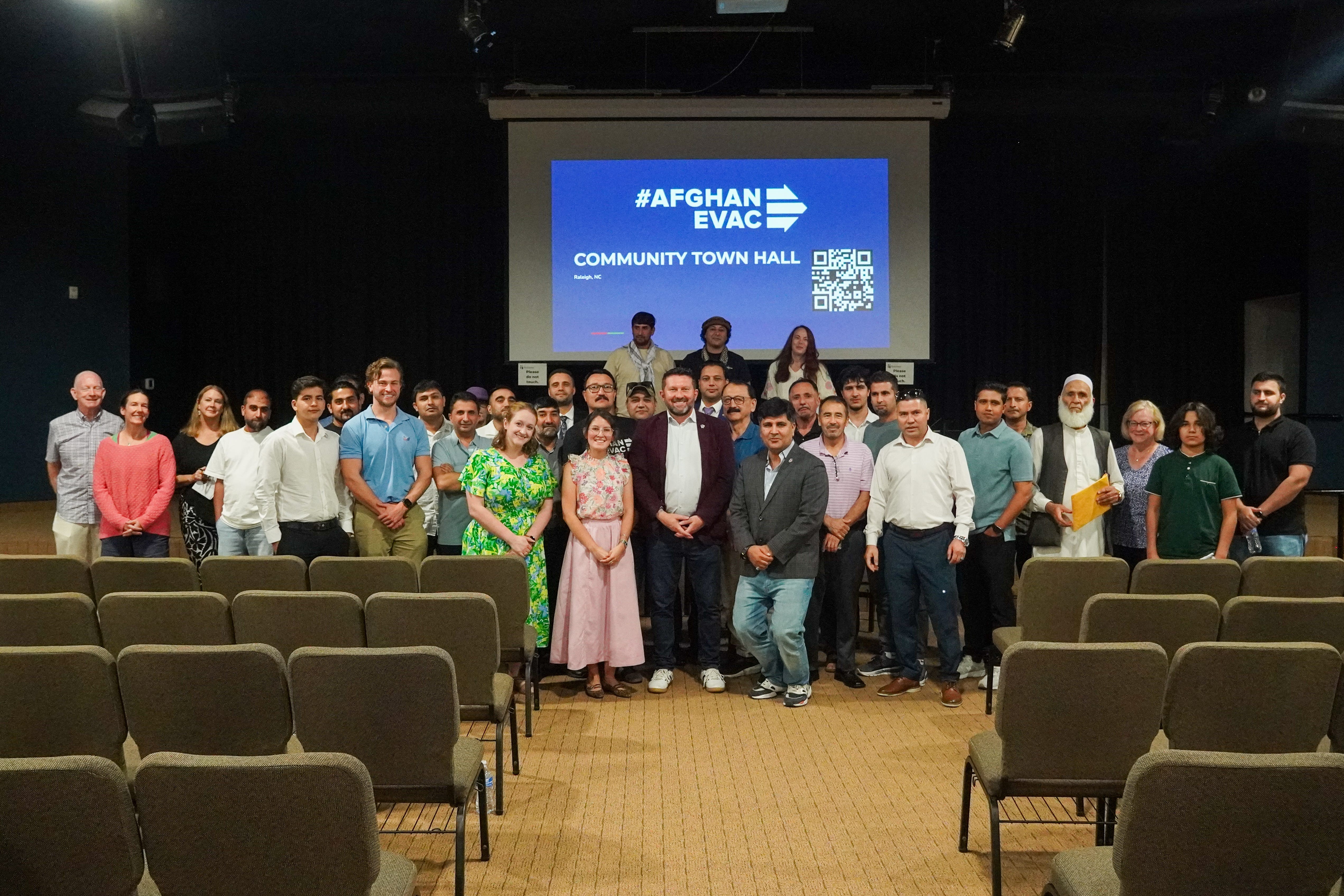
We ran the afternoon in English, Dari, and Pashto, and we spent more time listening than talking.
What people asked about most were the two questions we hear every single day, in every city, in every language. When will my case be approved? The green card, the work permit, the asylum decision. And when will I be allowed to reunify with my family? Those are not policy abstractions. They are the whole of a person’s life held in someone else’s inbox.
October 1 and Medicaid came up a lot too, and it is worth answering here. Afghan and Iraqi SIV holders remain eligible for Medicaid, and they are exempt from the five-year waiting period that most lawful permanent residents must complete before they can enroll. If you hold an SIV and a termination notice arrives, that notice may be wrong. Appeal before coverage ends, and call your resettlement agency to ask about deadlines and any state waiver options.
There was good news in that room too. One man stood up to say his work permit was finally approved, after fifteen months of waiting. That approval was not luck and it was not generosity. It came because Democracy Forward took USCIS to court and won in Dorcas International Institute of Rhode Island v. USCIS, where a federal judge struck down the policies freezing and delaying benefits for Afghans and nationals of dozens of other countries. Litigation is slow, unglamorous, and expensive, and it is the reason a man in North Carolina can work legally this month.
Then a father came up with a folder. Inside was the paperwork for his three children, all under twenty-one, all fully approved to join their mother and father in the United States. Approved. Vetted. Done. They cannot come, because the travel ban stands between them and a plane. That is what this system does right now. It approves a family, then refuses to let them live together as one.
It was also a reminder of how big this community has become. Team members from across the AfghanEvac family filled that room, including Megan from Team America Relief, Allison from the World Hazara Council, and more who drove in for the afternoon.


Why it matters Policy gets made by people who have never sat in a room like that one. Three approved children who cannot board a plane is not a paperwork problem, it is a policy choice, and it is exactly what we carry into Wednesday. If your community wants a town hall, tell us at contact@afghanevac.org.
WE FILED AT THE SUPREME COURT
On September 16, AfghanEvac filed an amicus brief at the U.S. Supreme Court in A.A. and F.A. v. Mast, alongside The Chamberlain Network and Professor Daniel Maurer, a retired Army lieutenant colonel and judge advocate. We do not do this often, and we did not do it lightly.
The case
An Afghan child was orphaned during the war, in a joint operation between the U.S. and Afghan militaries.
The United States transferred her to the Afghan government for family reunification, and she was placed with her extended family, who raised her.
Joshua and Stephanie Mast later obtained a Virginia adoption order through proceedings in which that family received no notice and no opportunity to be heard.
By the time they learned what had happened, Virginia’s deadline to challenge the order had run, and the Supreme Court of Virginia held that this ended the matter.
The U.S. government’s own filings describe what happened as an abduction.
We joined for two reasons. The first is that the standards at issue are the ones that protect Americans serving overseas. Judge advocates are trained to respect host-nation sovereignty and to deal honestly with courts, and those rules are not etiquette. They are what lets an American in uniform operate in someone else’s country and be trusted there. Our brief lays out those standards and what the public record shows happened in this case.
The second reason is closer to home. Our entire model runs on trust. Every day we tell Afghan families that if they follow the lawful process, register the case, submit the documents, sit for the interview, wait their turn, American institutions will deal with them fairly. That is a hard sell in a year like this one. It gets harder every time American authority is used against someone who relied on it. A family that was never told a court was deciding their child’s future is the sharpest version of that problem, and every Afghan family watching this case understands it immediately.
We take no position on who should raise this child. We are not litigating custody and we are not asking anyone else to. Our argument is about notice and an opportunity to be heard, which is the floor of due process, not the ceiling. Everything in the brief comes from the public record, including the government’s own filings and the courts’ own findings.
Our sincere thanks to the legal team who pulled this together.
Why it matters What the Court does here reaches well beyond one family. It tells every Afghan who trusted an American process whether that trust was earned.
Our explainer, the statement, and the brief are all available on our website.
THEY TOLD US WHAT THEY DID TO THE REFUGEE BUREAU
This morning The Washington Post published an investigation by David Nakamura and Adam Taylor, part of a six-month project with Forbidden Stories and 26 news organizations in 15 countries. Read it. Working from internal government records, it documents what has been done to the office that is supposed to run refugee admissions. Inside the Bureau of Population, Refugees and Migration sits a roughly 15-person shop called the Office of Remigration, a word popularized by white nationalists in Europe who want racial minorities expelled. As of the end of June, the administration had pledged at least $410 million to get 31 countries to accept people the United States deports who are not their citizens, including $81 million in direct payments to 13 foreign governments, under contracts written to bypass human rights safeguards. The State Department also took $250 million from refugee aid programs to help fund a DHS push to get migrants to leave on their own.
You do not have to infer the intent, because the man in charge said it out loud. Andrew Veprek, speaking in April at an anti-immigration think tank, said the bureau “had been a humanitarian assistance office” that “focused on bringing people to the United States.” Then: “Now, we are focused on implementing the president’s immigration agenda.” And: “We have changed the orientation of the bureau completely.” Veprek has since been promoted to oversee all U.S. foreign assistance and humanitarian affairs. His deputy, Christian Ehrhardt, a former embassy security officer, now travels Africa as what one U.S. official called a White House envoy, closing these deals.
Those two names should be familiar to readers of this newsletter, because we have been saying them for months. Veprek and Ehrhardt are the officials behind the decisions that have kept 1,039 Afghan allies sitting in a camp in Qatar with no destination plan, and they are the officials we have asked, repeatedly and in writing, to explain themselves. When we went to Washington on September 12 we requested meetings with both of them, along with Tommy Pigott. Nobody said no. Nobody said anything. The Post’s reporting now gives us a much clearer picture of what those offices have been prioritizing.
Why it matters The bureau sitting down with Congress on Wednesday to brief their plan for next year’s refugee number is the same bureau that spent this year building a deportation network, partly with money taken from refugee aid. When we say the Afghan allocation is zero by choice, these are the people making the choice, and now it is on the record.
COUNT THEM IN BY SEPTEMBER 23
By law, the President must set the fiscal year 2027 refugee admissions ceiling by October 1, after an “appropriate consultation” with Congress. That consultation is Wednesday, September 23. We expect a ceiling of 17,500, allocated to Afrikaners from South Africa, and an Afghan allocation of zero. The record explains why. The fiscal 2026 ceiling opened at a record-low 7,500, and when the administration raised it to 17,500 in May, the Federal Register notice allocated every slot to “Afrikaners from South Africa.” More than 12,000 South Africans have been resettled this fiscal year. Not one Afghan refugee has been admitted since January 20, 2025.
We are asking members on Judiciary, Foreign Relations, Foreign Affairs, and the relevant appropriations subcommittees to say plainly, in that room, that Afghan mission partners and U.S. military families belong in the fiscal 2027 determination, with a dedicated allocation of at least 5,000 in fiscal 2027 and at least 5,000 in fiscal 2028, naming Camp As Sayliyah, Afghans in Pakistan, the partnered units Secretary Mullin’s team says it wants prioritized, and family reunification. One more thing, because it decides whether you keep pushing after October 1. A signed number is not the end of it. The administration raised this past year’s ceiling mid-year with an emergency determination and gave every new slot to Afrikaners. The same tool is available for Afghan allies any day of the year. The precedent is theirs.
Why it matters Wednesday is the only moment in the year when Congress has a formal seat at this table. What members hear from home between now and then shapes what they say when they sit down. Write at afghanevac.org/count-them-in, and point offices to the bipartisan polling at afghanevac.org/polling.
THIRTEEN DAYS AND NO ANSWER
On September 8 we asked the State Department to correct, from the podium, its spokesman’s claim on national television that the people at Camp As Sayliyah are “primarily a group of people that were either unvetted, brought there by other contractors, not based off of promises made from the United States.” We set a deadline of September 18. It passed. Thirteen days after we sent the letter, the Department has not responded.
Why it matters A correction takes eleven seconds at a podium. Refusing to issue one, in the same week the Department consults Congress on next year’s refugee number, tells you how it intends to talk about these families when it matters.
NINE DAYS
Camp As Sayliyah is scheduled to close on September 30. As of our last count, 1,039 Afghan allies and family members are inside. More than 700 are women and children. Roughly 150 are the immediate family of American service members and recently separated veterans. Every person there was vetted before the United States government put them on a plane to Qatar. With nine days to go, there is still no published destination plan, no stated legal status on arrival anywhere else, and no confirmation that a transfer would preserve the American cases these families were promised.
We still expect the date to slip. An extension would be welcome, though it would not be a resolution. It moves the same unanswered questions to a later date and leaves the same children in the same containers.
Why it matters Congressional offices can meet residents directly through our virtual congressional delegations. If your member has not done one, tell them to get in touch with us and we will get them on the calendar.
INTERNATIONAL: REFOULEMENT BY A DIFFERENT NAME
Reason this week told the story of Farzana, a 32-year-old Afghan woman removed on August 28 to the Central African Republic along with roughly 40 to 50 men, the same day her lawyers filed for an emergency restraining order. Her fiancé applied for a Special Immigrant Visa after assisting the U.S. mission. She now lives in Bangui with no identity documents, no job, three months of resettlement support, and a recent malaria diagnosis. I told Reason we have heard of 20 Afghans removed on her flight alone. “The countries will essentially tell these Afghans, ‘OK, I guess you can go home.’ And that’s refoulement by a different name.”
In Pakistan, authorities say 2.76 million Afghans have been sent back since late 2023, and Punjab province is running 39 holding centers as arrests accelerate. The P-1 and P-2 families who write to us every week are inside those numbers.
Why it matters U.S. law and international obligations prohibit returning people to countries where applicable legal protections bar their removal because of persecution or torture. Sending someone to a third country does not eliminate those obligations. Removing them to a country where they have no status, no documents, and no future, knowing they will be pushed home to the Taliban, accomplishes the same thing with an extra stop.
IN THE NEWS
Stories from the past week.
Third-country removals
How Trump turned a refugee bureau into a $410 million deportation operation -- The Washington Post
‘They kept us like animals’: Afghan woman deported to Africa by Trump speaks out -- Reason
‘They Kept Us Like Animals’: Afghan Woman Deported to Africa by Government Officials Speaks Out -- International Business Times UK
The refugee program
“I believed the hype”: The white South Africans denied refugee status in the US -- The Guardian
Thousands of refugees in Arizona likely to lose healthcare in October -- KJZZ
Afrikaner refugee family reportedly denied US re-entry -- Cape Town Etc. A family that flew home to South Africa for cheaper medical care found out what refugee status actually means.
Status and enforcement
Trump has ended TPS for 13 countries. Salvadorans are still waiting for an answer. -- Politico
Immigrants’ Lawyers Say U.S. Is Redacting Documents Proving Legal Status -- The New York Times
Pakistan
Promises made
I Still Have Hundreds of Texts From the Fall of Kabul. They Remind Me of the Promises We Broke -- The War Horse
A father in Raleigh carries a folder with three approved children in it and no plane to put them on.
A man in the same room got his work permit after fifteen months, because lawyers went to court and won.
This morning we learned, in the government's own records, that the bureau built to bring people like them to safety has spent the year and $410 million building the opposite.
None of that is weather.
It is a set of decisions, made by people with names, and decisions can be remade.
On Wednesday, Congress gets its formal opportunity to challenge the administration’s refugee plan before the next determination is made.
Write the letter. Share the investigation. Show up to a courtroom.
We are not going anywhere.