


As we head into the final days of the year, the pressure on Afghan families is not easing. For many, it has now been more than four years since the fall of Kabul, four years of waiting, uncertainty, and lives lived in limbo despite having followed every rule the United States set in front of them.
Some Afghan families remain separated across continents. Others are here in the United States, legally, but without durable status, stable pathways, or clear answers about what comes next. The policies and enforcement actions unfolding right now are not happening in a vacuum. They are landing on people who have already spent years doing exactly what America asked of them, only to be left waiting.
I wrote more about this reality in an op-ed this week. The throughline is simple: four years later, our allies are still paying the price for federal inaction, broken systems, and political fear mongering.
This week’s update focuses on what has changed, what has not, and where your attention and support matter most right now.
Three Things You Can Do This Week
Share trusted resources for Afghans already in the United States. Many Afghan families here are seeking help navigating housing, employment, healthcare, and legal questions. Please share:
USAHello, which provides accessible, multilingual resources for refugees and immigrants already in the U.S.
IRAP’s legal explainers, which offer clear, free guidance on how recent policy changes affect Afghan cases.
Sign up to be a Battle Buddy today. Veterans and trained volunteers can accompany Afghan allies to immigration appointments and hearings. Presence matters. Solidarity matters. If you are able to show up, now is the time.
Support AfghanEvac. This work does not pause for the holidays. If you are able, please consider making a donation to help us sustain legal coordination, communications, and direct support.
December 31 SIV Application Deadline: What It Means and What It Does Not
We want to re-emphasize an important deadline that is now just days away, because confusion around this has caused unnecessary fear.
The deadline to submit a Special Immigrant Visa (SIV) application is December 31, 2025. This deadline applies to new applicants only.
Here is what that means.
What it means
Individuals without a pending SIV application must submit their application to the National Visa Center (NVC) by 11:59 PM Eastern Time on December 31 to preserve eligibility.
Applicants do not need to have all required documents ready by that date.
Once an application is submitted, the applicant will receive a confirmation email and will have 120 days to submit all required documentation.
If the documentation is not completed within that 120-day window, the case will be closed.
What it does not mean
This is not a termination of the SIV program for people who already applied.
This does not affect applicants who already have a case in the system, including those awaiting COM approval, interviews, or visa issuance.
This does not cancel existing SIV approvals or issued visas.
This deadline does not change the status of Afghans already in the United States.
The critical takeaway is this:
Submitting an application by December 31 preserves eligibility, even if documents are incomplete. Anyone who may qualify should submit before the deadline if at all possible.
ICE Activity Through the Holidays
Since our last update, we have continued to receive reports of Afghan allies being scheduled for ICE “check-ins” on federal holidays, including Christmas Day and New Year’s Day. These are not routine appointments.
Scheduling enforcement actions during holidays limits access to attorneys, courts, and advocacy support, and it places families under extreme stress at a time when most institutions are closed. Afghan parolees and evacuees remain in legal limbo because Congress has failed to provide durable status, not because they have violated the law.
It is also important to share this update clearly and responsibly: as of this writing, we have not received confirmed reports of Afghan allies being detained as a result of Christmas Day check-ins. That is a relief, and it is due in part to vigilance, legal readiness, and people showing up.
Battle Buddies have continued to accompany Afghan allies to ICE appointments and hearings where possible, and we know that presence matters. Our teams remain on alert, attorneys remain engaged, and we are actively monitoring appointments scheduled through New Year’s Day.
This does not mean the risk has passed. It means that attention, preparation, and solidarity are making a difference, and that vigilance remains essential.
We are actively escalating these cases with congressional offices, legal partners, and senior officials. If you are impacted, please share your information with us. Submitting details does not guarantee an outcome, but it allows us to understand the scope of what is happening and respond strategically.
January 1: What Changes and What Does Not
There is significant confusion about what happens on January 1. Here is the bottom line.
What does change
The expanded travel ban goes into effect, further restricting visa issuance for nationals of covered countries.
Implementation decisions by State and DHS will continue to shape how aggressively these policies are enforced.
What does not change
Visas that were already issued do not expire on January 1.
SIV holders are not suddenly undocumented on January 1.
Immigration cases do not automatically close or convert because of the calendar date.
We are concerned that fear and misinformation are being used to pressure people into bad decisions. If you have questions about your specific situation, consult a qualified immigration attorney before traveling or signing anything.
RCUSA at the Global Refugee Forum
Refugee Council USA participated in the Global Refugee Forum Progress Review in Geneva this month, continuing to elevate the consequences of U.S. policy choices on displaced communities, including Afghan allies.
AfghanEvac remains closely aligned with RCUSA and other partners who are pushing back against the normalization of mass exclusion, enforcement-first approaches, and the quiet dismantling of resettlement commitments. While global forums do not move cases on their own, they matter because they establish record, intent, and accountability, and because silence at moments like this is itself a policy choice.
Community Engagement: High Tech High
For sixteen weeks this fall, I spent time with students and educators at High Tech High Mesa in San Diego, talking about Afghan relocation, civic responsibility, and what it looks like to stand up for people when systems fail them.
What stood out was not just the students’ grasp of policy, but their instinctive understanding of fairness. They understood that Maryam’s outcome was not a tragedy of chance, but the predictable result of closed pathways and withdrawn protection. Their work, reflected in the student exhibition posters included here, grappled honestly with the consequences of U.S. refugee policy and the human cost of political paralysis.


These conversations matter. They shape how the next generation understands service, accountability, and moral courage, and they reinforce why this work must be explained clearly, repeatedly, and without euphemism. Please let me know if you’re interested in connecting with the educator who oversaw this work.
From Christmas Day
On Christmas, I sent two messages, rooted in the same conviction but addressed to very different audiences.
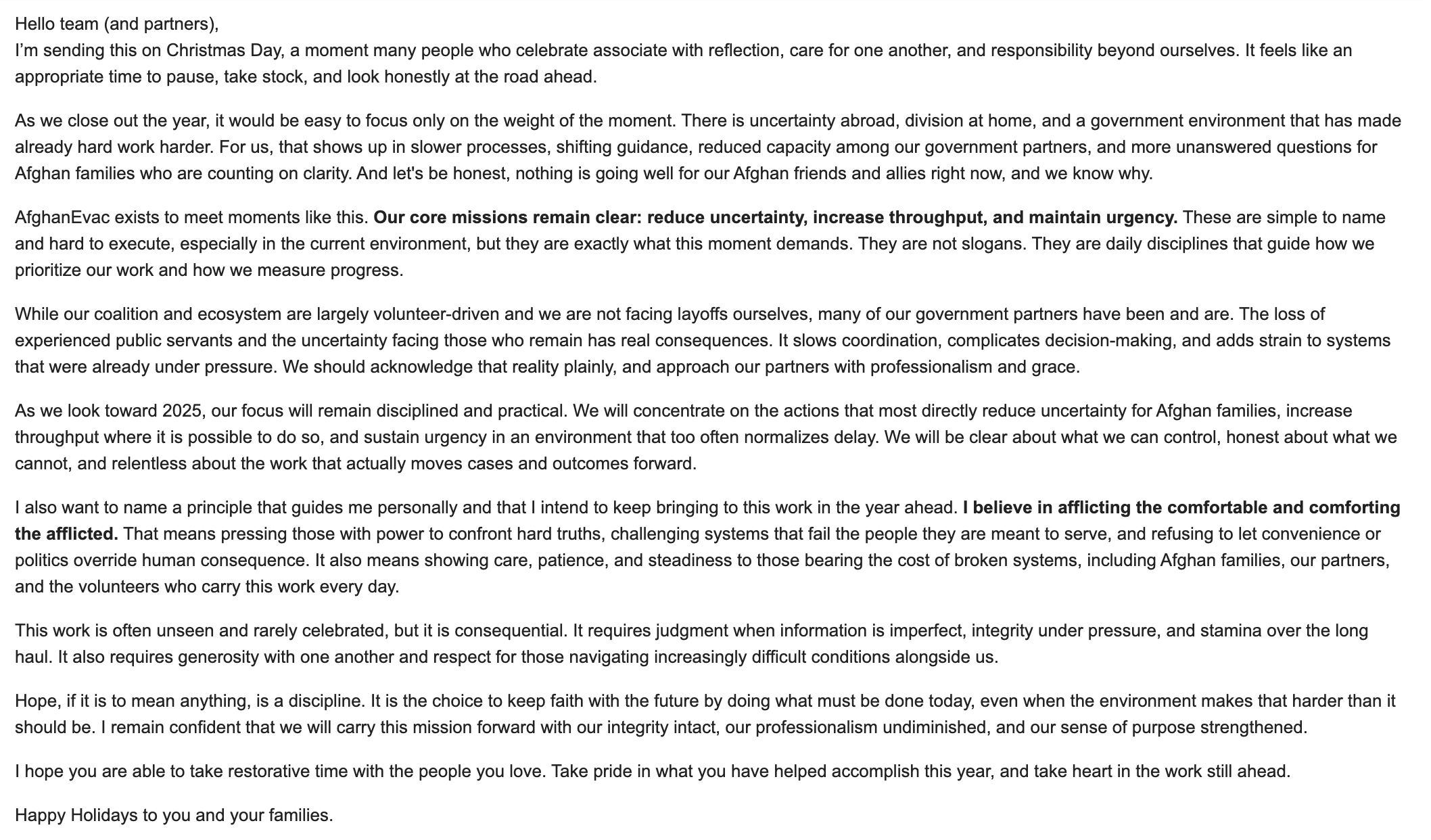
The first was to our community, reflecting on what it means to keep promises when it is inconvenient, politically difficult, or unpopular. I wrote honestly about the moment we are in, the strain on our partners, the uncertainty facing Afghan families, and why AfghanEvac’s core disciplines remain unchanged: reducing uncertainty, increasing throughput, and maintaining urgency. Not as slogans, but as daily commitments to people whose lives are being shaped by delay.
That same morning, I sent a separate message to President Trump’s Deputy Chief of Staff and Homeland Security Advisor, Stephen Miller. That note was more direct. It named the consequences of shutting down refugee admissions, halting family reunification, and weaponizing bureaucracy against Afghan allies who fought alongside U.S. forces. It made clear that cruelty is not strength, that deterrence is not morality, and that history will record who chose to abandon allies quietly rather than act honestly in public.
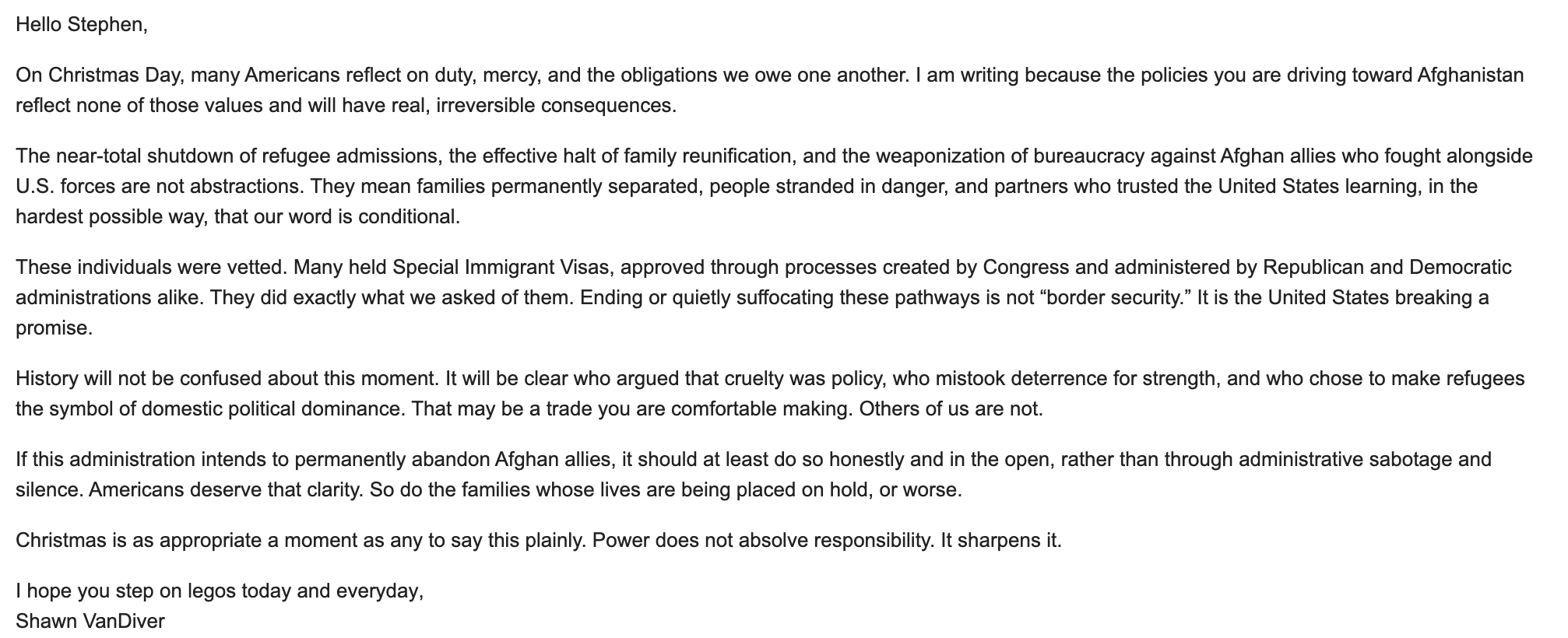
Both messages are worth revisiting as we move into the new year, because they speak to the same truth: power does not absolve responsibility. It sharpens it.
Two Stories, One System
I’m writing this week’s update from New York, on a holiday trip with my son that began in Philadelphia.
While standing on the steps of the Philadelphia Museum of Art, an Afghan man approached me and asked if we could take a photo together. We started talking. He told me he had been evacuated from Afghanistan, resettled in Texas, and is now thriving. He was proud, grounded, and building a life. He’s making it, despite all of the horrific things the United States government is doing to our allies here at home. His story is real, and it is one version of what keeping our word looks like.
Maryam’s story is the other.
Maryam was an Afghan police officer and the sole caregiver for three young children. Her case was made known to U.S. authorities by members of the AfghanEvac Coalition. The risks to her life and to her children were documented, escalated, and explicitly raised while she was seeking protection. When the last viable pathway was closed in early November, she was told there was no alternative. Three days later, she attempted to take her own life. She survived the attempt but died weeks later from complications related to those injuries. Her children are now in the custody of their biological father, who was affiliated with Taliban elements. Her son has been placed in an extremist madrasa. Her daughters have been removed from school and promised in marriage.
These outcomes were foreseeable. They were raised while Maryam was alive. They are now irreversible.
I shared her story online yesterday and we are hopeful her story will be picked up by press.
To Afghan allies reading this: please keep approaching me in public, keep telling your stories, and keep insisting on being seen. You are not an abstraction, and you are not alone. And you are not bothering me or anyone else who does this work when you say hello.
To everyone else: keep checking in. Keep showing up. Times are hard, and systems are failing. That is precisely when people are most valuable, and when our responsibility to one another matters most.
In the Press
‘That video saved our lives’: how women are defying the Taliban’s brutal crackdown on protest — The Guardian
Millions of Afghans face hunger as aid cuts deepen a humanitarian crisis — ABC News
How a child bride escaped Afghanistan and became a bodybuilding champion — NBC News
US Tells Afghan Migrants to Report on Christmas, New Year’s Day — Bloomberg
Opinion: America takes the holidays off. Afghan families pay the price. — Times of San Diego
A Closing Thought
Afghan families should not have to spend the last days of the year wondering whether compliance will land them in detention, whether silence will keep them safe, or whether America still means what it says.
AfghanEvac will continue to document what is happening, challenge abuses of power, and stand with our allies in real time. We are not backing down, and we are not going away.
Thank you for staying engaged, for sharing credible information, and for helping us hold the line.
Hello and Good day to Mr. VanDiver! Some of SIV applicants during their interview on Friday January 2, 2026 received refusals under the section 212(f) which cannot be appealed. No authority talked about this earlier. I as a SIv applicant who has his own interview in the coming days and spend a lot of money and months of waiting for my interview at US embassy in Pakistan, am totally devastated by what I saw. I send you a photo of that paper. Please enlighten us on this. Thanks
Sorry to hear about Maryam and will pray for her children. The world is
upside down. We must allow immigrates that are peaceful to live productive lives, but removing the criminals is also more important. Be kind—everyone has a story. 🙏🏻