

Fair warning — this is a long one, and you’re going to want to read it all.
Good morning, and welcome to 2026, where our New Year’s resolution is simple: push harder for our Afghan allies and refuse to let this effort fade into the background. In that spirit, we started the year by sending a letter to staff and Members of Congress on January 1st calling on them to step up with real action, not just words.
We also kicked off the year with a Town Hall on January 2nd, with more than 350 people joining to hear updates from our partners at AILA, USAHello, IAVA, and others. The engagement and urgency in that conversation reinforced just how critical this moment is.
This week’s update includes important new guidance on visa interviews, including recommendations designed to help Afghan applicants avoid irreversible harm while policies remain in flux. We strongly encourage you to read this section carefully and share it widely with families, advocates, and anyone supporting Afghan cases. We have also included a new graphic that lays out the current Afghan immigration pathways, reflecting what is moving, what is paused, and where the risks are right now.
A quick clarification up front: there has been some understandable confusion about visa refusal codes and authorities, specifically 212(f) and 221(g). While the numbers refer to different legal mechanisms, the practical reality is what matters most right now: refusals are happening, and increasingly they are permanent rather than temporary. That shift drives the guidance in this update.
Finally, in deeply concerning news, USCIS issued a sweeping new policy on January 1st that expands adjudication freezes and retroactive re-reviews. A detailed breakdown of that policy is included below.
Before we get into the nitty-gritty, though, we have a couple of easy action items you can do right now to help us out:
This year, we’re asking our supporters to set up a recurring monthly donation so we can keep moving the ball forward every month. Your recurring gift – whether it’s $50 or $5000 – means we can maintain momentum and provide our Afghan allies with the support they deserve.
Help us spread the word about Battle Buddies – encourage any veterans or frontline civilians you know to sign up, share our posts on social media, and buy some merch.
Share this update. We all need to spread the word so our allies here and abroad understand the implications of recent policy changes.
Policy update roundup
New USCIS policy effectively stopping final decisions on asylum and green card applications
Effective halt on family reunifications – no reunifications expected this year and resettlement agencies do not expect to receive any cases to be assured.
New, more restrictive travel ban is being implemented and we are seeing final visa refusals pursuant to INA 212(f), rather than temporary refusals under INA 221(g).
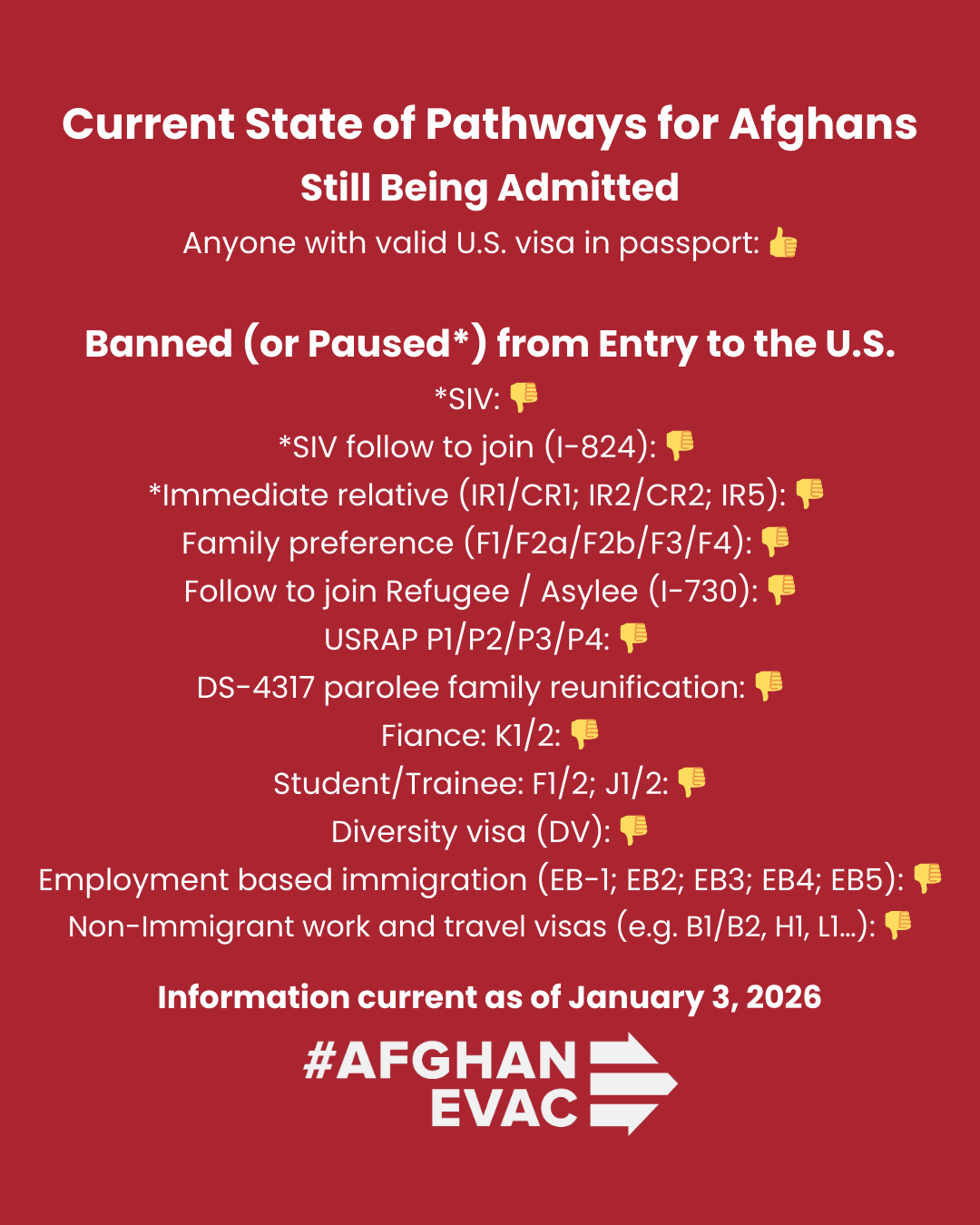
What this moment tells us
Taken together, these developments are not isolated bureaucratic changes. They reflect a coordinated policy posture that prioritizes delay, discretion, and deterrence over resolution. Decision freezes, retroactive re-reviews, final refusals, and narrowed exceptions all point in the same direction: reducing arrivals without formally ending programs.
For Afghan families, this means longer separations, higher risk at each procedural step, and fewer safe off-ramps once a case is put in motion. For advocates, it means the margin for error is smaller than ever. Timing, posture, and information-sharing now matter as much as eligibility itself.
This is why our guidance has shifted from “prepare and proceed” to “pause and protect.” The goal is not to stop movement forever, but to prevent families from losing years of progress because they were pushed into irreversible outcomes at the worst possible moment.
USCIS Policy Update – New Adjudication Holds and Re-Reviews (Effective January 1, 2026)
USCIS issued a new policy memo, PM-602-0194, that significantly expands adjudication holds and re-reviews for immigration benefit applications tied to countries designated under recent presidential proclamations.
What’s happening
USCIS has placed a hold on final decisions for many pending immigration benefit applications connected to countries listed in Presidential Proclamation 10998.
Cases may continue moving internally, but no approvals or denials can be issued while the hold is in place.
USCIS is also conducting a comprehensive re-review of previously approved benefits granted on or after January 20, 2021, including the possibility of re-interviews.
Who is affected
Individuals may be flagged based on nationality, country of birth, or citizenship-by-investment, not just current passport.
Family-based immigration cases are explicitly no longer broadly exempt and are now subject to the same scrutiny as other benefit types.
This has direct implications for family reunification, including follow-to-join and adjustment cases.
What USCIS is prioritizing
Expanded national security and public safety screening.
Heightened skepticism around identity documents from covered countries.
Increased use of interviews and re-interviews.
Broad officer discretion during the review period.
Limited exceptions
Some applications can still be decided, including:
Replacement green cards and citizenship documents.
Initial asylum work authorization (EADs) under court-mandated timelines.
Narrow law-enforcement or national-interest cases with HQ approval.
These exceptions are operational, not humanitarian, and are tightly constrained.
What this means in practice
This is not a routine delay. It is a decision freeze combined with a retroactive re-review posture.
Processing times for affected cases are now indefinite.
Family reunification pipelines should be considered indefinitely paused.
We should expect confusion, increased anxiety among affected families, and inconsistent field-level implementation.
What we’re doing
Monitoring for follow-on guidance expected within 90 days.
Tracking case impacts and escalation patterns.
Preparing targeted guidance and advocacy options as implementation becomes clearer.
We’ll continue to update as USCIS issues additional operational instructions or if litigation alters the landscape.
Update: Travel Ban, Visa Interviews, and Why We Are Recommending Postponement
We are updating our guidance on Afghan visa interviews following the new White House travel ban proclamation (issued in December) and changes in how refusals are being issued at U.S. consulates.
Important note:
This update is informational only and not legal advice. Immigration decisions are highly fact-specific, and individuals should consult a qualified immigration attorney before making decisions about interviews or travel.
Bottom line:
At this time, we are recommending that Afghans in all tracks, including Special Immigrant Visa (SIV) applicants, postpone visa interviews where possible until Congress and the courts are able to weigh in on the travel ban and related policies.
Critical clarification:
Despite what many have been told, SIV applicants are not functionally exempt under current implementation and are experiencing the same adjudication freezes and risk of final refusals as other Afghan applicants.
What changed
The new White House proclamation, effective January 1, 2026, significantly tightens entry restrictions under INA 212(f). While some categories, including SIVs and family of American Citizens, are referenced as exempt in law or prior policy, current implementation does not reliably protect those cases from adjudication freezes or final refusals.
Family-based cases are no longer broadly exempt, and SIV applicants are also subject to the same operational constraints and risks at consulates.
Why interviews are risky right now
Consular officers are currently unable to approve most Afghan visa applications. While interviews may continue, approvals are not being issued, and the type of refusals being used has shifted.
It is important to distinguish between two different legal concepts that are being experienced very differently on the ground:
INA 221(g) is a temporary refusal used for administrative processing. The case remains open, and the government still owes the applicant a final adjudication.
INA 212(f) is the authority behind the travel ban. When applied, it results in a final refusal of the visa application. The case is closed and, although the underlying petition would likely remain valid, the process may need to be restarted if the policy changes.
While applicants and advocates may hear different numbers referenced, the outcome is what matters most. We are increasingly seeing final refusals tied to 212(f) authority rather than temporary 221(g) holds.
A final refusal could require applicants to restart the entire process from the beginning once progress is made or policies are loosened, wiping out years of waiting and documentation.
That is why proceeding to interview right now carries significantly higher risk than it did even weeks ago.
How to protect your case
Applicants who choose to postpone interviews can take steps to keep their applications active:
Applicants may email their U.S. embassy or their National Visa Center point of contact to request postponement of a scheduled interview.
Under current rules, applicants must make contact at least once every 12 months to prevent termination for inactivity.
We strongly recommend checking in every 6 months to create a clear record of continued intent and avoid administrative closure.
What this means in practice
Going to an interview right now may turn a paused case into a closed case.
Waiting preserves your place in line and avoids irreversible harm.
This is an extraordinarily difficult recommendation, especially for families and SIV applicants who have already waited years, but protecting cases from final refusal is critical.
Our current recommendation
Postpone visa interviews where possible, including SIV cases, after consulting with legal counsel.
Applicants who already have valid visas issued before January 1, 2026 may still be able to travel.
We are actively tracking refusal codes, implementation patterns, congressional engagement, and litigation that could materially change this guidance.
We will update immediately if the risk calculus shifts. We know this uncertainty is exhausting. Our goal is to help families avoid permanent harm while continuing to push for lawful, durable solutions.
Congressional Engagement
Every congressional office received our letter on January 1st because 2026 must begin with action, not delay. This year marks the fifth anniversary of the fall of Kabul and the U.S. withdrawal, meaning many of our Afghan allies have now spent half a decade waiting for the United States to keep its promises. Congress has tools it can use, and we are pressing Members to use them.
Today, we sent a targeted letter to Senator Mullin, urging him to engage directly on the real-world consequences of current immigration and travel ban policies for Afghan allies and their families. We reached out to Senator Mullin specifically because he has the ear of the President and because he personally traveled to Afghanistan during the withdrawal to help. We know he cares about this issue, and we hope he will have the courage to take these concerns directly to the President and push for change. We sent a similar letter to Senator Blackburn last month.
In addition, today we are re-sending our January 1 letter to all congressional offices now that the holiday period has ended, to ensure it is seen, read, and acted on. This is not about volume for its own sake; it is about making sure responsibility does not get lost in the noise.
We are committed to transparency and accountability in this work. A full index of AfghanEvac’s official correspondence, including letters to Congress, the Administration, and other key stakeholders, is available at afghanevac.org/official-letters, where we will continue to post new letters as they are sent.
Town Hall
More than 354 people joined us live for our January 2nd Town Hall, with over 500 total registrations. Notably, roughly half of attendees were American citizens with no Afghan heritage, including veterans, advocates, faith leaders, caseworkers, and longtime volunteers. That matters. It is a reminder that this work is not only about Afghanistan. It is about whether the United States keeps its word and how Americans show up for people who stood with us.
We were joined by partners from AILA, USAHello, IAVA, and others, and focused the conversation on three core areas:
What the new USCIS policy and travel ban actually do in practice,
How families and advocates can avoid irreversible harm in the current environment, and
What pressure points still exist with Congress and the courts.
The biggest takeaway was sobering but clarifying: the system is not merely slow or overwhelmed; it is being intentionally constrained, and navigating it safely right now requires caution, shared information, and collective action. The turnout and engagement reinforced that people are paying attention and are ready to help, even in an increasingly hostile policy environment.
In the News — Not a ton of press this holiday week, but stay tuned next week!
3 Years After a Toddler’s Parents Fled Kabul, a Reunion Is Still on Hold – New York Times
Afghanistan International Special Report — Afghanistan International
Thank you, as always, for your continued support and for helping us keep this critical work going. We will still need it in 2026, and need to ramp up the work too. Our allies depend on it, and they deserve it.
Hello Sir ,
My family and I will remain eternally grateful for your humanitarian efforts and support for the allies of Afghanistan, even if the SIV process is permanently canceled and we are deprived of this opportunity.
We extend our best wishes for happiness and good health to you and to all those who have stood by us during these extremely difficult and trying times.
Thanks so much for the vital work you do and for this update!