


Good morning,
This week’s update is coming to you on Tuesday, as we spent yesterday observing Martin Luther King, Jr. Day. It reflects both real progress and serious setbacks, but there are reasons for cautious optimism alongside the challenges.
Observing Martin Luther King, Jr. Day yesterday underscored something we see constantly in this community. The volunteers who make this work possible reflect Dr. King’s belief that justice requires action, not comfort. They bring strength when institutions falter, temerity when the political winds shift, and selflessness in service of people they may never meet but refuse to abandon. This is what moral courage looks like in practice, and it is why this community matters.
Before we jump in, we want to note that today marks one year since President Trump’s inauguration and the signing of executive orders that effectively halted Afghan relocations. Those orders, and the policies that followed, have severely damaged the systems of safety that so many of us worked together to build. The past year has been marked by broken promises, shifting policies, and real harm to the very people the United States pledged to protect.
We would be remiss not to acknowledge the difficulty of the last twelve months, or the scale of the work still ahead of us to repair what has been broken. AfghanEvac remains committed to this mission, and we will stay in this fight for as long as it takes.
Below, we will share updates from the January 14th Senate Judiciary Committee hearing and provide information on several critical policy developments, including new visa suspensions, re-interview notices for Afghan refugees in the United States, and a major update on the proposed closure of Camp As-Sayliyah in Doha.
Action Items: Call your member of Congress and urge them to push back immediately on the State Department’s proposal to close Camp As-Sayliyah and move Afghan allies to unidentified third countries. This plan is not finalized, and congressional pressure matters now. Forcibly transferring people who were brought into U.S. custody under explicit promises of protection would constitute a betrayal of the highest order, and it must be stopped.
We also have a significant announcement coming soon about the state of Afghan relocations globally, and what must change to ensure that what happened to our Afghan allies is never repeated. Please watch this space and follow our social media channels for more details.
Senate Hearing on Afghan Parolees
Last Wednesday, we joined a packed room of veterans, advocates, and allies at the Senate Judiciary Committee’s hearing on Afghan parolees, standing in solidarity with one another and with our Afghan wartime allies. For our part, we are proud to have organized over 65 attendees and hundreds of Statements for the Record from veterans, frontline civilians, and Afghans impacted by these policies.
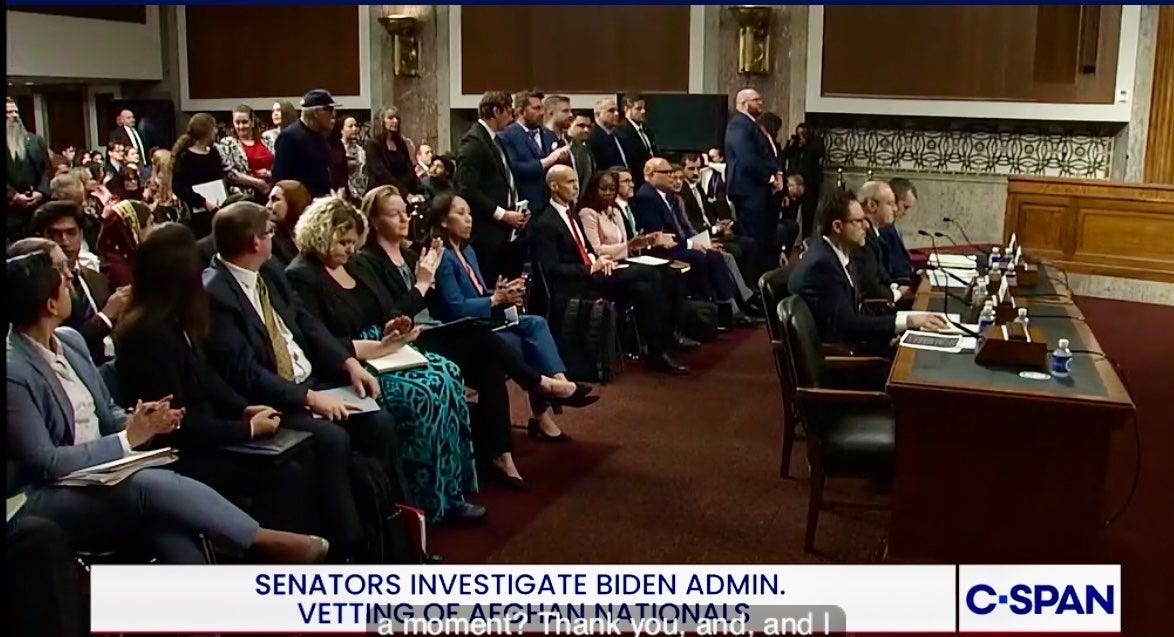
The hearing went extremely well, clearly establishing that Afghans paroled into the United States under Operations Allies Refuge and Allies Welcome (OAR/OAW) were thoroughly vetted, that individuals who failed to meet vetting standards were not permitted to remain, and that the system functioned as intended.
While the hearing’s title invoked the idea of a “Trojan Horse,” what the testimony actually revealed was that claims of insufficient Afghan vetting rest on a false premise. As has been repeatedly demonstrated, Afghan immigrants are among the most thoroughly vetted populations in U.S. history. The overwhelming majority of testimony reinforced this reality, and we hope it finally puts these bad faith narratives to rest.
We are grateful to the Members of Congress and their staff who made it clear that they believe that we must continue to keep the promises we made to our wartime allies. But even more, we are grateful to those who came out in support of our allies, sending a clear signal to members, staff, and the broader public that this issue is not abstract; it is human, urgent, and worthy of serious attention.
Visa Suspensions
The Trump Administration expanded its immigration crackdown on Thursday of last week, announcing the indefinite suspension of immigrant visa processing for people from 75 countries – dramatically increasing the number of individuals who are either directly or de facto barred from entering the United States.
This policy is intended to deny visas to those who may end up on public benefits upon arrival to the U.S., and it includes the spouses and children of U.S. citizens. Implementation is expected to begin immediately, further compounding delays and uncertainty for families seeking reunification.
Refugee Re-interview Notices and Operation PARRIS
Over Thanksgiving week 2025, U.S. Citizenship and Immigration Services announced a policy to begin re-interviews and reverification of refugees who entered the United States between January 2021 and January 2025. This policy was formally rolled out as part of Operation PARRIS (Post-Admission Refugee Reverification and Integrity Strengthening), a Department of Homeland Security initiative launched in January 2026 focusing initially on refugees in Minnesota who have not yet adjusted to lawful permanent resident status. Operation PARRIS involves enhanced background checks, re-interviews, and substantive reviews of refugee cases, and builds on broader enforcement directives under Executive Order 14161 and related proclamations.
As implementation has proceeded under PARRIS, there have been verified instances where individuals who received re-interview notices were subsequently detained and referred to Immigration and Customs Enforcement (ICE) following those re-interviews. Reports from resettlement agencies and community groups describe early-morning enforcement actions, arrests, and transfers to detention centers in other states, contributing to widespread fear and uncertainty among refugee families.
At best, this re-interview and reverification policy functions as an intimidation tactic, imposing stress and instability on people who already underwent extensive vetting before lawful admission. At minimum, it raises serious concerns about how administrative reviews intersect with enforcement practices on the ground. AfghanEvac is actively tracking re-interview notices, detention reports, and outcomes as they develop, and will continue to share verified information with communities and partners.
Camp As-Sayliyah Potential Closure
Late last week, the State Department notified Congress of its intent to close Camp As-Sayliyah (CAS) in Doha by March 31, 2026, and to move Afghan residents currently there to third countries. This intent has been confirmed to us directly by U.S. State Department staff. As of now, no receiving countries have been publicly identified, and no agreements have been announced. It is critical to underscore that this is an announced intent, not an executable plan.
There are approximately 1,100 individuals currently at CAS. More than half are women, and more than 150 are immediate family members of U.S. military servicemembers. Roughly 800 individuals are in the refugee pipeline with approved pathways to the United States. These individuals were moved by the U.S. government from Afghanistan into U.S. custody in Qatar with the explicit understanding that the United States would process their cases to completion.
As we reported last week, the State Department has already pursued a policy of offering cash payments to CAS residents to “voluntarily” repatriate to Afghanistan. These offers are being made in the absence of clear guidance, timelines, or information about next steps. Afghans at CAS face the prospect of indefinite confinement, with no freedom of movement off the camp and living conditions that were never designed for long-term housing or services. In this context, offering financial incentives to return to Afghanistan constitutes coercion and directly violates the international principle of non-refoulement.
The proposed closure of CAS would escalate this harm. Moving Afghan allies to unidentified third countries, without guarantees of safety, legal status, or durable solutions, would abandon people the United States brought under its protection and promised to resettle. Anything short of completing their cases and honoring approved pathways to the United States is unacceptable.
AfghanEvac is actively engaging Congress, the Administration, and partners across this ecosystem to stop this unconscionable plan. Afghans at CAS were brought there by our government with clear assurances that their cases would be processed to completion, and we will continue to press until those commitments are honored.
Please check out this thread on X for more context:


In the Press
Veterans stand with Afghan allies as Senate Republicans say they’re a public safety risk – KPBS San Diego
US suspending immigrant visa processing for 75 countries – CNN
A CT woman helped U.S. forces in Afghanistan. Why her life here has turned to fear. – Hartford Courant
Germany Plans to Relocate Over 400 Afghan Refugees from Pakistan – KabulNow
National Security Daily Jan 16th – Politico
GOP senators seize on shooting by Afghan national to slam Biden-era resettlement programs – Stars & Stripes
Veterans defend Afghan ally programs as Trump closes doors – Task & Purpose
‘Betrayal’: US to close Qatar camp housing Afghans awaiting US resettlement – Middle East Eye
U.S. Senate says halting refugee programs threatens thousands of Afghan lives – Khaama Press
Last week’s Senate hearing reaffirmed what we have long known: Afghan allies were thoroughly vetted, and the United States has both a moral and strategic obligation to stand by them. The proposed closure of Camp As-Sayliyah and the re-interview policy threaten to undermine that obligation.
Regardless of these setbacks, AfghanEvac remains committed to finishing the mission and ensuring that the promises made to our wartime allies are kept. Thank you for standing with us, and please stay tuned for an important announcement on what comes next regarding global engagement for our allies.