

Five years ago today, at 11:59 at night in Kabul (12:29pm Pacific / 3:29pm Eastern), Major General Chris Donahue walked up the ramp of the last C-17 out of Hamid Karzai International Airport. There is a photograph of it, taken through night vision, and he is rendered in that green the way a ghost would be. He was the last American soldier standing on Afghan ground. The ramp came up. The aircraft left.
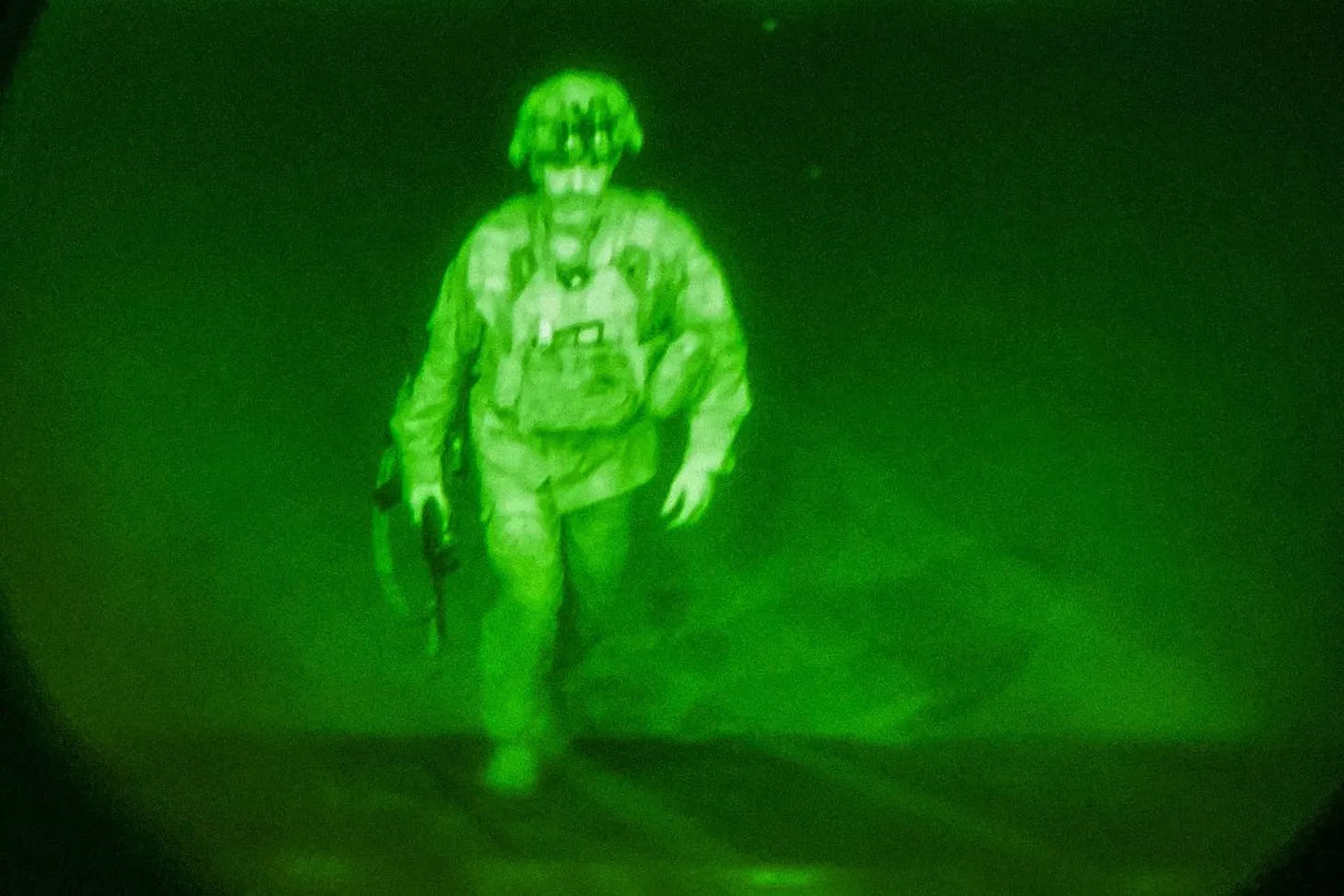
Then the world went quiet.
That is the part people who were not in it still do not understand.
For two weeks there had been nothing but noise. Phones going off at three in the morning. Gate codes, manifests, photographs of passports held up in a crowd, group chats stacked on group chats moving faster than anyone could read them, thousands of Americans and Afghans typing at once because typing was the only thing left to do.
Then the ramp closed, and the noise stopped all at once.
What was left was the kind of silence that only accompanies bad news, and the messages that kept arriving into it, hour after hour, from people who did not yet know that no one was coming for them.
Some of those messages never stopped. Five years later they still arrive on ordinary Tuesdays, from Kabul and Islamabad and Doha, from people waiting on a promise that was made in public and abandoned in the dark.
AfghanEvac started in that noise, in about forty group chats that did not know the others existed. There was no plan. There was a phone, a list, and a refusal to let it end there. Then we continued in the quiet, after building a partnership between government and civil society.
We are still here.
This is a special edition, and it is longer than usual. It is a year of work put on the record, and then four direct messages to the people who have carried this. The regular Monday Morning Update returns tomorrow.
Before anything else, an ask. If this work matters to you, become a monthly sustainer.
Monthly giving is what lets us staff a strategy instead of a crisis. It funds Battle Buddies, the research, the explainers that keep families from making irreversible mistakes, and the plain fact of showing up in courtrooms and hearing rooms where nobody else will. Sustained funding like this is worth more to us than a single larger gift, because it lets us plan past the next emergency.
THE FIRST FOUR YEARS
Most of what we are fighting for right now, we helped build.
After the airlift ended, the work became turning a two-week emergency into a functioning system. That meant standing up coordination between a federal government that had never done this at scale and hundreds of volunteer groups that had never worked with each other. It meant a memorandum of understanding with the State Department, signed with Secretary Blinken. It meant more than a hundred visits to processing sites, dozens of standing interagency meetings, and 145 distinct working relationships inside State alone. It meant building the data infrastructure that let anyone say, for the first time and with precision, how many Afghans were in the pipeline and exactly where they were stuck.
What came out of that was Enduring Welcome, and Enduring Welcome worked. Not perfectly, and never fast enough, but it moved more than 200,000 people to safety through legal, vetted pathways. Thirty-nine of our policy recommendations were adopted across eight federal agencies.
That is the part the current argument keeps leaving out. The system was not theoretical and it was not broken. It was built, it was staffed, it was screening people to a standard higher than almost any other traveler admitted to this country, and it was moving families onto airplanes. Then it was taken apart. Not by circumstance, not by a court, and not by any fact that changed about the people waiting in it. By decisions, made by people with names.
So when we say this is a choice, we are not speculating about whether a functioning system is possible. We watched one get built. We helped build it. And we watched the same country switch it off.
JANUARY THROUGH AUGUST 2026
We stopped a transfer to the Democratic Republic of the Congo. In April, we learned about the plan to move Afghans out of Camp As Sayliyah in Qatar to the DRC, placed it in national press, and moved Congress. Twenty-nine senators led by Senator Richard Blumenthal called it what it was. It is because of our relentless advocacy that this plan became untenable, and was cancelled in May. The World Health Organization declared an Ebola public health emergency in the DRC on May 17. The sequence matters. The plan died before the outbreak was declared, because people made it die.
We built the evidence base. This year we published the Five Years On series, and it is the most substantial body of research this coalition has ever produced.
Protection Promised (July 15), built on more than 316 primary-source government documents, written so it can be filed in a courtroom.
A Practitioner’s Companion (July 20), by our senior adviser Jeremiah Johnson, a former immigration judge, mapping relief and legal standards for attorneys with active Afghan cases.
The Unfinished Mission (August 5), the first full accounting of seventeen years of the Special Immigrant Visa (SIV) program, with ten recommendations.
The Allied Ledger (August 12), produced with Local Staff International and Professor Sara de Jong, comparing how eight nations kept or broke their commitments to wartime allies, released alongside Guidelines for the Rights and Protection of Local Staff.
The Ledger now holds more than 470 government source documents, 45 quarterly SIV reports, dozens of case-law decisions, and a live litigation tracker. We built it because records disappear, and because an argument without documents is just a feeling.
We asked the country what it actually thinks. On Thursday we released Still With Us, a national bipartisan poll conducted in partnership with HIAS by Lake Research Partners and The Tarrance Group, fielded July 23 to 30 among 1,000 likely 2026 voters.
84 percent say the United States should keep its commitment to the Afghans who worked alongside American troops, and to their families.
52 to 72 percent. Support for admitting Afghan allies jumps twenty points once voters simply learn who these people are, and more than doubles among Republicans, landing at 54 percent.
80 percent say we can protect national security and honor our commitments at the same time.
78 percent support reuniting the families of American citizens and service members.
76 percent support restoring protections for people who were already approved.
72 percent support a permanent program for wartime allies rather than another improvised fix after the next withdrawal.
70 percent want protection extended to everyone who risked their lives alongside Americans, not only the narrower group the current statute happens to cover.
63 percent oppose deporting or transferring Afghans to third countries.
83 percent of voters agree that no American in uniform should have to leave family behind; 73 percent of military households strongly agree.
The 72 and the 70 are the numbers we have been waiting years to see. The Special Immigrant Visa was built around a documented employment relationship with the United States. It was never built for the people who took exactly the same risk without one, the local staff two layers down a subcontract, the fixers, the drivers, the women who kept clinics and schools running because Americans asked them to. The public is well ahead of the law here.
None of that was an accident of question wording. We tested the recommendations from The Unfinished Mission directly, because we wanted to know whether the fixes we are proposing could actually hold before we asked anyone in Congress to carry them. They can. And we are working with congressional offices right now on long-term, conflict-agnostic mission partner legislation, a standing framework that applies to whoever stands with Americans in the next place we go, so that nobody has to build this machinery from scratch again while people are being hunted.
That is not a divided country. That is a government out of step with its own people.
We kept this story in the news, and we want to help you tell yours. 289 press stories so far this year, and 818 since we started. We do not track that number for vanity. The poll is the reason it matters. Support for Afghan allies jumps twenty points the moment people learn who these families actually are, which means every story is worth roughly that much ground. Five years in, we have gotten good at knowing which reporters cover which stories, what makes an editor say yes, and how to protect people who take a real risk by speaking publicly. That capacity is not ours to hoard. If you are an Afghan ally, a veteran, a resettlement worker, or a partner organization sitting on a story that belongs in the press, send it to us.
We kept Afghans front of mind for Congress
ongress. More than a thousand statements for the record ahead of the January Senate Judiciary hearing. A shadow hearing in February convened by Representative Sydney Kamlager-Dove. Some virtual congressional delegations into Camp As Sayliyah, in April and July, where members of Congress heard directly from families living under intercepted missiles. An open letter with more than a thousand signatures, hand-delivered to fifty offices. Letters from 83 House members in June, led by Representatives Jason Crow and Don Bacon, and from 35 members in August, led by Representative Scott Peters and Senator Blumenthal. The bipartisan Afghanistan Temporary Protected Status Act was introduced in July as H.R. 9899 and in August as S. 5308. The ARCH Act followed, to preserve the service records that prove who these people are.
We have not let a single court ruling go unanswered. AfghanEvac is not a party to these cases, and we do not pretend to be. What we do is make sure that when a court moves, Afghans are not the last people to learn what it means for them.
In May, Judge Tanya Chutkan found that the State Department had woefully failed its obligations in Afghan and Iraqi Allies v. Rubio and imposed binding monthly benchmarks. We have tracked every compliance filing since and published what they show, which is 916 cases in June against a benchmark of 1,000, and 811 in July against a benchmark of 2,000. The August filing, benchmark 3,000, is due in early September, and we will publish it either way.
When the Dorcas decision vacated four USCIS policies in June, we had an explainer out the same week so families and their attorneys knew what had actually changed and what had not. When CLINIC v. Rubio struck down the 75-country visa suspension on August 21, we said within hours that the win was real but narrow, because the entry proclamation still stands, and a family that sells a house on a misread headline cannot get that house back. Wins and losses get the same treatment here, which is a fast, plain explanation of what a ruling actually means for an Afghan case.
We built tools the community can actually use, and did not just make this about words. V-PRIC, our Visa Pathways and Relocation Information Center at pathways.afghanevac.org, covering 124 visa classifications across 197 countries with a guided assistant in more than 40 languages. A rebuilt action center that generated more than a thousand individual actions across 40 states in its first week. Explainers on Chief of Mission withdrawals, the asylum interview rule, public charge, the defense bill, and H.R. 9773. A COM help intake. A lawyers list. A women and girls list. A story submission channel at afghanevac.org/your-story for allies abroad who wanted a way to be heard safely.
We showed up, and we listened. Town halls and listening sessions in Sacramento, Fort Worth, Dallas, Rochester, Riverside, Pleasanton, San Diego, and today in Lowell. We did the same work abroad, with a town hall in São Paulo alongside HIAS, convenings in London and Berlin with international partners and Afghan-led organizations, and the Global Alliance built with Local Staff International. A Global Update in February drew nearly 1,900 people from 31 countries, 48 states, and 49 congressional offices. A Global Alliance Update in August drew partners from more than 16 countries, over half of them joining from Afghanistan and Pakistan. We did more listening in those rooms than talking, and most of what is in this newsletter started in one of them.
We refused to let a death go quiet. Mohammad Nazeer Paktiawal served alongside U.S. Army Special Forces in Paktika. He was a father of six in Richardson, Texas. Immigration and Customs Enforcement detained him on March 13, and he was dead in under twenty-four hours. We spent this year on the death certificate, the records fight, the press conferences, and the congressional demands, and in July we obtained the autopsy report. The photographs are still outstanding. We are not finished.
AND THEN THERE IS YESTERDAY
On Friday, a deportation plane carrying roughly seventy people left the Dallas area for the Central African Republic, with stops in Senegal and Sierra Leone along the way. We understand about twenty of the people on board were Afghan.
One of them is a twenty-four-year-old the New York Times identified only as Khalil, at his attorney’s request, because using his full name could get him killed. An immigration judge granted him withholding of removal last year after finding his fear of persecution credible. His father, his brother, and his sister worked alongside American forces. Another brother was a pilot trained by the United States, and he was killed fighting the Taliban in 2020. After Kabul fell, the Taliban raided the family’s house looking for them.
Marine Colonel Zachary Schmidt supervised Khalil’s brother during the war and testified at Khalil’s hearing. “I firmly believe that if this young man is forced to return to Afghanistan he will be killed,” he told the Times. “The United States made a commitment to protect the people who helped us, and that includes their families.”
The Central African Republic is in a civil war. It appears on the State Department’s own list of places Americans are told not to go. People sent there on these flights receive no legal status, no work authorization, and no legal support. Friday’s was the third such flight since June.
That plane took off the day before the fifth anniversary of the last flight out of Kabul. AfghanEvac is a named source in that story, and we are still pushing it, because sending a man who won protection in an American courtroom to a country at war is not a loophole and it is not an oversight. It is a policy. Policies can be ended.
Read it here: “Relative of Afghans Who Helped U.S. Military Is Deported to Africa,” by Miriam Jordan and Hamed Aleaziz, The New York Times, August 29.
TO AFGHAN ALLIES AND TO THE DIASPORA
You do not need us to tell you what these five years have cost. You have lived every day of it, in Kabul and Islamabad and Doha and Sacramento, in apartments where the phone is checked before anything else in the morning.
Here is what we owe you, said directly.
We will not lie to you to make a headline feel better. When a court ruling is narrow, we will say it is narrow, even when a clearer story would generate more feelings. When there is no pathway, we will tell you there is no pathway, and we will tell you why, and we will tell you who decided it. The August 21 ruling was real. It did not open the door. We said so within hours because a family that sells a house on a misread headline cannot get that house back.
We will keep putting your words in front of power rather than speaking over them. The letters that arrived this summer from Priority 1 and Priority 2 families in Pakistan, from an SIV applicant four years into waiting, from a young woman inside Afghanistan asking only whether any safe and realistic path exists, are the most important documents we handled this year. They went to Congress. They will keep going.
We know what we cannot do. AfghanEvac does not run casework and does not provide legal representation. Pretending otherwise would waste the hours you do not have. What we can do is change the conditions your case sits inside, keep the records that prove your service, and make sure that when a decision gets made, someone in that room has read the file.
And this. Your case is not a favor being considered. It is a debt being paid late.
TO VOLUNTEERS AND ADVOCATES
Five years is a long time to stay angry at something and keep being useful about it. Most movements do not manage it. You have.
The Battle Buddies program has more than a thousand registered veteran volunteers. The training takes about forty minutes. The record still stands: where a Battle Buddy is present, nobody has been detained or deported. That is not a slogan, it is an outcome, and it belongs to Steve in Texas, Monica and Leisel outside Washington, the volunteer in Philadelphia, the one in Eugene who read about a family’s rebuilt business and asked how to join their circle instead of just sharing the article.
What you are doing is unglamorous on purpose. It is a biometrics appointment with snacks for six kids. It is a hearing where you say nothing and your presence is the entire point. It is a car ride. It is a name read aloud on a Wednesday. There is no version of the last five years where the government kept this promise on its own, and there is no version of the next five years where it does either. It gets kept because people keep showing up in single rooms on ordinary Tuesdays.
If you have been meaning to sign up, do it now. September is going to be heavy. Camp As Sayliyah is scheduled to close on September 30 with more than a thousand people still inside, over half of them women and children, roughly 150 of them the immediate family of American service members and veterans. The fiscal year 2027 refugee admissions determination is due the same day. We are going to need every hand.
TO THE AMERICAN PUBLIC
If you have followed this only loosely, here is the whole thing in four sentences.
The United States asked Afghans to work beside American troops for twenty years. Congress wrote that promise into law and built a vetting system so demanding that the people who cleared it are among the most thoroughly screened travelers ever admitted to this country. Since January 1, 2026, exactly one Special Immigrant Visa has been issued. Roughly 178,000 people hold Chief of Mission approval and are waiting.
This is not a backlog. Backlogs are what happen when a system is overwhelmed. This is what happens when a system is switched off, and every part of it that was switched off can be switched back on.
We are not asking you to take our word for it. Take the numbers you produced. Eighty-four percent of likely voters say keep the promise. Eighty percent say security and honor are not in conflict. Once people learn who these Afghans actually are, support jumps twenty points and more than doubles among Republicans. There is no meaningful constituency in this country for abandoning the people who kept Americans alive. There is only a policy, and policies are choices, and choices can be unmade.
The ask is simple. Learn one story well enough to tell it at a dinner table. Call your representative and your senators about the Afghanistan TPS Act. Share the research at reports.afghanevac.org with someone who assumes this was settled in 2021. And when someone tells you the country has moved on, tell them the country was polled, and it has not.
TO OUR PARTNERS
This team has never been a building. It is more than 250 organizations that agreed to work in the same direction. It’s an entire ecosystem that, even though we sometimes disagree, we know we are at our best when our eyes are on our shared goal of helping our Afghan friends and colleagues.
To the legal organizations who took the cases and wrote the briefs, to the resettlement agencies who caught families the federal government dropped, to the veteran service organizations who understood immediately why this was a veterans issue, to the Afghan-led and Afghan-American organizations who did the hardest and least credited work of all, and to the researchers and data people who made sure our arguments came with footnotes, thank you.
A few collaborations deserve to be named because they were formal and public. HIAS partnered with us on the Still With Us poll, and they have been a genuine partner in every sense of the word. Local Staff International and Professor Sara de Jong built The Allied Ledger with us and made it an international argument instead of an American one. Iraq and Afghanistan Veterans of America built Battle Buddies alongside us. And this year we were joined at a hundred local events by community organizations who fed people, translated, drove, and opened their spaces without asking what they would get for it.
ON DOING THIS WORK DIFFERENTLY
Not everyone in this space works the way we do, and some of the disagreements are real ones.
Some are more cautious. Some believe in working quietly inside the building, and some believe the building only responds to noise. Some do direct casework we deliberately (usually) do not do. Some have taken positions we think are wrong, and some have taken positions we thought were wrong and turned out to be right.
Here is what five years taught me. This crisis is far too large for one theory of change, and the people waiting do not care which of us is correct about tactics. A family that gets out because a quiet channel worked is just as out as a family that gets out because someone made it a national story. Every organization in this fight has moved someone the rest of us could not reach.
So we will keep our disagreements where they belong, which is between us and not in front of the families. If your organization is working this problem in good faith, you have our respect, and you have a partner in us whether or not we ever agree on method. There is more than enough work.
WE ARE NOT GOING ANYWHERE
The quiet that fell when that ramp closed was never an ending. It was the sound of the cameras leaving. The work did not stop that night. It just stopped being televised, and a lot of people decided to keep doing it anyway with nobody watching.
Five years ago, this was forty group chats and a bad feeling. Today it is a coalition with a research arm, a litigation tracker, a volunteer corps, a bipartisan poll, and a documented record that will outlive every official currently refusing to answer our letters.
None of that was the goal. The goal is that they all come home. We have not reached it. Roughly 250,000 people are still waiting across more than 90 countries, and more than a thousand of them are sitting in a camp in Qatar with a closure date and no announced destination.
But an organization built for a two-week emergency is entering its sixth year with more capacity than it has ever had, and that is not an accident. It is what happens when a lot of people decide, over and over, that they are not going to be the ones who look away.
As this goes out, I am walking into the International Institute of New England's office in Lowell, Massachusetts for an Afghan community town hall. There is no better way I could spend today than in a room with Afghan families and the volunteers who show up for them, trading information, answering the questions nobody else will answer, and building the thing that holds when governments do not. That room is the whole organization in miniature. It has been the answer for five years.
So plan on us. Plan on us in September when the camp is supposed to close. Plan on us in the next Congress, and the one after that, and in whatever administration comes next, asking the same question with the same documents. This ends when the promise is kept, and not one day before.
One more time, because it is the thing that keeps this going. Become a monthly sustainer today.
Five years in, the work is not slowing down, and steady support is what turns a movement into an institution that outlasts the news cycle. If you cannot give, give an hour instead at afghanevac.org/battle-buddies. Both count. Both are needed.
Thank you for five years. Let’s finish it.
With deepest respect and solidarity,
Shawn VanDiver
President and Founder, #AfghanEvac
U.S. Navy veteran
The regular Monday Morning Update returns tomorrow, August 31.
We, the Afghans of Pakistan, trust you.