

WHY WE’RE PUBLISHING THIS TODAY
Senate Armed Services Committee Chairman Roger Wicker introduced the National Defense Authorization Act for Fiscal Year 2027 yesterday. AfghanEvac has reviewed both the Senate and House versions. There is genuinely good news in this bill. There is also a provision that has been characterized as a protection for Afghan allies at Camp As Sayliyah -- and we want to be honest with you about what it actually does.
ACTION ON THIS
Read AfghanEvac’s full analysis of both bills and what they mean for Afghan allies
Contact your members of Congress and demand standalone legislation protecting Camp As Sayliyah residents before September 30
THE MASSIVE WIN: A RECORDS PRESERVATION PROGRAM THAT MATTERS
Senator Mike Rounds authored something that Afghan allies have needed for years.
Section 1080 of the Senate bill would require the Department of Defense to build a secure online portal to document and preserve the service records of Afghan allies whose documentation was lost or destroyed in August 2021. If you have been in the P1 or P2 pipeline and have struggled to prove your service to adjudicators, this provision was written for you.
Here is what it would do:
The portal must be operational within 180 days of enactment. Applications are accepted from anywhere outside the United States, including from inside Afghanistan. A designee can apply on behalf of someone who cannot submit themselves. DoD will review service records, internal records, and biometric data. Approved applicants receive a preserved record for potential future use in immigration or naturalization proceedings. No fees. No deadline sooner than ten years from enactment.
This program does not grant immigration status or a pathway to the United States. It is a records program. But for tens of thousands of Afghan allies whose service has gone undocumented, it is the infrastructure that should have existed from the beginning. It should become law. It should also become standard practice for every future conflict in which foreign nationals serve alongside American forces.
We are grateful to Senator Rounds for making it happen. We will fight to ensure it survives floor votes and conference intact. The House bill contains no equivalent provision.
On the statement, put it at the very bottom as a labeled capstone, not “below” in the middle of the flow.
Right now the line “Our full statement is embedded below” sits just before your analysis button and the TAKE ACTION ask. If you drop a long, formal statement there, you put a wall of text between the reader and the “Act now” button, and you bury your closing punch. Sequence it like this instead: WHAT NEEDS TO HAPPEN, then the rest-of-the-bill pointer and analysis button, then TAKE ACTION, then your two-line close, then a divider, then the statement under a header like AFGHANEVAC’S FULL STATEMENT FOR THE RECORD. That way the press and your most committed readers find it, but it doesn’t step on conversion or the emotional close. Change the earlier cue to “Our full statement for the record is at the bottom of this email” so the pointer still works.
On being clear with allies, yes, unambiguously. This is the most important edit in the whole piece. Your credibility with the community depends on never letting them believe they are protected when they are not, and false hope here is not harmless. Someone could turn down a third-country option thinking a shield is coming in September. Saying it plainly also reinforces the anti-misinformation posture you have built all year.
Your other three points all live in the same section, so here is a consolidated rewrite of THE CAS LANGUAGE that folds in all of it. Drop-in:
THE CAS LANGUAGE: A SIGNAL, NOT A SOLUTION
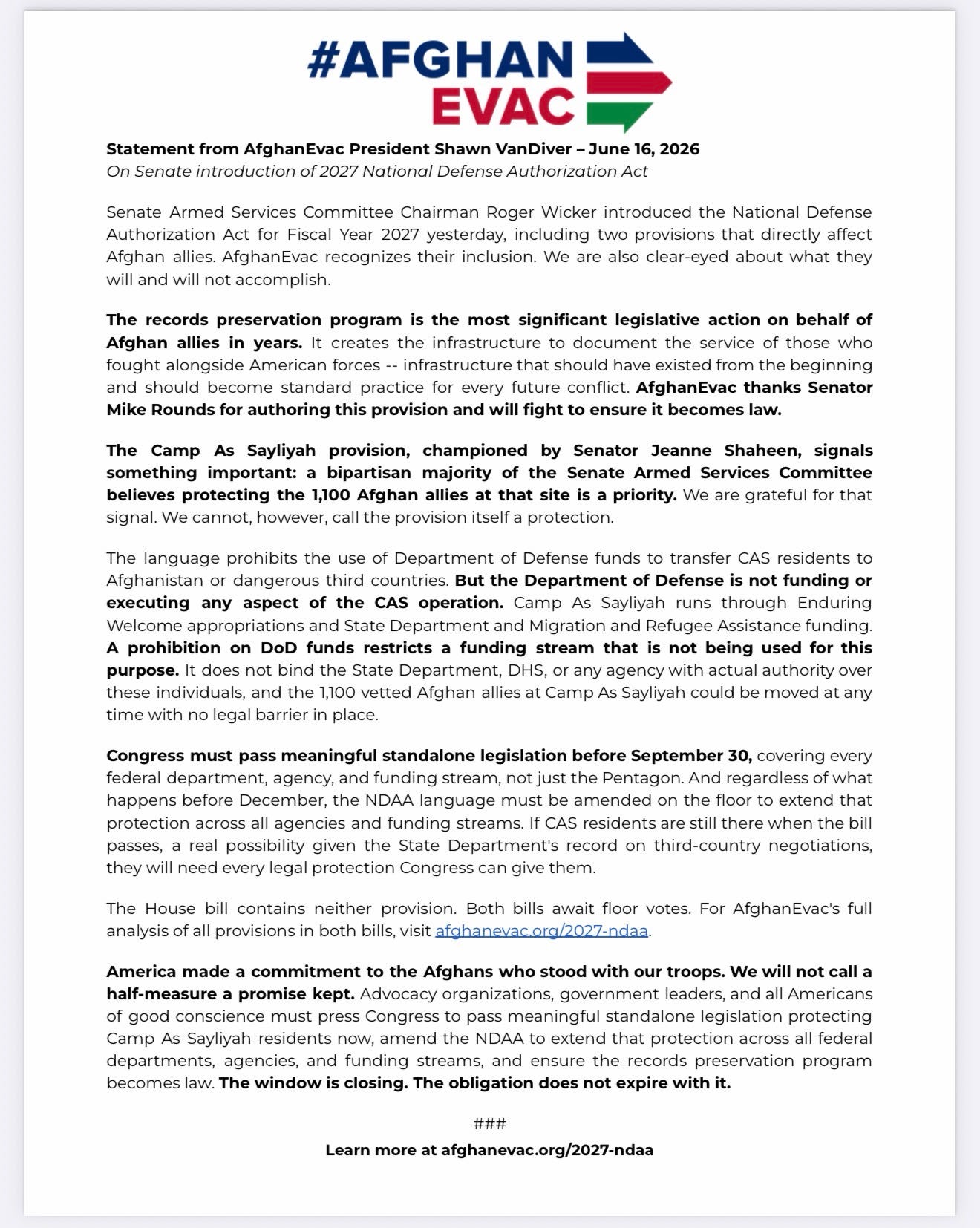
Senator Jeanne Shaheen championed a provision in the Senate bill prohibiting the transfer of Camp As Sayliyah residents to Afghanistan or dangerous third countries. The fact that this language made it into a Republican-led committee’s markup tells us something meaningful. The Senate Armed Services Committee believes protecting the 1,100 Afghan allies at that site is a priority. We are grateful to Senator Shaheen for her leadership, and we read this as a genuine signal that the Senate is paying attention.
But we have to be honest about what the provision actually does, because the people it names are counting on us to tell them the truth.
As written, if it passed tomorrow, it would offer no legal protection to the people at Camp As Sayliyah.
The provision applies only to Department of Defense funds. DoD does not fund or operate Camp As Sayliyah, and it has not since 2023, when responsibility for the site and for Enduring Welcome shifted to the State Department. CAS today runs on Enduring Welcome appropriations and State Department Migration and Refugee Assistance funding. A prohibition on DoD funds restricts a funding stream that stopped touching this site years ago. The agencies with actual authority over these individuals, State and DHS, are completely untouched by this language.
The provision’s congressional briefing requirement does not close that gap. A briefing is a notification, not a request for permission. It requires that Congress be told about a transfer. It does not give Congress, or anyone, the power to stop one.
And then there is timing. The NDAA will not be signed until December. Camp As Sayliyah is slated to close September 30, and camp staff have already told residents to expect to be gone by September, months before this provision would ever take effect. The 1,100 vetted Afghan allies at that site, transported there by the U.S. government and promised consideration for admission, could be moved at any time, through any existing funding channel, with no legal barrier in place.
To our Afghan allies reading this, we want to be completely clear. This is a good sign. It is not protection. It would not protect you in September, and it would not protect you today. Anyone who tells you otherwise is not giving you the full picture.
WHAT NEEDS TO HAPPEN
Two things.
First, Congress needs to pass standalone legislation before September 30 that prohibits the forced transfer of CAS residents to Afghanistan or any dangerous third country, and that applies to every federal department, agency, and funding stream -- not just the Pentagon.
Second, the NDAA must be amended on the floor or in conference to extend that protection across all departments, agencies, and funding streams. Because if CAS residents are still there in December -- a real possibility given the State Department’s record on third-country negotiations -- they will need every legal protection Congress can give them.
Both bills also contain provisions related to Afghanistan that do not directly affect Afghan ally resettlement or the Camp As Sayliyah population -- including an extension of the Afghanistan War Commission and, in the House bill, a prohibition on DoD funds supporting the Taliban. Our full provision-by-provision analysis of both bills covers all of them.
TAKE ACTION
We have built a campaign tool so you can send a message directly to your House member and both senators today. It takes less than two minutes. The message explains exactly what the NDAA language does and doesn’t do, and asks Congress to act before September 30.
Share the link. Send it to your networks. The window between now and September 30 is short.
America made a promise to the Afghans who stood with our troops. Parts of Congress are working to honor it. The effort is real and we recognize it.
The gap between that effort and what these allies actually need is also real. We will keep saying so -- and pushing for more -- until the gap is closed.
Our full statement on the provisions
No more Muslim immigrants.
511980
We are P2 Case holders and we stuck in Afghanistan.