

Why a special edition? Since news broke that two Afghans arrived in the United States this week, many of you have written with questions. How did this happen? Who else can come? What does it mean for your family's case? We wanted to answer as much as we can in one place, right away, instead of waiting for Monday. Here is what we know, what we are asking for, and how you can help.
On Tuesday morning, something that almost never happens anymore happened.
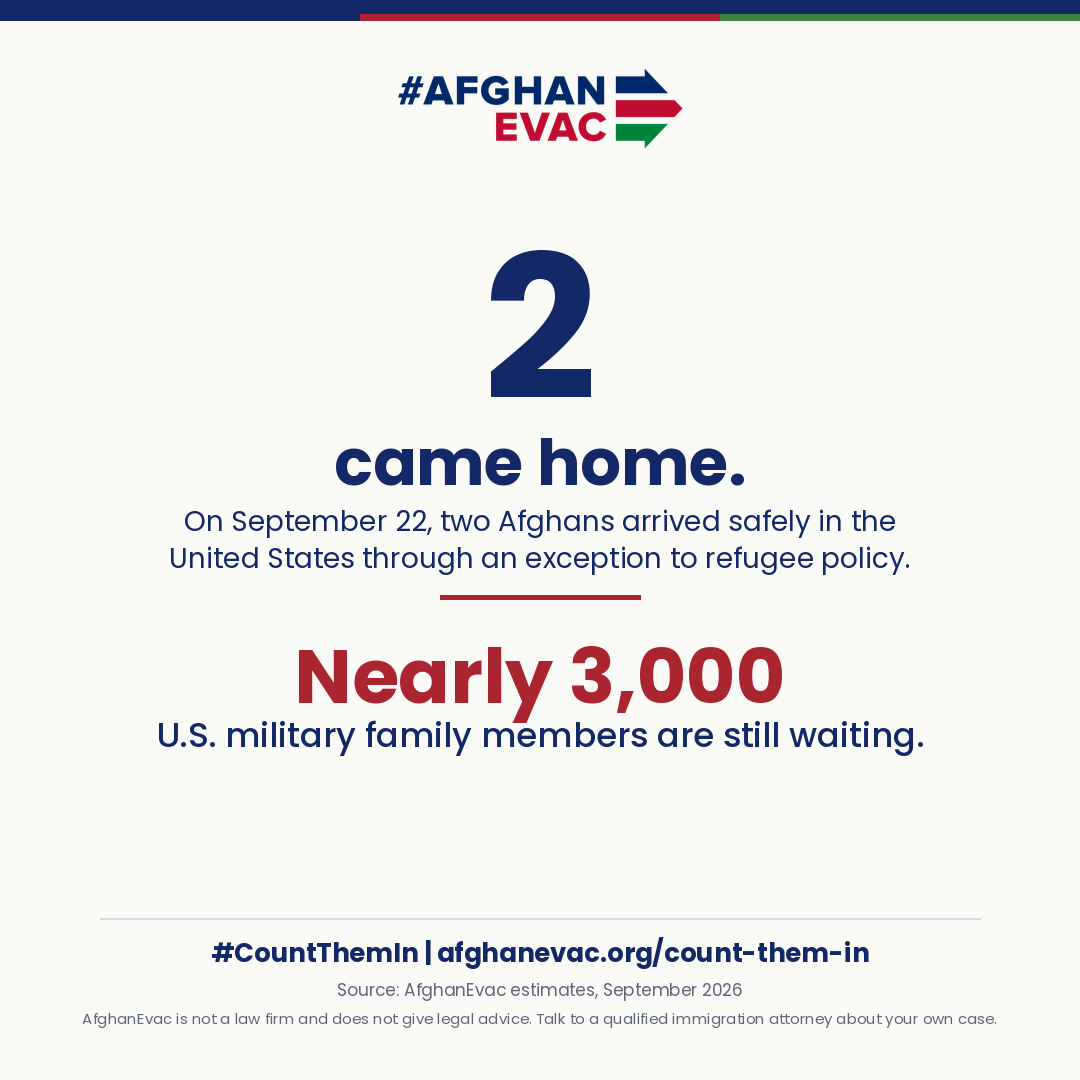
Two Afghans landed safely in the United States through the U.S. Refugee Admissions Program (USRAP), on an exception to current policy.
They are only the fourth and fifth Afghans admitted as refugees this fiscal year (2026).
Refugee admissions are largely frozen, and the travel ban blocks nearly every Afghan at the door, but someone looked at this family and said yes.
The next day (yesterday), House and Senate Judiciary Committee staff were briefed on next year’s refugee admissions. Afghan allies aren’t named in that plan. The timing could not matter more.
Important: the refugee program has not reopened. This week's arrival does not mean refugee processing has resumed for Afghans, and it does not mean cases are moving. Neither is happening. What it does show is that the government can say yes when it chooses to, and we are going to do everything we can to get it to reopen the program for every eligible family. Please do not pay anyone who claims they can get you or your family onto the next flight. There is no fee or application that unlocks an exception like this one, and anyone who says otherwise is not telling you the truth.
What You Need to Know
The arrival, and who we are thanking for it
Why this family belongs here
What it proves, and who is still waiting
The briefing, and what we’re asking Congress to do
A new resource for families already here
Start with the ways you can take action, then read on.
ACTION YOU CAN TAKE
Write your members of Congress through #CountThemIn. 2,769 letters have already gone in. Ask them to secure named admissions for Afghan allies in the FY2027 refugee determination. It takes two minutes: afghanevac.org/count-them-in
Call your Representative and both Senators through the U.S. Capitol Switchboard at (202) 224-3121. Ask the operator to connect you, then ask your members to press the State Department and the Department of Homeland Security (DHS) to extend the same decision to every eligible Afghan referred to USRAP through the Priority 1 and Priority 2 programs, including the families of U.S. service members and family reunification cases.
Say thank you in public. Post with #CountThemIn and thank the officials who made Tuesday possible. Positive reinforcement matters, and they should hear that Americans noticed.
Share our statement (below) with your network, your faith community, and your local newspaper.
For those already here, being able to live with dignity matters. Share our new benefits guide at afghanevac.org/obbb, which helps Afghan families understand the food and health benefit changes and what they can do about them.
Military families, tell us your story. If your spouse, child, or parent is stranded overseas, we want to help your story reach Congress and the press. https://afghanevac.org/your-story
Reporters: we can connect you with service members whose families are stranded and with veterans who served alongside Afghan allies. Email press@afghanevac.org.
TWO AFGHANS CAME HOME
On Tuesday, September 22, two Afghans arrived in the United States through USRAP under an approved exception to current policy. Since January 1, 2026, Proclamation 10998 has barred entry to nearly all Afghan nationals. Under those rules, and under Executive Order 14163, an Afghan can reach the United States as a refugee only when senior officials decide that the person’s admission serves the national interest. This week, they made that decision.
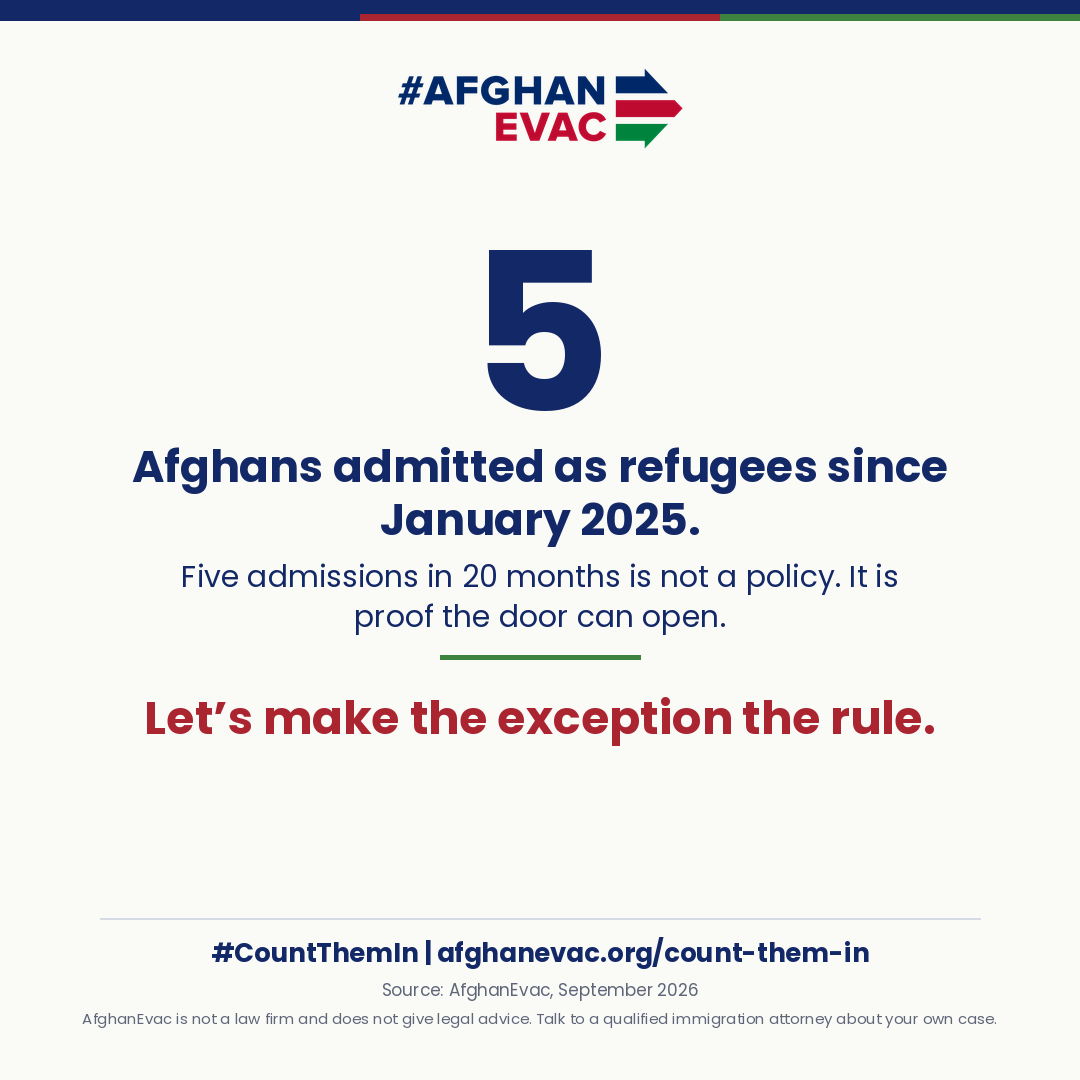
This family is only the second Afghan arrival of its kind since January 2025. The first three were unaccompanied minor children from Camp As Sayliyah, who were admitted before last November’s shooting in Washington. That makes five Afghans admitted as refugees in 20 months.
It happened because specific people chose to make it happen, and they deserve to be named:
Stephen Miller, White House Deputy Chief of Staff for Policy, pushed it from the White House.
Andrew Veprek, Assistant Secretary of State for Population, Refugees, and Migration, made it happen at the State Department.
Secretary of State Marco Rubio and Secretary of Homeland Security Markwayne Mullin signed off, as Executive Order 14163 and Presidential Proclamation 10998 require.
We thank each of them, and we thank President Trump, whose administration made this call. We have disagreed with some of these officials on a great deal. On this, they were right.
We have spent a lot of this year telling you when decisions were wrong. This one was right, and we want to say so plainly.
OUR STATEMENT
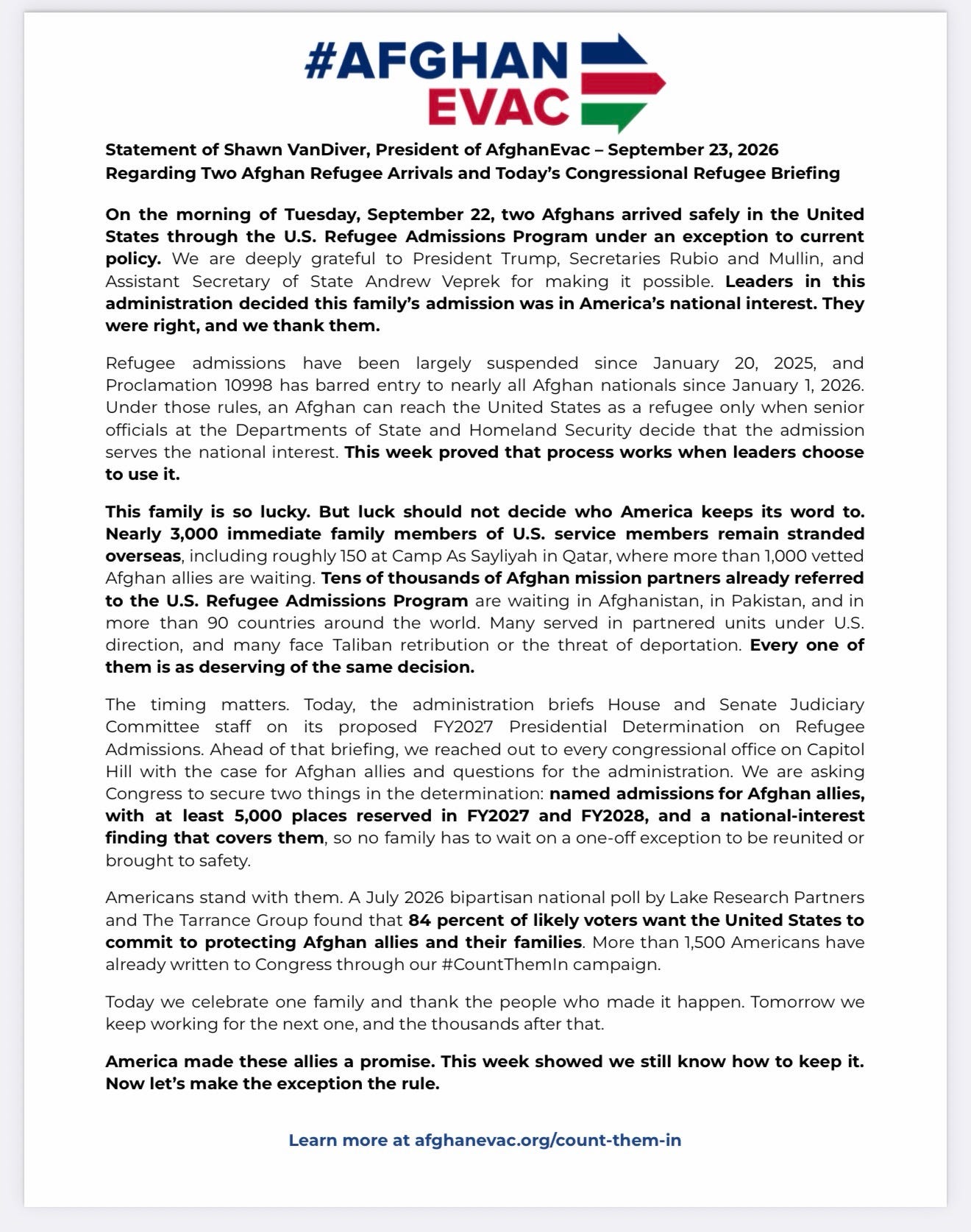
Read and share our full statement on the arrival and the congressional briefing.
THIS FAMILY BELONGS HERE
We want to be clear about something. This family is as deserving as anyone who has ever come to this country through the refugee program. They were vetted by the U.S. government. Senior officials reviewed their case and decided their admission served the national interest. They did everything that was asked of them, and they waited through a process that had all but stopped.
No one should target this family, attack them, or question whether they deserve to be here. They do. If you see anyone doing that online or anywhere else, we ask you to stand up for them, the same way Americans have stood up for Afghan allies for five years.
This family is so lucky. We are grateful for them, and we’re glad they’re home. But luck should not decide who America keeps its word to.
WHAT IT PROVES, AND WHO IS STILL WAITING
For a year and a half, families have been told the door was shut. Tuesday proved it isn’t. It opens when leaders choose to open it. This is a choice. It can be made again.
Nearly 3,000 immediate family members of U.S. service members are still stranded overseas. They are the spouses, children, and parents of Americans who wear this country’s uniform. Roughly 150 of them are at Camp As Sayliyah in Qatar, alongside more than 1,000 Afghan allies and family members who were vetted by the U.S. government and flown there on U.S. government aircraft. The camp is scheduled to close September 30. Beyond Qatar, tens of thousands of Afghan mission partners already referred to USRAP are waiting in Afghanistan, in Pakistan, and in countries around the world. Many are separated from spouses and children who are already here.
Why it matters Five admissions in 20 months is not a policy. It’s a proof of concept. The same decision that brought this family home is available for every one of them. What’s missing is not the authority. It’s the will to use it at scale.
THE BRIEFING
On Wednesday, September 23, the administration briefed House and Senate Judiciary Committee staff on its proposed FY2027 Presidential Determination on Refugee Admissions. That consultation is Congress’s formal say before the determination is signed. The proposal sets a ceiling of 17,500 admissions and does not name Afghan allies.
Ahead of the briefing, we sent every congressional office on Capitol Hill a memo making the case for Afghan allies, along with questions for the administration. We are asking Congress to secure two things in the determination: named admissions for Afghan allies, with at least 5,000 places in FY2027 and FY2028, and a national-interest finding that covers them. Without both, every family is stuck waiting on a one-off exception.
Why it matters Tuesday showed the exception works. The determination is how you turn an exception into a policy.
EVERY ELIGIBLE FAMILY
We are also working with congressional offices on a bipartisan letter to Secretaries Rubio and Mullin. The letter thanks them for Tuesday’s decision and asks how it happened. It also asks them to use the same process for every eligible Afghan referred to USRAP through P-1 and P-2. That includes the families of U.S. service members and Afghans seeking to reunite with immediate family already lawfully in the United States. No family on that list is more deserving than another. Every one of them has already been referred, and every one of them is waiting on the same decision this family received.
Why it matters If your member of Congress wants to do something concrete this week, this is it. Ask them to sign.
A NOTE ON SIV FAMILIES
This week’s decision came through the refugee program, so it does not reach Afghans applying for Special Immigrant Visas (SIVs). SIV applicants are on a separate visa pathway, and under Proclamation 10998 their visas are not being issued even as their cases move forward. Many of them worked directly for the U.S. government and military. We believe they should be able to come too, and we will keep pressing for a way through for them alongside every refugee case.
AMERICANS ARE WITH US
A July 2026 bipartisan national poll by Lake Research Partners and The Tarrance Group found that 84 percent of likely voters want the United States to commit to protecting Afghan allies and their families. That support crosses party lines. So should the response.
KEEPING THE PROMISE MEANS PROTECTING THE FAMILIES WHO ALREADY MADE IT HERE
Not only the ones still waiting. The 2025 reconciliation law, often called the One Big Beautiful Bill Act (OBBBA), restricted food and health benefits for many Afghan allies already living in the United States. Families who did everything right are now trying to figure out what they can still count on.
So we built something that didn’t exist. Our new guide at afghanevac.org/obbb explains, in plain language, what changed, who is affected, and what families can do now. It includes ten regional guides covering California, Texas, the D.C. metro area, Arizona, Georgia, New York, the Carolinas, Colorado and Utah, the Pacific Northwest, and New England, so families can find what applies where they live. It’s also available as a carousel in English, Dari, and Pashto, and partners can download the graphics free at go.afghanevac.org/obbb-graphics.
One point matters most. Applying for a green card does not restore benefits eligibility. Only an approved green card clears that hurdle. If a family has been cut off, they should contact their local benefits office to confirm the cut was lawful and to ask about free clinics nearby.
If you work with Afghan families, at a resettlement agency, a clinic, a mosque, a church, or a school, please share it. AfghanEvac is not a law firm and does not give legal advice. Talk to a qualified immigration attorney about your own case.
We have written a lot of hard updates this year, and we’ll write more. This one is different.
For one family, the promise held.
We want to stay in that feeling for a minute, because it reminds us what all this work is for.
Then we’re going back to work, because there are thousands more families just as deserving, and nearly 3,000 of them belong to people who have served this country. Tuesday showed that America still knows how to keep its word.
Our job now is to make sure it keeps it for everyone who stood with us. Let’s make the exception the rule.
AfghanEvac is powered by people like you. Support the work.
Thank you for the good news you gave us. But I hope that an effective decision will also be made regarding the Afghan refugees stranded in Pakistan, who have been partners of American forces.
Hi sir this is good news.we appreciate you thanks for your hard work God bless you.