

The withdrawal anniversaries are behind us. The countdown to September 30 starts now.
On Friday, a deportation plane left Dallas for the Central African Republic. Among those aboard was a young Afghan whom a U.S. immigration judge had protected from return to Afghanistan. Thirty days from today, Camp As Sayliyah is scheduled to close with more than a thousand Afghans still inside and no announced destination plan.
This week, three things matter most. Start there, then read on.
THREE THINGS TO DO THIS WEEK
Share the polling, tag us, and use the hashtag. Post afghanevac.org/polling wherever you are online, tag @AfghanEvac, and use #StillWithUS. The most useful thing you can do this week is make it impossible for any office in Washington to keep calling this politically risky. Copy and paste if it helps:
Eighty-four percent of Americans say we should keep our promise to the Afghans who served alongside our troops. Support jumps twenty points once people simply learn who they are. New bipartisan polling from @AfghanEvac and HIAS. #StillWithUS afghanevac.org/polling
Contact Congress before September 30, and bring the numbers with you. Demand resumed processing and a safe, public destination plan for Camp As Sayliyah, and a fiscal year 2027 refugee admissions determination that includes Afghans. Send your representative and both senators the polling, then ask what they intend to do with a bipartisan mandate this clear. Facts and a script at afghanevac.org/cas. Take action at action.afghanevac.org.
Push the Afghanistan TPS Act. Ask your representative to cosponsor H.R. 9899 and your senators to cosponsor S. 5308. The House bill still needs more cosponsors. Tools at afghanevac.org/tps.
THEY SENT HIM TO A COUNTRY AT WAR
On Friday, a deportation plane left the Dallas area for the Central African Republic, with stops in Senegal and Sierra Leone. Roughly seventy people were aboard. CBS News identified at least twelve Afghans on the flight; The New York Times reported roughly twenty. There were Iranians, Nepalis, and Nicaraguans as well. None were sent to their own countries.
One of them is a twenty-four-year-old identified publicly only as Khalil, at his attorney’s request, because his full name could get him killed. An immigration judge granted him withholding of removal last year after finding that he faced a credible risk of persecution in Afghanistan. His father, his brother, and his sister worked alongside American forces. Another brother, a pilot trained by the United States, was killed fighting the Taliban in 2020. After Kabul fell, the Taliban raided the family’s house looking for them.
Colonel Zachary Schmidt, an active-duty Marine who supervised Khalil’s brother during the war, testified at his hearing. “It is my belief that if Khalil gets sent back to Afghanistan, that he will be killed,” he told CBS News. His attorney, Alma David, put the pattern plainly: “The goal is to obliterate the global refugee protection system, and his case should serve as a warning.”
The Central African Republic is in the middle of a civil war and has been for decades, and it sits on the State Department's own list of countries Americans are told not to visit. CBS News reports that over the course of ten days, three ICE flights carried more than a hundred people to eight African countries. No publicly disclosed framework guarantees the people sent to the Central African Republic legal status, work authorization, or continuing legal support.
Why it matters When an administration cannot return a person to Afghanistan because a judge found he would face persecution, and instead sends him to a third country in active conflict, the order is honored on paper and emptied in practice. That is not ordinary enforcement. It is a circumvention of the protection a court granted, and it runs against the principle of non-refoulement, the rule that a state does not deliver people into danger, whether directly or by routing them through somewhere else. It is becoming part of the operating model.
Read it and send it on. The New York Times broke the story on Friday with AfghanEvac as a named source, and that is a gift link, so it opens for everyone.
THIRTY DAYS TO SEPTEMBER 30
Friday’s flight is the reason the next thirty days matter so much. Three deadlines land on the same Wednesday. Camp As Sayliyah in Qatar is scheduled to close, with more than a thousand Afghans still inside and no announced destination for them. The fiscal year 2027 Presidential Determination on Refugee Admissions is statutorily due. And the fiscal year ends, taking the appropriations and visa allocation posture with it.
The camp population is not abstract. Roughly 150 of the people inside are the immediate family of American service members and veterans. More than four hundred are children who have not been in a classroom in years. The people inside have undergone extensive vetting. Many have completed interviews, and the consular cohort includes people with Chief of Mission approval. What is missing is a policy decision to resume and finish processing, and it is one this administration has repeatedly refused to make.
We have made this ask before. Thirty-five members of Congress led by Representative Scott Peters and Senator Richard Blumenthal wrote to Secretaries Rubio, Mullin, and Hegseth on August 7. Eighty-three House members led by Representatives Jason Crow and Don Bacon wrote in June. Twenty-nine senators wrote in the spring opposing the third-country transfer scheme. More than a thousand people signed our open letter, hand-delivered to fifty offices. There is no version of this where the government can claim it did not know.
What we want is narrow and achievable. Restart processing for camp residents whose cases are ready. Publish a destination plan before the closure date rather than after it. Do not let a closure date become a transfer deadline. And do not move a single family to a third country the State Department itself tells Americans not to visit. If the camp closes on September 30 with no plan, that will not be a logistical failure. It will be a decision, made by named people, and we will name them.
Our honest read is that September 30 will slip. The Department has no published destination plan, and it has been here before. Its self-imposed March 31 closure deadline passed without an announcement, an accounting, or a single family moved. A deadline with no plan behind it is not a deadline, it is a date on a slide. We expect an extension, and we would rather say so plainly than let a thousand people spend the month believing they are about to be put on a plane to nowhere.
That is not reassurance. An extension is not a solution. It is more months in a camp for four hundred children who have not been in a classroom in years, and it hands the Department more time it has not used well so far.
We are also hearing that Rwanda has moved to the top of the Department’s third-country list. We have not confirmed it, nobody has announced it, and we are working to pin it down. We are saying it out loud anyway, because the Democratic Republic of the Congo plan taught us that these arrangements move fastest when nobody outside the building knows they exist.
TO THE FAMILIES AT CAMP AS SAYLIYAH
Read this part carefully, and pass it on.
You are allowed to refuse. You are allowed to take a document away and read it before you sign it. You are allowed to ask for it in Dari or Pashto, and to have someone you trust read it with you. Do not sign anything you do not fully understand, and do not accept a verbal promise about what happens after you land. Ask who would be legally responsible for you in the destination country, what status you would hold there, whether you could work, whether your children could go to school, and what happens to your United States case if you go. If nobody will put those answers in writing, that is your answer.
Then tell us what you are being offered, at afghanevac.org/your-story. We are not attorneys and we cannot take your case. What we can do is make sure it is not happening quietly, which is the only reason the DRC plan died.
Every one of these arrangements has been built on your consent. That is why they arrive with cash offers and forms to sign rather than with orders. Which means the answer can be no.
WHAT THE COUNTRY ACTUALLY WANTS
On Thursday we released, in partnership with HIAS, a national bipartisan poll conducted by Lake Research Partners, a Democratic firm, and The Tarrance Group, a Republican firm, among 1,000 likely 2026 voters fielded July 23 to 30. We commissioned it because five years of this fight have run on an assumption nobody had bothered to test, which is that the American public moved on. That assumption is wrong.
84 percent say the United States should keep its commitment to the Afghans who worked alongside American troops, and to their families.
52 to 72 percent. Support for admitting Afghan allies jumps twenty points once voters simply learn who these people are, and more than doubles among Republicans, landing at 54 percent.
80 percent say we can protect national security and honor our commitments at the same time.
78 percent support reuniting the families of American citizens and service members.
76 percent support restoring protections for people who were already approved.
72 percent support a permanent program for wartime allies rather than another improvised fix after the next withdrawal.
70 percent want protection extended to everyone who risked their lives alongside Americans, not only the narrower group the current statute happens to cover.
63 percent oppose deporting or transferring Afghans to third countries.
83 percent of voters agree that no American in uniform should have to leave family behind; 73 percent of military households strongly agree.
Two findings deserve far more attention than they have gotten. Seventy-two percent support a permanent wartime allies program rather than another improvised response after the next withdrawal, and 70 percent want protection extended beyond the narrow group covered by the current Special Immigrant Visa statute. The SIV was built around a documented employment relationship with the United States. It was never built for the local staff two layers down a subcontract, or the drivers and fixers, or the women who kept clinics and schools open because Americans asked them to. The public is ahead of the law.
None of that came from loose question wording. We built the instrument to test the recommendations in The Unfinished Mission, because we wanted to know whether the fixes we are proposing could hold politically before asking any member of Congress to carry them. They can. We are working with congressional offices right now on long-term, conflict-agnostic mission partner legislation, a standing framework that applies to whoever stands with Americans in the next place we go.
Why it matters Every ask in this newsletter has been treated in Washington as politically costly. It is not. It is politically popular, in both parties, and it is now documented by a bipartisan pollster pairing. If a congressional office tells you there is no appetite for this, they are describing the building, not the country.
THE COMPLIANCE NUMBERS ARE GOING THE WRONG WAY
The court in Afghan and Iraqi Allies v. Rubio ordered the State Department to complete 1,000 Chief of Mission adjudications in June, 2,000 in July, and 3,000 in August. State reported 916 in June and only 811 in July. In Thursday’s joint status report, plaintiffs asked for a concrete staffing plan, clearer reporting broken out by case type, an explanation of the late-June systems outage, and immediate steps to catch up.
Why it matters The trend line is not a plateau. It is a decline. The August filing lands in early September, and the number will tell us plainly whether this administration intends to accelerate processing or keep crippling it.
69 HOUSE MEMBERS CHALLENGE THE ASYLUM INTERVIEW RULE
Representatives Morgan McGarvey and Pramila Jayapal led sixty-nine House members in a letter urging U.S. Citizenship and Immigration Services to rescind the interim final rule, effective July 28, that lets asylum officers refer affirmative asylum cases straight to immigration court without an interview. The government’s own estimate is that up to 31 percent of roughly 1.4 million pending affirmative asylum cases could be affected. Litigation is already moving in Immigration Equality v. Mullin, filed August 19.
Why it matters The affirmative asylum interview is the first dedicated opportunity for an applicant to present the claim directly to a decision-maker. Eliminating it may move cases off USCIS’s docket, but it does not resolve them. It shifts them to immigration court, where applicants are far more likely to be unrepresented.
IN THE COURTS
The First Circuit appeal in Dorcas International Institute of Rhode Island v. USCIS is moving, with appellee appearances entered August 25 and the government’s opening brief due September 10. Two of the four vacated USCIS policies remain vacated after the August 14 panel ruling. In CLINIC v. Rubio, the State Department’s temporary immigrant visa appointment rescheduling was described as running through August 31, so the question this week is whether appointments actually resume on September 1. Our explainer on that ruling and its limits stays at afghanevac.org/clinic.
Why it matters September will test whether agencies follow through on what they told the courts they would do.
INSIDE THE SECRET SCHOOLS
On Friday the New York Times published a report from inside Afghanistan’s underground schools for girls, the classrooms that exist only because the Taliban has barred girls from education past the sixth grade. It is worth your ten minutes, and it is a gift link, so you can send it to anyone. UN Women’s five-year assessment, published this month, describes the exclusion of Afghan women and girls from education, work, movement, and public life as normalized rather than contested, while funding for the programs that serve them collapses.
Why it matters Every argument for winding down the pipeline rests on an unstated assumption that conditions inside Afghanistan are tolerable enough to leave people there. They are not. Join our women and girls list at afghanevac.org/women-and-girls.
INTERNATIONAL
A Pakistani court questioned the legal basis of a visa extension plea brought by eighty-seven Afghan students, with a reported remark from the bench that “we are at war with Afghans.” Separately, UN-Habitat reported that more than six million Afghan migrants have returned to Afghanistan over three years, while shelter assistance is funded at roughly seven million dollars against a stated need of a hundred and sixty million. Turkey, for example, detained thirty-six Afghan migrants and one Iranian attempting to reach Greece.
Why it matters American processing does not happen in a vacuum. Every month it remains frozen or severely constrained, the third countries our allies are waiting in grow more hostile and less able to hold them, and the pressure to return to Taliban-controlled Afghanistan gets harder to resist.
THE LOWELL TOWN HALL
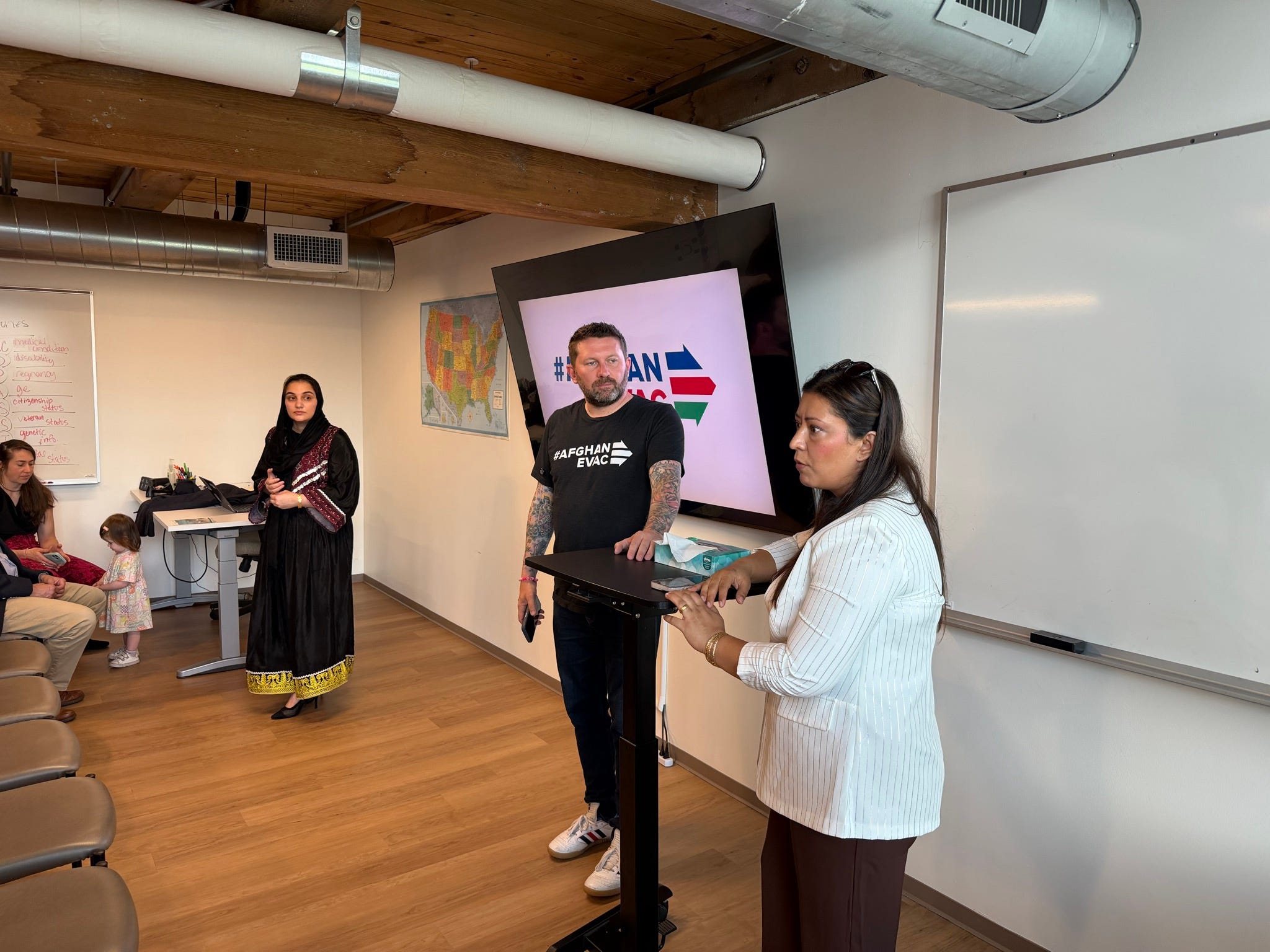
We spent the fifth anniversary of the last flight out of Kabul in a room in Lowell, Massachusetts. More than eighty people came.
Two subjects dominated that room, and neither one was the anniversary. The first was family reunification. People trying to get a spouse, a parent, or a child out, finding every door either closed or silent, and asking what is left. The second was the benefits caught in the USCIS pause, the work permits, green cards, and adjustments that stopped moving and took people’s ability to work, travel, and plan with them.
That is what five years looks like from the inside. Not a retrospective, but specific unanswered questions from people who have waited far too long. Nobody in that room needed to be told what happened in 2021. They needed to know what happens to a pending I-730 in 2026.
Our thanks to Jeff and Caroline from the International Institute of New England, for hosting us and for running the kind of operation that makes an unfamiliar room feel safe to speak in. Thank you as well to Bahara at AAPI and to John Moses of the Mass Afghan Alliance, who helped pack the room. That work is nearly invisible and nearly the whole reason anyone walks through the door. These events belong to the local organizations that build the trust long before we show up.
If your community wants a town hall, request one at afghanevac.org/town-hall.
THE LETTERS FROM PAKISTAN
Over the weekend our inbox filled with near-identical messages from Priority 1 and Priority 2 applicants stranded in Pakistan, many of them addressed to several organizations at once, all asking for action before September 1. They are coordinated, and that is not a criticism. It is what people do when the ordinary channels have stopped answering.
We are reading every one. We cannot promise casework, and we will not pretend the September 1 date carries a decision behind it. What we can promise is that these letters go where letters go, which is to Congress, into the record, and into the next thing we publish.
FIVE YEARS, AND A SPECIAL EDITION
Yesterday’s special edition put the year’s work on the record, with a full accounting of what this coalition produced between January and August, our new polling, and notes written directly to Afghan allies and the diaspora, to volunteers and advocates, and to the American public.
Wednesday’s Abbey Gate anniversary brought proclamations and official statements. We would trade every proclamation for one flight manifest.
IN THE NEWS
Stories from the past week.
The poll
Most Americans Support Visa Protections for Afghan Allies, Poll Finds -- Politico Pro
Poll Shows 72% of Americans Support Admitting Afghan Allies -- KabulNow
Majority Of US Voters Back Afghan Allies’ Resettlement, Shows New Poll -- Afghanistan International
Most Americans Support Protecting Afghan Allies Who Assisted US Military, Poll Finds -- Khaama Press
Third-country deportations
U.S. Deports Afghans, Including Relatives of Wartime Allies, to Central African Republic -- The New York Times (gift link)
ICE deports Afghans and others to Africa, expanding “third country” deportations -- CBS News
US deports relative of Afghans who aided military to Africa -- Al Jazeera
Trump administration deports relative of Afghans who helped US military to Central African Republic -- NPR
US deports 12 Afghans to Central African Republic -- Pajhwok Afghan News
US deports relative of Afghans who helped US military to Africa -- Ariana News
Women and girls
Inside Afghanistan’s Secret Schools for Girls -- The New York Times (gift link)
Five years on
5 years after withdrawal, a grave picture for Afghans inside and outside the US — The Hill
Why the United States Can’t Quit Its Wars -- The New York Times (gift link)
International
‘We Are at War with Afghans’: Pakistan Court Questions Visa Plea by 87 Students -- Khaama Press
More Than 6 Million Afghan Migrants Have Returned Home in Three Years, UN-Habitat Says -- Khaama Press
Turkey Detains 36 Afghan Migrants and One Iranian En Route to Greece -- Khaama Press
Congress
Reps. McGarvey, Jayapal Demand Trump Administration Reverse Rule to Fast-Track ICE Detention and Deportation Proceedings for Asylum Seekers -- Office of Rep. Morgan McGarvey
Khalil won protection in court. A federal immigration judge heard the evidence, heard an active-duty Marine colonel testify that this young man would be killed, and ruled in his favor. On Friday he was put on a plane anyway. Keep that in mind for the next thirty days, because it is the clearest answer available to anyone who tells you the system is working as designed. It is working exactly as designed. The design is the problem.
September will not be gentle. A camp is scheduled to close, a refugee ceiling gets set, a fiscal year ends, and a court finds out whether an agency meant what it told a judge. Every one of those outcomes will be decided by a small number of people who could pick up a pen this week and probably will not unless someone makes them. That is not a reason to look away. It is the entire reason to call, because the polling we released on Thursday settles the question this fight has been arguing with itself about for five years. The country is not the obstacle. The country is with us.
Support this work at afghanevac.org/donate. Take action at action.afghanevac.org. Find resources at afghanevac.org/resources.