


We are entering a defining moment for Afghan allies and the policies that shape their future. In the span of days, we are seeing leadership changes at DHS, new restrictions on basic support like food assistance, the intentional collapse of key relocation infrastructure overseas, and growing pressure on the very people who have been doing this work. None of these developments exist in isolation. Taken together, they paint a clear picture of where things stand, and where they may be headed.
Take Action NOW
Read the latest reporting from NBC News about Camp As Sayliyah. Share our Instagram post from this morning on the topic.
Donate to AfghanEvac so we can continue our work.
Share one of these posts on your social media, drafts below:
Did you know that there are 1100 Afghan allies, mostly women and children, stuck on a U.S. run base in Qatar? Read the latest update from #AfghanEvac at afghanevac.substack.com
Afghans in California: Did you know that CalFresh benefits are changing on April 1 due to the One Big Beautiful Bill? AfghanEvac is tracking the latest updates and you can read the State of California’s Frequently Asked Questions at https://www.cdss.ca.gov/benefits-services/food-nutrition-services/calfresh/frequently-asked-questions
Markwayne Mullin Takes Office as Secretary of Homeland Security
Senator Markwayne Mullin has been confirmed and sworn in as the new Secretary of Homeland Security, replacing Kristi Noem, following a 54–45 Senate vote. He takes over at a volatile moment, with DHS operating amid a funding standoff and ongoing immigration policy shifts central to the administration’s agenda. Mullin, a close Trump ally, will oversee ICE, CBP, FEMA, and the broader immigration enforcement system, placing him at the center of decisions affecting Afghan allies, asylum policy, and domestic enforcement priorities.
Early signals suggest a focus on operational efficiency and alignment with the administration’s broader immigration posture, though details on policy changes remain limited. For AfghanEvac stakeholders, the key question is not just leadership style, but whether DHS under Mullin will continue tightening enforcement and restricting pathways, or create space for pragmatic solutions on cases involving vetted Afghan allies already in the system.
Nazeer’s Death and What It Represents
Reporting continues on the death of Nazeer, an Afghan ally who supported U.S. efforts and later died in ICE custody in Texas. His story is not an isolated incident. It reflects the growing risks Afghan allies face as pathways stall, protections erode, and individuals who followed the rules find themselves caught in a system that is increasingly difficult to navigate. Nazeer’s death is a stark reminder that delays, uncertainty, and policy breakdowns have real human consequences.
We will update the AfghanEvac community once autopsy results are released and his official cause of death has been determined.
We are grateful to journalist Beth Bailey for her dogged, consistent reporting on stories like Nazeer’s and for continuing to shine a light on the lived experiences of Afghan allies and volunteers across the AfghanEvac movement. These stories are often overlooked, but they matter deeply. They force accountability, they document reality, and they ensure that people like Nazeer are not forgotten.
For Afghans in California – April 1 CalFresh Changes
Starting April 1, California will implement federal changes tied to the “One Big Beautiful Bill” that significantly restrict CalFresh eligibility for immigrants.
According to the state, most lawfully present immigrants, including refugees, asylees, parolees, and some Afghan nationals, will no longer qualify for CalFresh unless they have adjusted to lawful permanent resident (green card) status. These changes are being applied at the state level based on federal law, and current recipients may see impacts at their next renewal rather than immediately.
At the same time, federal guidance remains inconsistent, and longstanding law still protects certain humanitarian groups, including Afghan SIV holders, from waiting periods once they are lawful permanent residents. The result is widespread confusion among caseworkers and families, and a real risk that eligible individuals may be wrongly denied benefits.
Bottom line: some Afghans, especially parolees or those without green cards, are at risk of losing CalFresh after April 1, while others should remain eligible, but may need to advocate for themselves as the system adjusts.
AfghanEvac is engaging the State of California to clarify who is and isn’t eligible, so please stay tuned to our social media or next week’s update for more information.
Camp As Sayliyah Update
More than 1,100 Afghan allies and family members remain at Camp As Sayliyah in Qatar, a site never meant to be permanent. These individuals were vetted and placed into U.S. pathways, including SIV, refugee, and family reunification, before being moved there by the U.S. government. In January, the State Department told both Congress and residents that the camp would close by March 31. Families have held onto that date as a promise of movement and resolution.
Today, with less than 24 hours to go, residents still have no information about where they are going or when. At the same time, missiles are landing closer to the camp, with credible reports of impacts nearby.
These families are now effectively trapped, not by their own choices, but by a failure to execute a plan. This is no longer a policy debate. It is a matter of safety. The deadline may have been arbitrary when it was set, but the current security environment has made it urgent. And yet, there is still no clear path forward. Closing Camp As Sayliyah without a defined, functioning alternative risks turning what was meant to be a temporary waypoint into a prolonged and dangerous crisis.
Recent reporting highlights growing fear among residents that they could be sent to third countries or left without durable status, while returning to Afghanistan is not a viable option due to Taliban control and credible threats tied to their past work with the United States.
We are hearing indications that residents may receive updates from the State Department this week. We hope that signals real progress and not simply movement without resolution. Success here is not just getting people out of the camp. It means safety, dignity, legal clarity, and honoring commitments across all three pathways, SIVs, refugees, and family reunification. Anything less risks becoming a failure to follow through on U.S. promises. We have outlined what success looks like in a recent statement and social thread, and we will continue pushing for outcomes that meet that standard.


Bipartisan Support Remains
At the most recent House Foreign Affairs Committee markup on legislation focused on Afghan women and girls (legislation supported by our AfghanEvac Coalition team), members from both parties reaffirmed bipartisan commitment to Afghan allies. Notably, Rep. Darrell Issa emphasized that Congress must prioritize restarting pathways for those who supported U.S. missions, signaling recognition across party lines that current policies are falling short.
That alignment matters. While the bill itself focuses on human rights, the conversation made clear there is growing bipartisan awareness that SIV processing, refugee admissions, and family reunification must be restored. Congressional pressure will be essential to ensuring the United States follows through on its commitments and does not leave Afghan allies behind.
Asylum Policy Update
Recent reporting indicates the administration is scaling back parts of its recent asylum crackdown following the National Guard shooting, but the rollback is limited. Nationals from countries not subject to the current travel ban will continue to have access to asylum processing, even as broader restrictions remain in place.
For Afghans, the impact is different. Because Afghanistan is included in the travel ban, Afghan nationals remain disproportionately affected by the crackdown, with continued barriers to accessing asylum and other protections. Bottom line: while some pathways are reopening for others, Afghans are still facing a more restrictive and uncertain system at a moment when access to protection is critical.
Community Update: A Dangerous Moment
Recent reporting highlights the case of Bajun Mavalwalla, a U.S. Army veteran who served in Afghanistan and is now facing federal conspiracy charges tied to his participation in an ICE protest. He is one of several individuals charged under statutes that carry significant prison time, in what legal observers describe as an escalation in how protest-related cases are being handled.
This moment should give all of us pause. Many of the same people who fought alongside Afghan allies, and who continue working to support them today, are now operating in an environment that feels increasingly uncertain and, at times, punitive. Regardless of politics, the stakes are clear: when those closest to the mission begin to face legal risk simply for showing up, it signals a shift that should concern anyone committed to the safety of Afghan allies and the integrity of the promises made to them.
While not involved with the coalition directly, Bajun was involved with the broader AfghanEvac movement. He is someone who has worked to help Afghan families navigate pathways to safety.
Current State
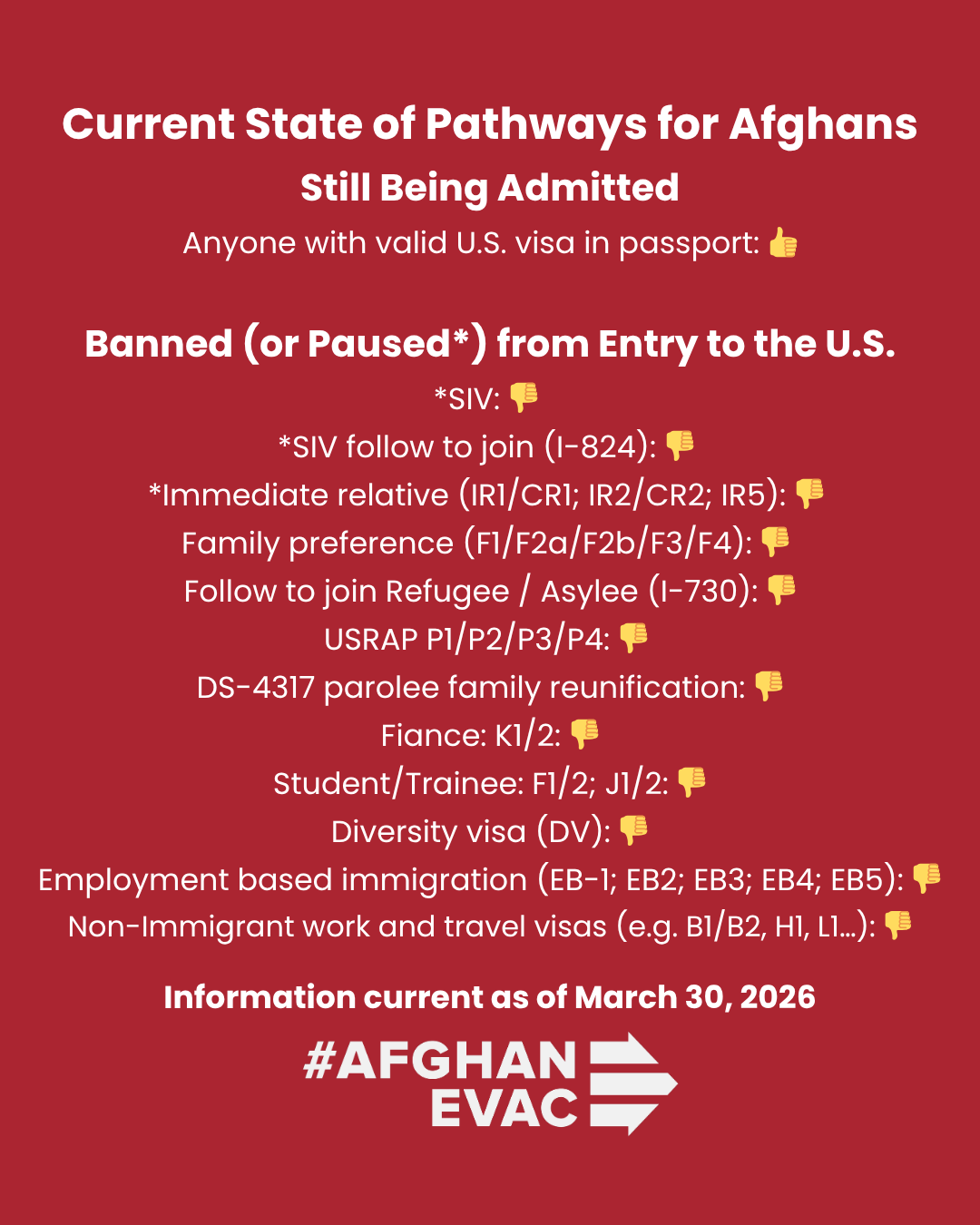
For those wondering the current state of pathways, we’ve created the graphic below. You are welcome to share on social media.
In the Press
US moved over 1,000 refugees to Doha base. War has brought it into crosshairs — ABC News
Left in limbo, Afghans who served with U.S. forces fear Trump could send them back to the Taliban — NBC News
How an Afghan man who aided U.S. military forces died in ICE custody in Texas — Houston Public Radio
Hundreds of Afghan refugees stranded at Doha camp under Iran missile threat — Khaama Press
Internal memos hint at Mullin’s first changes as DHS secretary — Washington Post
Army veteran faces conspiracy charges after participating in anti-ICE protest — PBS News
An Afghan Ally Was Arrested by ICE. Less Than 24 Hours Later, He Was Dead. — Reason Magazine
I Worked in Operation Allies Welcome. Americans Must Not Betray Our Afghan Allies— Liberal Currents
A Note to Those Still Doing the Work
To those across government who are still working, often quietly, to help Afghan allies: we see you. We know you are navigating restrictive policies, limited tools, and difficult constraints, and still choosing to push cases forward, answer questions, and do what you can to help. That work matters more than you may hear, and it is not going unnoticed.
We also want to be clear about where our frustration lies. It is not with you. It is with political leadership that is choosing policies that cause harm, stall pathways, and break commitments made by the United States to those who stood with us. When this moment passes, we will remember who showed up, who tried to make the system work, and who fought to uphold the values we claim as a country. We respect you, we appreciate you, and we are grateful for your continued efforts.
What happens next will not be determined by any single policy or decision, but by whether there is sustained pressure to align action with commitment.
The tools to get this right still exist.
The question is whether they will be used to preserve pathways, protect families, and follow through on promises made to Afghan allies. We will continue to push for that outcome, clearly, consistently, and with urgency.
The closure of these sites is a major inflection point.
When that pipeline slows or stops, people don’t just wait — they fall out of the system entirely. That’s when you start seeing exactly what’s being reported now: prolonged limbo overseas, detention in the U.S., and real risk of return.
This is what it looks like when priorities shift in immigration policy.
Allah help you guys